
You’re spending money on your website. Maybe even ranking on Google. Getting a decent amount of traffic. But when you check your email or phone logs, the quote requests just aren’t there.
Here’s the uncomfortable truth: most roofing websites are built to look good, not to generate leads. They win design awards but lose customers. They rank in search results but don’t convert visitors into quote requests.
This article breaks down exactly why your roofing website isn’t converting and what to do about it—starting today.
Table of Contents
- Which type of roofing company are you?
- Your website doesn’t establish trust fast enough
- Navigation is confusing visitors, not guiding them
- Your messaging talks about you instead of their problem
- Conversion points are buried or nonexistent
- Mobile experience is killing your lead flow
- Slow load times are costing you quotes
- You’re attracting the wrong traffic
- Social proof is missing or poorly displayed
- Frequently asked questions
Which Type of Roofing Company Are You?
Before we diagnose the problem, let’s figure out where you’re starting from. Most roofing companies fall into one of three categories when it comes to their website and lead generation.
Getting Traffic, Zero Conversions
Your website ranks. Google Analytics shows visitors. But your phone isn’t ringing and quote requests aren’t coming through.
Your issue: Conversion optimization—your site attracts eyeballs but doesn’t compel action.
No Traffic, No Conversions
Your website exists. It might even look professional. But Google Analytics is basically a ghost town, and your inbox reflects that reality.
Your issue: Visibility first, then conversion—you need traffic before you can convert it.
Some Traffic, Some Leads—But Inconsistent
You get a few quote requests here and there. Some months are solid, others are dead. You can’t figure out why it’s so unpredictable.
Your issue: Systematizing what works—you need a repeatable process, not luck.
The rest of this article focuses primarily on the first scenario—you have traffic but it’s not converting. If you’re in scenario two, you’ll still find value here, but your priority should be generating qualified traffic through SEO and local visibility strategies.
Your Website Doesn’t Establish Trust Fast Enough
Homeowners researching roofing companies are already skeptical. They’ve heard horror stories. They know roofing is expensive. They’re worried about being sold something they don’t need.
Your website has about 8 seconds to prove you’re trustworthy. If it doesn’t, they’re gone—probably to a competitor who does a better job establishing credibility.
Here’s what trust looks like on a high-converting roofing website:
Immediate Trust Signals
- Local city/county name in the headline
- Years in business prominently displayed
- Licensing and insurance info visible
- Real customer reviews (not hidden)
- Clear phone number—large, clickable
Reinforcing Credibility
- Before/after photos of real local projects
- Video testimonials from actual customers
- Manufacturer certifications displayed
- BBB rating or industry affiliations
- Warranty information clearly explained
🚩 Red Flag: If your homepage doesn’t mention your city, show reviews, or display your phone number prominently, visitors are bouncing before they even scroll. They need to know where you are and that you’re legitimate within seconds of landing.
Trust isn’t built through claims like “best roofing company” or “quality workmanship.” It’s built through specificity and proof. Show real work. Name real neighborhoods. Feature real customers. The more tangible evidence you provide, the faster skepticism melts.
Your Messaging Talks About You Instead of Their Problem
Look at your homepage right now. Read the first three headlines. Count how many times the word “we” appears versus “you” or “your.”
If “we” dominates, you’re doing it wrong.
Visitors don’t care about your company history, your mission statement, or how passionate you are about roofing. At least not yet. They care about their roof, their problem, and whether you can solve it without hassle.
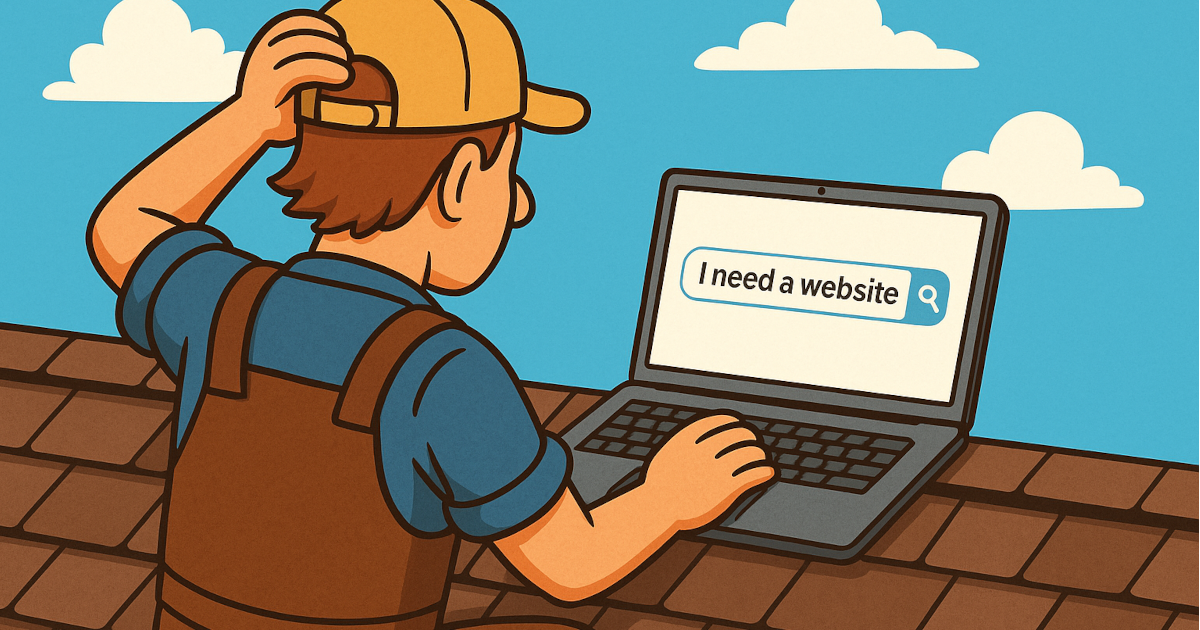
Here’s how to flip your messaging from company-focused to customer-focused:
Company-Focused (Doesn’t Convert)
“We are a family-owned roofing company with over 20 years of experience. We pride ourselves on quality workmanship and customer satisfaction.”
Why it fails: Generic. Could describe any roofing company. Doesn’t address visitor needs.
Customer-Focused (Converts)
“Roof damage after last week’s storm? Get a free inspection and honest replacement estimate—no pressure, no gimmicks. Serving [City] homeowners since 2004.”
Why it works: Addresses the immediate problem. Removes friction (“no pressure”). Shows local presence and longevity.
The customer-focused version works because it enters the conversation already happening in the visitor’s head. They’re worried about storm damage. They want an honest quote. They’re skeptical of high-pressure sales tactics. Your headline addresses all of that.
Every page on your site should follow this pattern:
- Acknowledge their situation (the problem or need)
- Present the solution (how you solve it differently)
- Remove objections (address fears and friction)
- Make action easy (clear next step)
💡 Pro Tip: Run every headline through this test: “Does this sentence make the visitor feel understood?” If not, rewrite it from their perspective, not yours. Your company story matters—just not in the first 8 seconds.
Conversion Points Are Buried or Non-Existent
You’ve heard the phrase “clear call-to-action.” But most roofing websites interpret that as slapping a “Contact Us” button in the header and calling it done.
That’s not enough. Not even close.
A high-converting roofing website has multiple conversion opportunities, each calibrated to where the visitor is in their decision process. Not every visitor is ready to request a quote immediately. But they might be ready to take a smaller step.
The Conversion Ladder for Roofing Websites
Ready to Talk Now
- Click-to-call phone button
- “Schedule Free Inspection” form
- “Get Instant Quote” CTA
- Live chat option
Gathering Information
- “See Our Work” gallery link
- “Read Customer Reviews”
- “Learn About Roof Types”
- “Check Our Service Area”
Early Research Stage
- “Download Roof Maintenance Guide”
- “Storm Damage Checklist”
- “Cost Calculator”
- Educational blog content
The mistake most roofing websites make is only offering high-intent conversion points. If a visitor isn’t ready to call or submit a form, they have nowhere else to go—so they leave.
By offering medium and low-intent options, you capture contact information from people who need more time to decide. Then you nurture them through email follow-up until they’re ready to request a quote.
Example: Someone searching “how long does a roof last” isn’t ready to buy. But if your blog post on that topic offers a free “Roof Lifespan Guide” PDF in exchange for their email, you’ve captured a future customer. Three months later when they’re ready to replace their roof, you’re the company they remember.
This is how conversion-optimized service websites actually work—they meet visitors wherever they are in the buying journey and give them a logical next step.
Mobile Experience Is Killing Your Lead Flow
Here’s a stat that should terrify you: 70-80% of local roofing searches happen on mobile devices. Yet most roofing websites are designed desktop-first, with mobile as an afterthought.
The result? You’re hemorrhaging leads simply because your mobile experience is frustrating.
Think about the last time you searched for a service on your phone. You’re probably standing outside looking at damage. Or sitting in your car. Or lying in bed late at night worrying about a leak. You want one thing: a phone number you can tap immediately.
🚩 Mobile Red Flags
- Phone number not clickable
- Tiny text that requires zooming
- Buttons too small to tap accurately
- Forms with 10+ fields
- Pop-ups that cover content
- Slow image loading
- Horizontal scrolling required
✓ Mobile Best Practices
- Sticky click-to-call button at top
- Minimum 16px body text
- Large, thumb-friendly tap targets
- 3-field forms maximum
- No intrusive interstitials
- Optimized images under 200kb
- Single-column layout
The most common mobile conversion killer? Contact forms that require too much information. Asking for name, email, phone, address, service needed, preferred date, and a message field guarantees 80%+ of mobile visitors will abandon it.
The fix? Reduce friction ruthlessly:
- Name
- Phone number
- Service type (dropdown)
That’s it. You can collect the rest during the phone call. The goal is getting the lead, not qualifying them through a form.
💡 Test This: Pull up your website on your phone right now. Can you call your company in under 3 seconds? If not, you’re losing dozens of leads every month. Fix this today—it’s the easiest conversion win you’ll ever implement.
Slow Load Times Are Costing You Quotes
If your website takes more than 3 seconds to load on mobile, you’re losing 40% of visitors before they even see your content. They don’t wait. They hit the back button and click on your competitor’s site instead.
Page speed isn’t just a technical SEO factor. It’s a conversion rate multiplier. A faster site means more visitors stick around long enough to request a quote.
The biggest culprits slowing down roofing websites:
Image Problems
Uncompressed 5MB photos straight from a DSLR camera. Hero images that are 4000px wide when they only display at 1200px.
Fix: Compress images to under 200kb. Use WebP format. Implement lazy loading.
Bloated Plugins
WordPress sites with 40+ plugins, half of which aren’t even being used. Each one adds weight and slows load time.
Fix: Audit and remove unnecessary plugins. Combine functionality where possible.
Cheap Hosting
Bargain $3/month shared hosting with servers that respond slowly under any traffic load. You get what you pay for.
Fix: Upgrade to quality managed hosting or a performance-focused provider.
The good news? Speed improvements are often quick wins. Optimizing images alone can cut load time in half. And unlike content or design changes, speed optimization has an immediate measurable impact on conversion rates.
⚠️ How to Check: Use Google’s PageSpeed Insights or GTmetrix to test your site. If your mobile score is below 50, speed is absolutely killing your conversions. If it’s below 30, you’re in crisis mode—fix this before spending another dollar on marketing.
You’re Attracting the Wrong Traffic
Sometimes the problem isn’t your website—it’s the quality of visitors landing on it.
You can have a perfectly optimized site, but if the people arriving are:
- Outside your service area
- Looking for DIY advice instead of hiring a contractor
- Researching for a project 6 months away
- Price shopping with no intent to buy
…then conversion rates will stay low no matter what you change on the site.
How to Diagnose Traffic Quality Issues
Open Google Analytics (or whatever analytics tool you use) and check:
1. Bounce Rate by Landing Page
If your homepage has a 75%+ bounce rate, visitors aren’t finding what they expected. Either your meta description is misleading or your headline doesn’t match search intent.
2. Top Organic Keywords
Are you ranking for “how to install shingles yourself” or “roof repair cost breakdown”? Those are informational queries—visitors aren’t ready to hire anyone. Target transactional keywords like “roofing company near me” or “emergency roof repair [city]”.
3. Geographic Location
If 40% of your traffic is coming from outside your service area, you’re wasting visibility on people who can’t hire you. Tighten your local SEO focus and geo-target your content.
4. Average Session Duration
If visitors spend less than 30 seconds on your site before leaving, they’re not engaging with your content. This signals either poor relevance or poor user experience (or both).
The Fix: Audit your keyword strategy. Stop chasing high-volume informational keywords and start targeting buyer-intent terms. A page that gets 50 visitors/month from “roof replacement [city]” will generate more leads than a page getting 500 visitors/month from “roof types explained.” Quality > quantity.
If you’re serious about driving the right kind of traffic, check out how strategic web design aligns with SEO to attract qualified local leads instead of random browsers.
Social Proof Is Missing or Poorly Displayed
Here’s an uncomfortable truth: homeowners don’t trust roofing companies by default. They’ve heard too many stories about fly-by-night contractors, shoddy work, and inflated prices.
Your job is to overcome that skepticism through proof. Not claims. Not promises. Proof.
The problem? Most roofing websites either:
- Don’t display social proof at all
- Bury reviews on a separate page no one visits
- Show generic testimonials without names or photos
- Feature outdated reviews from 2019
How to Display Social Proof That Actually Converts
Google Reviews Widget
Embed your Google Business Profile reviews directly on your homepage. Real names, real faces, real star ratings. Update automatically so they stay fresh.
Video Testimonials
A 30-second video of a happy customer standing in front of their new roof is worth 100 written testimonials. Video is visceral—it’s impossible to fake genuine satisfaction.
Before/After Gallery
Show the transformation. Include neighborhood names (“Oak Ridge subdivision”) and project details (“replaced 30-year-old shingles with GAF Timberline HDZ”). Specificity = credibility.
Manufacturer Certifications
Display logos from GAF, Owens Corning, CertainTeed, etc. Being a certified installer signals training, accountability, and access to better warranties. Use this to your advantage.
Local Business Badges
Chamber of Commerce member? BBB accredited? Angi Super Service Award? Show these trust signals prominently. They reassure visitors you’re established and accountable.
Project Count/Years in Business
“Over 3,200 roofs installed since 2004.” Numbers like this build confidence. They show you’re not a fly-by-night operation—you’ve been around and you’ll be around.
💡 Pro Tip: Place your best review or testimonial directly on your homepage, above the fold, near your main call-to-action. Make it impossible to miss. This single change can boost conversions by 15-25% because it addresses skepticism at the exact moment visitors are deciding whether to trust you.
Frequently Asked Questions
Why isn’t my roofing website generating quote requests?
Most roofing websites fail to generate leads because they lack clear conversion paths, have confusing navigation, don’t address visitor concerns at the right stage of their decision process, or fail to establish trust through social proof and clear messaging. Additionally, many sites are optimized for search engines but not for actual human behavior once visitors land on the page.
What’s the biggest mistake roofing companies make with their websites?
The biggest mistake is treating the website as a digital brochure instead of a lead generation system. Roofing companies often focus on what they want to say about their company rather than addressing what homeowners actually need to know at each stage of their buying journey. This results in websites that get traffic but don’t convert visitors into quote requests.
How long should it take to see results from website improvements?
Conversion rate improvements from website optimization can often be measured within 2-4 weeks as you accumulate enough visitor data to compare performance. However, if you’re also implementing SEO changes to increase traffic, those results typically take 3-6 months to fully materialize. The key is measuring both traffic quality and conversion behavior separately.
What conversion rate should a roofing website aim for?
A well-optimized roofing website should convert 3-7% of qualified visitors into quote requests or phone calls. Sites below 2% typically have fundamental conversion problems. Sites above 7% usually have excellent messaging, trust signals, and clear calls-to-action matched to visitor intent. The key word is ‘qualified’ visitors—traffic quality matters as much as conversion rate.
Should I focus on SEO or website conversion first?
Fix conversion issues first. Driving more traffic to a website that doesn’t convert is like pouring water into a leaky bucket. Once your site converts at 3%+ and provides a good user experience, then invest in SEO and paid traffic to scale. This approach ensures every marketing dollar works harder and generates actual business results, not just vanity metrics.
Ready to Turn Your Website Into a Lead Generation System?
You don’t need a website redesign. You need a conversion audit.
We’ll analyze exactly why your traffic isn’t converting and give you a prioritized list of fixes—starting with the changes that will have the biggest immediate impact on your quote request volume.
No sales pitch. No 18-page proposal. Just honest feedback on what’s broken and how to fix it.
Want more strategies for growing your roofing business online? Explore our website design insights for conversion-focused tactics that actually work.