
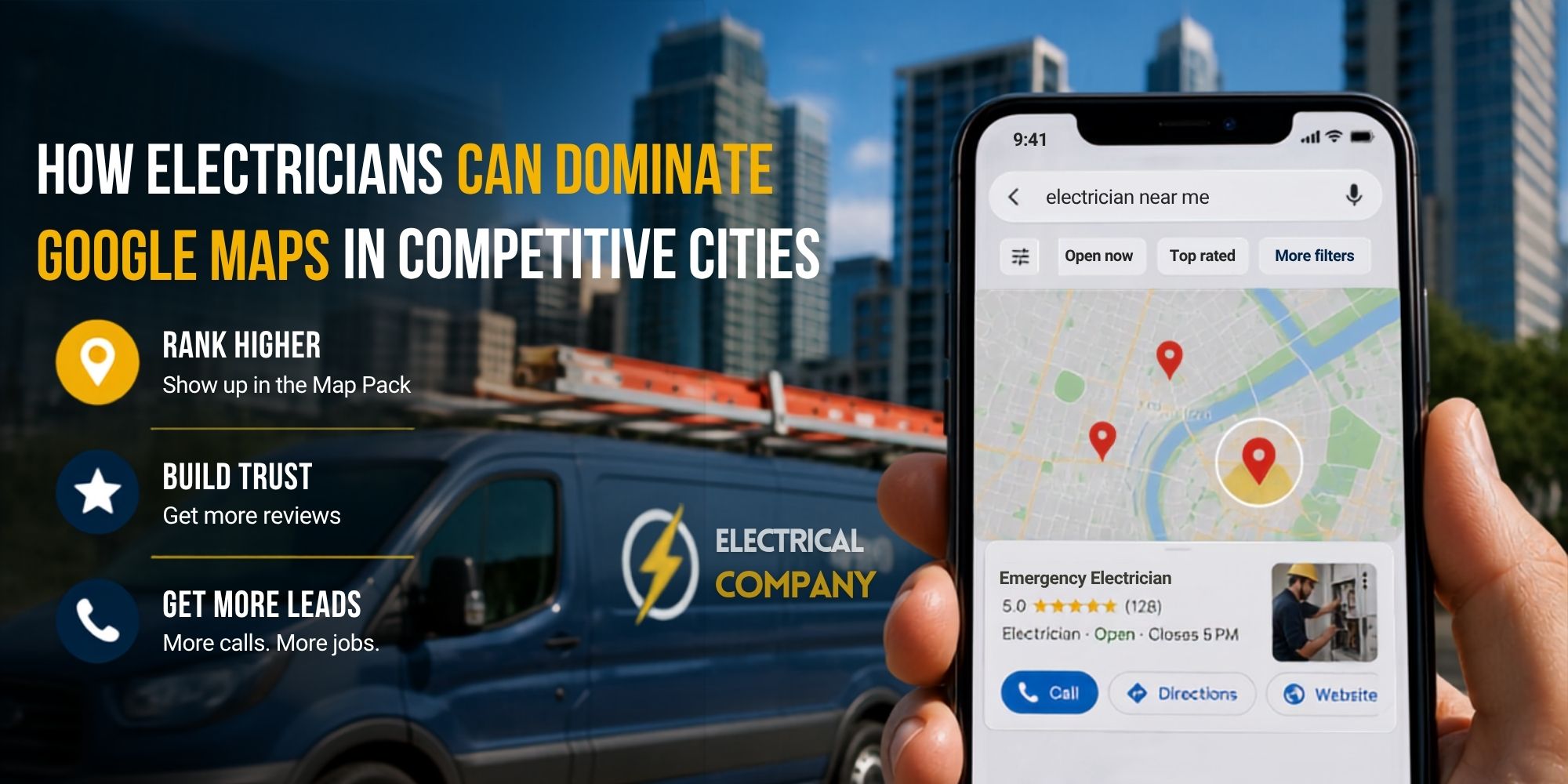

How Electricians Can Dominate Google Maps in Competitive Cities
You’ve watched competitors show up in the Google Maps 3-pack while your business sits buried on page two. You know people are searching for electricians in your city right now, but your phone isn’t ringing because your Google Business Profile isn’t visible where it counts.
Ranking on Google Maps isn’t luck, and it’s not about paying for ads. It’s a system built on specific, repeatable actions that signal to Google your business is the most relevant and trustworthy option for local searchers.
This guide walks through the exact ranking factors that matter, the common mistakes electricians make that tank their visibility, and the practical tactics that move the needle in markets where dozens of other electrical contractors are fighting for the same spots.
What You’ll Learn
- The three core ranking factors Google uses for local electrician searches
- How to set up and optimize your Google Business Profile correctly
- Review generation strategies that work without sounding pushy
- Why citations matter and where electricians should be listed
- How your website and content influence Map Pack rankings
- Tactics that help you outrank established competitors
- The avoidable mistakes that cost electricians Map Pack visibility
- Answers to the most common questions about ranking on Google Maps
Which Type of Electrician Are You?
New to Google Maps
You recently claimed your Google Business Profile or just launched your electrical business. You’re not ranking yet, and you’re not sure where to start.
Focus first on: Complete profile setup, initial citation building, and review generation systems.
Stuck on Page Two
You show up in Google Maps results, but never in the top three. You’re getting some visibility but missing the majority of local search traffic and calls.
Focus first on: Review velocity, citation consistency audits, and adding more relevance signals to your profile.
Competing Against Giants
You’re up against large electrical contractors with hundreds of reviews and years of established presence. You need an edge to break into the top spots.
Focus first on: Niche service differentiation, hyper-local content, and advanced profile engagement tactics.
The Three Core Factors That Control Google Maps Rankings
Google doesn’t publish the exact algorithm for local rankings, but years of testing and observation have made the pattern clear. Three core signals determine where your electrical business appears in the Map Pack.
Relevance: Does Google Think You Match the Search?
Relevance is about whether your business profile matches what the searcher is looking for. If someone searches “emergency electrician near me,” Google scans your profile for keywords like “emergency,” “24-hour,” or “same-day service.”
Your business name, categories, services list, business description, and posts all feed into this signal. The more clearly your profile communicates what you do—and for whom—the more likely Google will surface you for the right searches.
Relevance isn’t about keyword stuffing. It’s about accuracy and completeness. A profile that lists “residential electrical repair,” “panel upgrades,” “EV charger installation,” and “ceiling fan wiring” will match more search queries than a profile that just says “electrician.”
Distance: How Close Are You to the Searcher?
Proximity matters. If someone searches “electrician” from a mobile device, Google prioritizes businesses near their current location. If they search “electrician in [neighborhood],” Google uses that location as the reference point.
You can’t change your physical address, but you can expand your service area in your profile settings. You can also create localized content on your website and include neighborhood-specific keywords in your business description to signal that you serve multiple areas.
Distance isn’t the only factor, which is why businesses farther away can still outrank you if their relevance and prominence signals are stronger. But in tightly contested markets, being 2 miles closer can be the tiebreaker.
Prominence: How Well-Known and Trusted Is Your Business?
Prominence is Google’s way of measuring reputation and authority. Are people talking about your business online? Do you have reviews? Are you mentioned on other websites and directories? Does your website attract traffic and links?
This is the hardest signal to manipulate and the most powerful one to build. Reviews are the most visible prominence signal, but they’re not the only one. Citation consistency, engagement on your Google posts, website authority, and even offline brand recognition feed into prominence.
A business with 80 reviews and solid citations will usually outrank one with 15 reviews, even if the smaller business has a perfect 5.0 rating. Volume and velocity matter because they signal ongoing activity and customer satisfaction.
Pro Tip: Most electricians focus only on reviews. The real advantage comes from optimizing all three signals simultaneously. A complete, keyword-rich profile (relevance) + consistent citations (prominence) + service area targeting (distance) creates compounding effects that reviews alone can’t deliver.
How to Optimize Your Google Business Profile for Electrician Searches
Your Google Business Profile is the foundation of your local ranking power. Most electricians claim their profile and stop there. That’s like building a house and forgetting the roof.
Profile optimization isn’t a one-time task. Google rewards active, complete, and accurate profiles. The more data you provide, the more confidently Google can show your business for relevant searches.
Choose the Right Primary Category
Your primary category is the strongest relevance signal on your profile. For most electrical contractors, the right primary category is “Electrician.” Not “Electrical Installation Service” or “Electrical Repair Service”—just “Electrician.”
Add secondary categories to capture specific service niches: “Lighting Contractor,” “Electrical Wholesaler,” “Generator Shop,” or “Home Automation Company” if those services represent a meaningful part of your business. Don’t add categories you don’t actively offer—it dilutes relevance.
Write a Keyword-Rich Business Description
Your business description should clearly explain what you do, who you serve, and what makes you different. This is not creative writing—it’s functional search optimization. Include the services you offer, the areas you serve, and any specializations that set you apart.
Example: “Licensed electrician serving [City] with over 15 years of experience in residential electrical repair, panel upgrades, EV charger installation, and emergency electrical service. We specialize in older homes and provide same-day service for urgent electrical issues.”
Front-load the most important keywords because Google may truncate the description in search results. Lead with your core service, then expand into details.
Add Every Service You Actually Offer
Google’s Services section lets you list specific offerings. Most electricians leave this blank or add three generic entries. That’s wasted relevance.
Add 15 to 25 services that represent actual work you perform: “ceiling fan installation,” “GFCI outlet repair,” “whole-house surge protection,” “electrical panel inspection,” “generator installation,” “smart thermostat wiring.” The more specific, the better.
Each service can be assigned a custom description. Use it. These descriptions are indexed by Google and help match your profile to long-tail search queries.
Define Your Service Area Accurately
If you’re a service-area business (you go to customers, not the other way around), hide your address and define your service area by city, zip code, or radius. Don’t list areas you won’t actually serve—Google may deprioritize your profile if a user in that area clicks and then bounces because you don’t respond.
Be realistic. If you serve a 30-mile radius, say so. If you only serve three specific cities, list those cities. Accuracy improves relevance and prevents wasted leads.
Upload High-Quality Photos Regularly
Photos don’t directly affect rankings, but they influence click-through rate, which is a behavioral signal Google monitors. Profiles with more photos get more engagement, and engagement boosts prominence.
Upload photos of completed work: panel upgrades, lighting installations, service trucks, team members on the job. Add new photos every month to signal that your business is active. Avoid stock images—Google and users both prefer real, specific visuals.
Post Weekly Updates to Your Profile
Google Posts are short updates that appear on your profile. They expire after seven days, but they signal activity and relevance. Post about recent projects, seasonal services, electrical safety tips, or service area reminders.
Posts don’t need to be elaborate. A simple update like “Completed a 200-amp panel upgrade in [Neighborhood] this week. Serving [City] with reliable electrical service” keeps your profile fresh and reinforces location relevance.
Caution: Never use a fake address to appear closer to high-value areas. Google actively filters fake locations, and competitors can report you. A suspension can take months to resolve and destroys your rankings overnight.
How to Generate Reviews That Actually Move Your Rankings
Reviews are the most visible prominence signal. They influence rankings, click-through rate, and conversion. But review generation isn’t about gaming the system—it’s about building a repeatable process that turns satisfied customers into public advocates.
Review velocity matters more than total count. A profile with 30 reviews—10 from the last 60 days—will often outrank a profile with 150 reviews if the most recent one is from two years ago.
Ask Every Customer, Every Time
The biggest mistake electricians make is inconsistency. They remember to ask after a great job but forget after routine work. You need a system that prompts you to ask every time, regardless of job size.
The best time to ask is immediately after completing the work, while you’re still on-site. Hand the customer a card with a QR code that links directly to your Google review page, or send a text with the link before you leave the driveway.
Simple ask: “If you’re happy with the work, I’d really appreciate a quick review. It helps other folks find us when they need an electrician.” That’s it. No guilt, no pressure.
Make It Easy: Direct Links and QR Codes
The harder it is to leave a review, the fewer you’ll get. Don’t ask customers to search for your business and figure it out themselves. Give them a direct link or QR code that opens the review form in one tap.
You can generate a review link from your Google Business Profile dashboard. Print it on business cards, add it to email signatures, and include it in follow-up texts.
Respond to Every Review—Good and Bad
Review responses signal to Google that you’re actively managing your profile. They also show potential customers how you handle feedback. A thoughtful response to a negative review can neutralize the damage—or even improve your reputation.
Keep responses brief and professional. Thank reviewers by name, reference the specific service they mentioned, and reinforce your commitment to quality. For negative reviews, acknowledge the issue, offer a solution, and take the conversation offline.
Example: “Thanks for the feedback, John. I’m sorry the scheduling didn’t go smoothly. I’d like to make this right—please call me at [number] so we can resolve this.”
Never Buy or Fake Reviews
Google’s detection algorithms flag unnatural review patterns: clusters of reviews from the same IP range, reviews from accounts with no other activity, suspiciously similar phrasing across multiple reviews.
Penalties range from filtered reviews (they disappear but your profile stays live) to full suspension (your listing vanishes from Maps). Recovery can take months, and during that time, you’re invisible to local searchers. It’s never worth the risk.
Review Generation Benchmarks for Electricians
New Business (0–20 reviews)
Goal: 3–5 reviews per month. Focus on building a foundation of authentic feedback from every completed job.
Established Business (20–100 reviews)
Goal: 5–8 reviews per month. Maintain velocity to stay competitive and signal ongoing customer satisfaction.
Market Leader (100+ reviews)
Goal: 8–12 reviews per month. Defend your position by maintaining review momentum as competitors catch up.
Why Citations Matter and Where Electricians Should Be Listed
Citations are online mentions of your business name, address, and phone number (NAP). They appear on directories like Yelp, Yellow Pages, HomeAdvisor, Angi, and industry-specific platforms.
Google uses citations to verify your business legitimacy and physical location. The more consistent your NAP information appears across the web, the more confident Google becomes that your business is real, active, and trustworthy.
Inconsistent citations hurt you. If your business name is “ABC Electric” on Google but “ABC Electrical Services” on Yelp, Google sees conflicting signals. If your phone number is different across directories, Google can’t confirm which listing is accurate.
Core Directories Every Electrician Needs
Start with the high-authority directories that Google trusts most. Claim and optimize your profile on each one, ensuring your NAP matches exactly across every platform.
- Yelp — High authority, strong local SEO signal
- Facebook Business Page — Social proof and engagement signal
- Yellow Pages — Legacy directory still indexed by Google
- Better Business Bureau — Trust and credibility signal
- Angi (formerly Angie’s List) — Home service–specific directory
- HomeAdvisor — Lead generation and citation value
- Thumbtack — Service marketplace with citation weight
Industry-Specific Directories
Beyond general directories, electricians should target platforms specific to the trades and home services. These citations reinforce your industry relevance.
- Electrical Contractor Network (ECN) Mag
- National Electrical Contractors Association (NECA)
- Local Chamber of Commerce
- State and county licensing boards (if they publish directories)
How to Audit Your Existing Citations
Google your business name + city. Look at every result that mentions your business. Check for NAP inconsistencies: mismatched phone numbers, outdated addresses, variations in your business name.
If you find incorrect listings, claim them and update them. If you can’t claim them, contact the directory’s support team and request corrections. This cleanup work is tedious but essential—every inconsistency dilutes your prominence.
Key Insight: Citation building isn’t about quantity. Fifteen consistent, high-authority citations beat fifty inconsistent, low-quality ones. Focus on accuracy first, then breadth.
How Your Website Content Influences Google Maps Rankings
Your website and your Google Business Profile are connected. Google uses your website to confirm the services you claim to offer, verify your location, and assess your overall authority.
A well-optimized website strengthens your local SEO by providing the context and depth that a Google Business Profile can’t hold. It’s not about tricking Google—it’s about proving you’re the best match for the search.
Create Service Pages for Each Core Offering
If you list “panel upgrades” and “generator installation” on your Google profile, you should have dedicated pages on your website explaining those services in detail. Each page should include:
- What the service is and who needs it
- How the process works
- Why it matters (safety, code compliance, energy savings)
- Local context (city, county, or regional considerations)
These pages reinforce relevance and give Google more reasons to trust your profile. A solid website design strategy ensures these pages are clear, fast, and optimized for both users and search engines.
Publish Location-Specific Content
If you serve multiple cities or neighborhoods, create a page for each one. These location pages should explain what makes electrical work in that area unique: older housing stock, common code violations, local permit requirements, or seasonal demand patterns.
Example: “Electrical Services in [Neighborhood]” — discuss the types of homes, common electrical issues, and how your team serves that area specifically. This signals hyper-local relevance to Google and improves your chances of ranking for geo-modified searches.
Write Educational Blog Content
Blogging builds topical authority and captures long-tail search traffic. Write about the questions customers ask: “How do I know if my electrical panel needs an upgrade?” “What causes circuit breakers to trip?” “Is it safe to install a ceiling fan myself?”
These articles position you as an expert, drive traffic to your site, and create more touchpoints for Google to connect your website to your Google Business Profile. The strategies that work for electricians often mirror tactics used in other trades—like the approaches outlined in digital marketing for roofers, which rely on education and trust-building.
Embed Your Google Map on Your Website
Embedding your Google Business Profile map on your contact page creates a direct connection between your website and your Map listing. It’s a small signal, but it reinforces consistency and makes it easier for users to find you on both platforms.
Tactics That Help You Outrank Established Competitors
Breaking into the top three Map Pack spots in a competitive market requires more than just optimization basics. You need to outwork, outthink, and outmaneuver competitors who already own established positions.
Target Niche Services Your Competitors Ignore
Most electricians compete on generic keywords like “electrician near me.” If you specialize in EV charger installation, smart home wiring, or solar panel hookups, emphasize those services on your profile and website.
Niche relevance can overcome authority gaps. A business with 40 reviews that clearly specializes in “Tesla charger installation” may outrank a generalist with 200 reviews when someone searches for that specific service.
Dominate Hyper-Local Searches
Instead of trying to rank citywide, focus on specific neighborhoods or zip codes where you already have a presence. Create neighborhood-specific content, mention those areas in your business description, and ask customers in those areas to leave reviews mentioning the neighborhood.
This strategy carves out geographic pockets where you can dominate, even if you’re not competitive citywide yet.
Leverage Google Q&A
The Questions & Answers section on your Google Business Profile is an underused opportunity. Add your own questions and answers to preemptively address common concerns: “Do you offer emergency electrical service?” “What areas do you serve?” “Are you licensed and insured?”
These answers are indexed by Google and can influence relevance. Plus, they prevent competitors or bad actors from asking misleading questions.
Monitor and Report Fake Competitor Profiles
Fake profiles and spam listings clog the Map Pack. If you notice competitors using virtual offices, keyword-stuffed business names, or fake locations, report them to Google. Legitimate businesses shouldn’t have to compete with rule-breakers.
Google may not act immediately, but consistent reporting from multiple sources often leads to enforcement.
Common Mistakes That Cost Electricians Map Pack Visibility
Most ranking problems aren’t caused by what you’re not doing—they’re caused by what you’re doing wrong. These avoidable mistakes suppress rankings and waste effort.
🚩 Inconsistent NAP Information
Your business name, address, and phone number must match exactly across Google, your website, and all directories. Even small variations confuse Google’s algorithm.
🚩 Ignoring Negative Reviews
Not responding to negative reviews signals neglect to both Google and potential customers. A thoughtful response can neutralize damage and demonstrate professionalism.
🚩 Keyword-Stuffed Business Name
Adding keywords to your business name (“Best Electrician NYC Emergency 24/7”) violates Google’s guidelines and can result in suspension. Use your real business name only.
🚩 Incomplete Profile Sections
Leaving services, hours, or business description blank weakens relevance signals. Google prioritizes complete, actively maintained profiles over sparse ones.
🚩 Using a PO Box or Virtual Office
Google requires a physical address where customers can visit or you can be reached. Virtual offices and PO boxes violate the rules and risk suspension.
🚩 Neglecting Profile Activity
Profiles that never post updates, add photos, or respond to reviews signal inactivity. Google rewards businesses that demonstrate ongoing engagement and freshness.
Frequently Asked Questions About Ranking on Google Maps
How long does it take to rank on Google Maps as an electrician?
Most electricians see meaningful movement in Google Maps within 60 to 90 days of consistent optimization. In competitive markets, it often takes 4 to 6 months to crack the top three positions. The timeline depends on your current Google Business Profile health, review volume, citation consistency, and how active your competitors are.
What’s the most important factor for ranking in the Google Maps 3-pack?
Google Business Profile optimization is the foundation. Your profile must be complete, accurate, and actively maintained. But the true ranking power comes from three combined signals: verified citations across consistent directories, a steady flow of authentic customer reviews, and strong relevance signals from your website and online content.
Do I need to pay for Google Ads to show up on Google Maps?
No. The Google Maps 3-pack is organic—you don’t pay to appear there. Google Ads can place your business above the map as a sponsored result, but the core Map Pack rankings are earned through local SEO tactics like profile optimization, reviews, and citation consistency.
Can fake reviews help me rank higher on Google Maps?
Fake reviews are a liability, not a strategy. Google’s detection systems flag unnatural review patterns, and penalties can suppress or remove your listing entirely. Authentic reviews from real customers carry far more weight and build the trust that converts searchers into paying clients.
How many reviews do I need to compete with other electricians on Google Maps?
There’s no magic number, but velocity and recency matter more than volume. A profile with 40 reviews—20 of them from the last 90 days—will often outrank a stale profile with 150 reviews from three years ago. Aim to generate 3 to 5 authentic reviews per month as a baseline.
What are citations and why do electricians need them for Google Maps?
Citations are online mentions of your business name, address, and phone number (NAP) on directories like Yelp, Yellow Pages, or industry sites. Google uses citation consistency to verify your business legitimacy and physical location. Inconsistent or missing citations weaken your local ranking signals.
Final Takeaway: Ranking on Google Maps Is a System, Not a Secret
There’s no magic trick that vaults an electrician into the Map Pack overnight. What works is a systematic approach built on relevance, consistency, and reputation. Optimize your Google Business Profile completely. Build citations across high-authority directories. Generate reviews consistently. Create content that reinforces your expertise and location.
Every electrician in your market has access to the same tactics. The difference between page one and page two is execution: doing the work month after month, monitoring what works, and adjusting when necessary.
The businesses that dominate Google Maps aren’t necessarily the best electricians—they’re the ones who treat visibility as a priority and build systems that compound over time.
Ready to Build a Visibility System That Works?
If you’re tired of watching competitors show up on Google Maps while your phone stays quiet, let’s talk. No pitch, no pressure—just a conversation about what’s working in your market and what it takes to get your business in front of more local customers.
“`