

The Difference In How Remodeling Companies Show Online
You’ve noticed it. Some remodeling companies always seem to have a full project pipeline while others struggle to fill their calendar. The difference isn’t always the quality of their work—it’s how effectively they show up online when homeowners are actively searching for help.
This isn’t about having the biggest marketing budget or the fanciest website. It’s about understanding what actually drives leads in the remodeling industry and building a system that works consistently. Let’s break down exactly what top performers do differently.
Table of Contents
Which Type of Remodeling Company Are You?
The Word-of-Mouth Company
You’ve built your business on referrals and past clients. Your work is excellent, but when referrals slow down, so does your pipeline.
You need: A system that captures online search traffic without depending on someone knowing your name first.
The Inconsistent Lead Company
Some months you’re turning projects away, other months you’re scrambling. You have marketing in place but results swing wildly.
You need: Integration across channels so multiple systems support each other and create predictable lead flow.
The Growth-Ready Company
You have a solid foundation but want to scale systematically. You’re ready to invest in marketing infrastructure that generates compounding returns.
You need: The complete playbook that top performers use to dominate their local market online.
Local Search Dominance: The Foundation
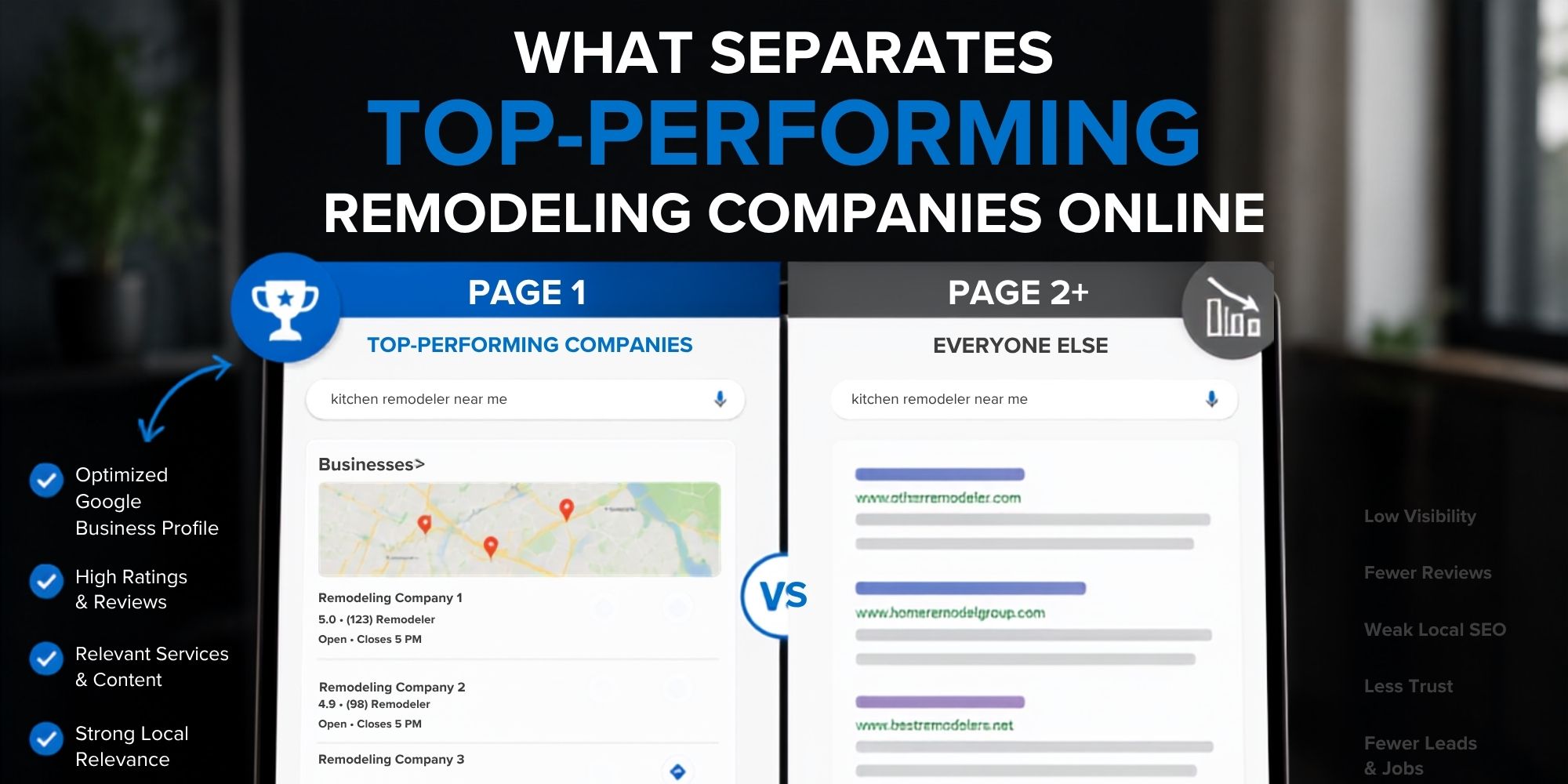
When someone searches “kitchen remodeling contractor near me” or “bathroom renovation [your city],” where do you show up? Top-performing companies appear in the Google Map Pack and the top organic results. Consistently.
This doesn’t happen by accident. It’s the result of systematic optimization across multiple signals that Google uses to determine local relevance and authority.
Reality check: If you’re not in the top 3 Map Pack results for your primary service + city searches, you’re invisible to 60%+ of potential clients who never scroll past that section.
What Top Performers Do Differently
✓ Complete profile with services, service areas, and attributes
✓ Fresh photos added weekly (projects, team, process)
✓ Weekly Google Posts with project updates and tips
✓ Response to every review within 24 hours
✓ Consistent NAP (name, address, phone) across 50+ directories
✓ Active profiles on Houzz, Angi, HomeAdvisor, Porch
✓ Local chamber and trade association listings
✓ Construction/remodeling-specific directories
✓ Dedicated pages for each service area with unique content
✓ Local project examples and testimonials per area
✓ Area-specific details (permits, codes, neighborhood insights)
✓ Embedded Google Maps showing service coverage
This foundation takes 60-90 days to build properly, but once in place, it generates compounding returns. Every review, post, and citation strengthens your local search position.
A Website That Actually Converts Visitors
Getting traffic to your website means nothing if visitors leave without taking action. Top-performing remodeling companies treat their website as a lead-generation machine, not a digital brochure.
The difference is stark. Average remodeling websites convert 1-2% of visitors into leads. High-performing sites convert 4-8%—meaning they generate 4-8 times more leads from the same traffic.
The Conversion Architecture
Above the fold clarity: Visitor should understand what you do, who you serve, and what action to take within 3 seconds. Hero section with clear headline, one compelling image, and prominent CTA.
Project gallery that sells: Not just pretty pictures. Before/after comparisons, project scope descriptions, client testimonials, and budget ranges. Let prospects imagine their own project.
Trust signals everywhere: Client reviews, years in business, project count, certifications, insurance details, manufacturer partnerships. Remove every reason to doubt.
Service pages that answer questions: Each service page should explain the process, timeline, cost factors, what’s included, and what’s not. Help prospects self-qualify.
Multiple conversion paths: Phone click-to-call, contact form, instant quote request, project planner download, virtual consultation booking. Different prospects prefer different methods.
Speed and mobile experience: Page loads in under 3 seconds. Flawless on phones. 60%+ of remodeling searches happen on mobile—your site must work perfectly there.
Common mistake: Companies spend thousands driving traffic to a website that doesn’t convert. Fix the website first, then invest in traffic. Otherwise you’re pouring water into a leaky bucket.
Content That Builds Authority and Trust
Here’s what separates top performers from everyone else: they consistently publish helpful content that answers real questions homeowners are searching for.
Not promotional content. Not keyword-stuffed blog posts written for search engines. Genuine, useful information that helps someone make a better decision about their remodeling project.
The Content Types That Generate Leads
1. Project-Type Guides
“Complete Guide to Kitchen Remodeling in [City]” — Timeline, cost breakdown, permit process, design considerations, contractor selection. 2,500+ words. Becomes the definitive resource.
Why it works: Targets high-intent searches and demonstrates deep expertise before the prospect ever contacts you.
2. Decision-Stage Content
“Should You Remodel Your Bathroom or Build an Addition?” — Comparative content for prospects weighing options. Helps them clarify what they actually need.
Why it works: Captures people in the consideration phase and guides them toward a decision where you’re positioned as the obvious choice.
3. Local Market Insights
“Navigating Historic District Remodeling Rules in [Neighborhood]” — Address local specifics that national competitors can’t. Show you understand the local context.
Why it works: Impossible for out-of-area competitors to replicate. Creates unbeatable local relevance.
4. Process Transparency Content
“What to Expect During Your First Week of a Kitchen Remodel” — Demystify the process. Reduce the fear and uncertainty that keeps prospects from moving forward.
Why it works: Most competitors hide their process. Transparency builds trust and differentiates you immediately.
↓ What Makes Content Work
→ Answers a specific search query
→ Includes local context and examples
→ Demonstrates real expertise (not generic advice)
→ Helps reader make a decision
→ Includes a soft CTA (not aggressive)
↑ What Wastes Time
→ Generic advice anyone could write
→ Keyword stuffing without substance
→ Short 300-word posts with no depth
→ Content that promotes but doesn’t help
→ Inconsistent publishing (3 posts then silence)
Top performers publish 2-4 in-depth articles per month, consistently. After 12 months, they have a content library that ranks for dozens of relevant searches and establishes them as the local authority. For more strategies on building digital marketing systems that work, explore our digital marketing resources.
Reputation Management That Compounds
Here’s an uncomfortable truth: 93% of consumers read online reviews before choosing a local business. For high-ticket services like remodeling, that percentage approaches 100%.
Your online reputation isn’t a side project. It’s a primary driver of whether someone picks up the phone to call you or moves on to a competitor with better reviews.
Top Performer Benchmark
4.7+ stars
40+ Google reviews
Reviews from last 90 days
Owner responds to every review
The Review Generation System
1. Timing: Ask within 48 hours of project completion, when satisfaction is highest.
2. Make it easy: Direct link to your Google review page. One click, no friction.
3. Multiple touchpoints: Email, text, in-person request. Don’t rely on one method.
4. Follow through: Thank every reviewer personally. Use testimonials on your site.
Handling Negative Reviews
Respond within 24 hours. Acknowledge the concern, take responsibility, explain what you’ll do to resolve it.
A professional response to a negative review often increases trust more than having zero negative reviews (which looks suspicious).
🚩 Red flag: Companies with 5.0 stars but only 8 reviews. Or 4.2 stars with the last review from 14 months ago.
Both signal the company isn’t actively managing reputation. Prospects notice and move on.
Building a strong review profile takes 6-12 months of consistent effort. But once established, it creates a moat around your business that’s difficult for competitors to cross.
Strategic Paid Advertising (Not the Spray-and-Pray Approach)
Top performers don’t view paid advertising as their primary lead source. They use it strategically to complement organic efforts and capture high-intent searches while SEO gains traction.
The key word: strategic. Not bidding on every possible keyword. Not broad targeting that burns budget. Surgical campaigns focused on specific project types and geographic areas.
The Smart Paid Strategy
Google Local Services Ads (LSA)
Pay-per-lead, not pay-per-click. Appear at the very top of search results with “Google Guaranteed” badge. Background-checked and license-verified.
Cost: $30-80 per lead depending on project type. Works best for kitchen, bath, and full home remodels.
Google Search Ads (Highly Targeted)
Target exact-match searches for your profitable project types: “kitchen remodel contractor [city]” not “home improvement tips.”
Use negative keywords aggressively to exclude DIY searches, price shoppers, and low-intent queries.
Budget: $2,000-5,000/month for competitive markets. Less for smaller areas.
Facebook/Instagram (Retargeting + Showcase)
Not for cold lead generation. Use to retarget website visitors and showcase finished projects to warm audiences.
Works best: When combined with strong organic presence. Reinforces brand awareness.
Reality check: Paid ads deliver immediate leads but stop the moment you stop paying. SEO takes 4-6 months but delivers compounding returns. Smart companies use paid ads while building organic dominance, then scale back paid spend as organic traffic grows.
Building a Marketing System That Scales
Here’s what most remodeling companies get wrong: they treat marketing as a collection of disconnected tactics. A little SEO here, some ads there, occasional social media posts when someone remembers.
Top performers build systems. Every component supports the others. The result is a lead generation machine that produces predictable results month after month.
The Integrated Marketing System
✓ Website conversion optimization
✓ Google Business Profile complete optimization
✓ Citation building across 50+ directories
✓ Review generation system implementation
✓ First 10 service/location pages published
✓ 2-4 in-depth blog posts per month
✓ Google LSA and selective search ads
✓ Weekly Google Posts with project updates
✓ Ongoing review generation (goal: 3-5/month)
✓ Performance tracking and optimization
✓ Top 3 rankings for primary keywords
✓ 60+ Google reviews, active growth
✓ 40+ published content pieces ranking
✓ Predictable lead flow: 15-30 qualified leads/month
✓ Brand recognition in service area
The investment framework: Top-performing companies invest 5-10% of revenue into marketing. A company doing $2M annually allocates $100K-$200K across strategy, execution, and paid media. This isn’t an expense—it’s infrastructure that generates 3-5x ROI over 18-24 months.
Why Most Marketing Fails
🚩 Inconsistent execution
Three months of effort, then nothing for six months. Marketing compounds—gaps reset progress.
🚩 No measurement
Can’t identify what’s working. Keeps doing things that don’t generate ROI.
🚩 Wrong priorities
Focuses on vanity metrics (social followers) instead of lead volume and quality.
🚩 Impatience
Expects immediate results from SEO. Quits after 60 days just as momentum builds.
The companies that dominate their market understand marketing as a long-term investment in business infrastructure. They commit to 12-18 months of consistent execution and reap compounding returns for years afterward. If you’re ready to build a marketing system that actually drives consistent leads, explore our approach to contractor digital marketing or see how we help businesses grow.
Common Questions About Remodeling Company Marketing
+What marketing strategies help remodeling companies consistently generate high-quality leads?
Top-performing remodeling companies combine multiple strategies into a cohesive system: a conversion-optimized website with clear CTAs and real project photos, active Google Business Profile management with weekly posts and review responses, local SEO targeting specific service areas and project types, strategic content marketing that answers buyer questions at each stage, selective paid advertising to capture high-intent searches, and a structured referral system that turns past clients into advocates.
The key is integration—each channel reinforces the others rather than operating independently. Companies that treat marketing as disconnected tactics see inconsistent results. Those who build systems see predictable, compounding growth.
+Why do some remodeling companies get more online leads than their competitors?
Companies that dominate their market online share specific characteristics: they show up consistently in local search results through optimized Google Business Profiles and location-specific content, their websites immediately communicate expertise through professional project galleries and client testimonials, they have 40+ recent reviews with an average rating above 4.7, they respond to all inquiries within 2 hours, their content demonstrates deep knowledge of local building codes and design trends, and they maintain visibility through regular blog posts, social proof, and community involvement.
It’s not one factor—it’s the cumulative effect of doing multiple things well. A competitor with fewer capabilities but better execution will always outperform a skilled company with poor online presence.
+What does successful remodeling company marketing look like today?
Modern remodeling marketing is a connected system with five core components: local search dominance (Google Business Profile optimization, local citations, and location pages), a website that converts visitors into leads (fast loading, mobile-friendly, clear CTAs, real project photos), content that builds authority (blog posts answering common questions, project showcases, area guides), reputation management (consistent 5-star reviews with responses, testimonials, case studies), and strategic paid advertising for high-value keywords when organic rankings take time.
Success comes from treating marketing as infrastructure, not a project—consistent activity that compounds over months and years. Companies that view marketing as an occasional effort will always struggle with inconsistent lead flow.
+How much should a remodeling company spend on marketing?
Industry benchmarks suggest 5-10% of revenue for established companies, but the real answer depends on growth goals and market competition. A company doing $2M annually might invest $100K-$200K, split between monthly services (SEO, content, Google Ads management) and foundational assets (website redesign, professional photography, brand development).
New companies often need to spend proportionally more to build market presence. The key is viewing marketing as revenue infrastructure that generates compounding returns, not an expense. Companies that cut marketing during slow periods often create the next slow period.
+How long does it take for remodeling company marketing to show results?
Timelines vary by channel. Google Business Profile optimization can show improvements in 2-4 weeks. Paid advertising generates leads immediately but requires 4-6 weeks to optimize cost per lead. SEO and content marketing take 4-6 months to gain traction but deliver the highest ROI long-term. Review generation shows impact within 30 days.
Most companies see meaningful lead increases within 90 days when implementing a complete system, with compounding returns over 12-18 months as content library grows, domain authority builds, and brand recognition increases in their service area. The companies that commit to this timeline dominate their market. Those seeking instant results chase short-term tactics that never build lasting competitive advantage.
Ready to Build a Marketing System That Actually Works?
You don’t need hype or empty promises. You need a practical system built on what actually generates leads for remodeling companies. No pressure, no pitch—just a conversation about where you are and where you want to be.