
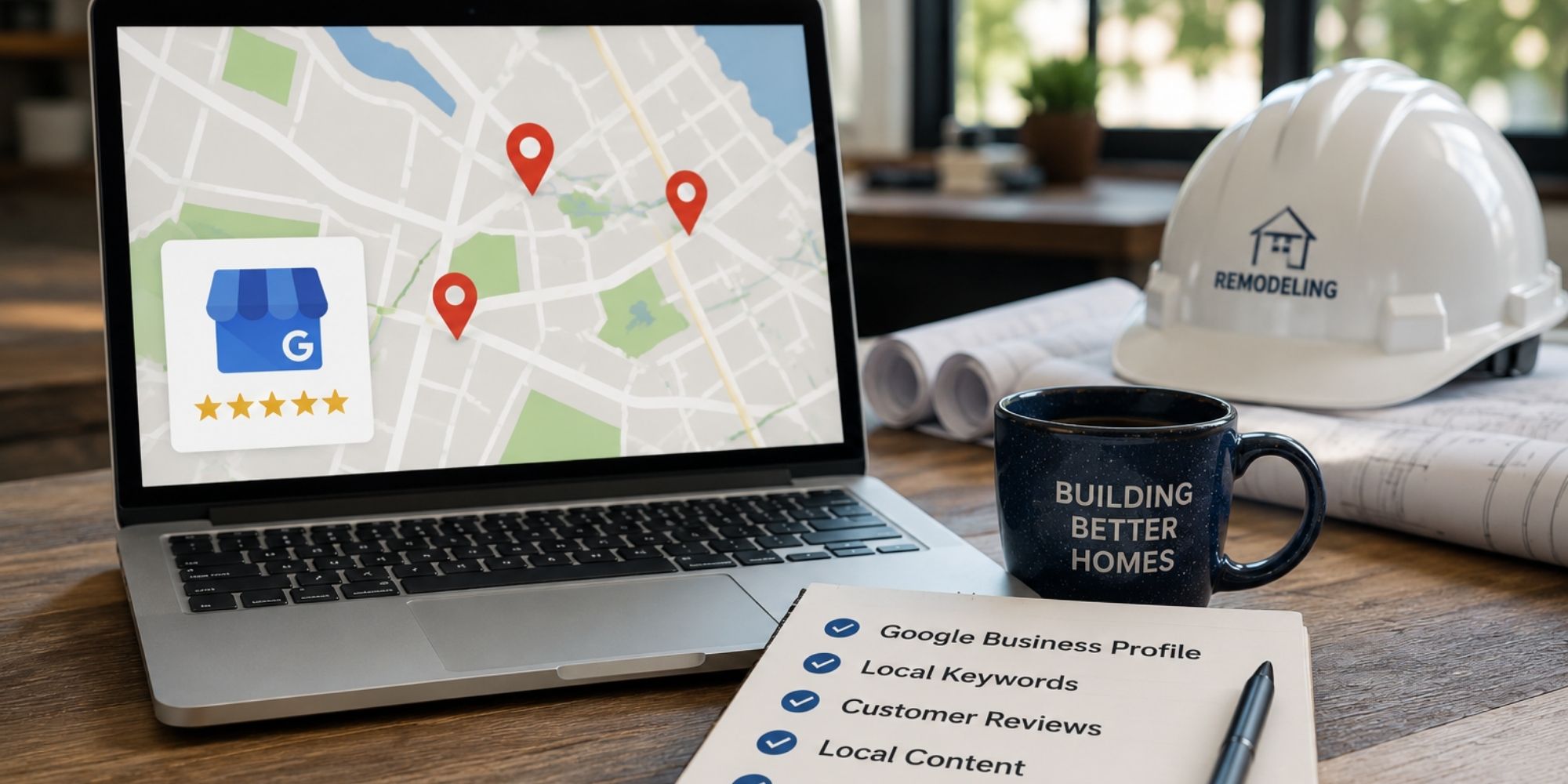

Local SEO Strategies Remodeling Contractors Overlook (And Why You’re Losing Jobs to Competitors Who Don’t)
You’re doing good work. Your past clients love you. But when homeowners in your city search “kitchen remodeler near me,” your name doesn’t show up—and three competitors who aren’t as good as you are getting those calls instead.
The gap isn’t your craftsmanship. It’s local SEO execution—the invisible architecture that determines whether Google shows you to ready-to-hire homeowners or buries you on page three. Most contractors treat local SEO like a checkbox: claim your Google profile, maybe get some reviews, call it done. But the contractors dominating their markets are implementing strategies most never even know exist.
This guide breaks down the overlooked tactics that actually move the needle—the ones that take you from invisible to impossible to ignore in your local market.
📋 What You’ll Learn
- Which type of contractor needs which strategy
- The Google Business Profile tactics nobody talks about
- How to own your service area without spammy city pages
- The citation and authority signals Google actually cares about
- Review velocity strategies that outperform competitors with more reviews
- Local content that builds authority (not generic blog fluff)
- Schema markup that tells Google exactly what you do and where
- Red flags that kill local rankings
- Common questions contractors ask about local SEO
Which Type of Contractor Are You?
Your local SEO roadmap depends on where you’re starting. Pick the profile that fits you—each needs a different approach.
The Invisible Contractor
You have a website (maybe). Your Google Business Profile is claimed but barely maintained. You have under 10 reviews. When you Google yourself, you’re nowhere.
Your focus: GBP optimization, review collection, NAP consistency, foundational citations.
The Stalled Contractor
You show up sometimes—page 2, bottom of the map pack. You have 15-30 reviews. You post to your GBP occasionally. But you’re stuck. Competitors with worse work keep outranking you.
Your focus: Review velocity, location-specific content, advanced GBP tactics, competitive citation gap analysis.
The Growth-Mode Contractor
You dominate your core city. You rank in the map pack. But now you’re expanding into neighboring cities or adding new service lines, and you’re starting from scratch there.
Your focus: Multi-location strategy, service-area expansion content, geo-targeted landing pages, niche authority building.
The Google Business Profile Tactics Nobody Talks About
Your GBP is the single most powerful local SEO asset you control. But “claiming it and adding photos” is table stakes. Here’s what actually moves you up the map pack.
Reality check: Most contractors set up their GBP once and forget it exists. The ones dominating local search treat it like a living sales channel—updated weekly, optimized ruthlessly, and monitored constantly.
✅ Weekly GBP Posts (The Secret Weapon)
Google rewards active, frequently updated profiles. Posting 1-2 times per week signals to Google that you’re a current, legitimate business—not an abandoned listing.
What to post:
- Project completions — before/after with location mention (“Just finished this Maplewood kitchen…”)
- Process updates — mid-project shots with educational context
- Seasonal relevance — “Planning a spring bathroom remodel? Here’s what to consider”
- Review highlights — screenshot a great review, add commentary
Each post should include a local keyword naturally and a call-to-action link back to a relevant page on your site.
📸 Photo Strategy That Outranks Competitors
Most contractors upload 10-15 photos once and call it done. Top-ranking profiles have 100+ photos and add new ones weekly.
The overlooked photo types that boost rankings:
🔧 In-progress shots
Show your process—framing, electrical, plumbing. Builds trust and signals you’re actively working.
👥 Team photos
People connect with people. Crew on-site, company meetings, job site safety—humanizes your business.
📍 Geo-tagged project photos
Take photos with location services ON. Google reads EXIF data—it’s a signal you actually work in that area.
🏆 Awards and certifications
EPA lead-safe, manufacturer certifications, local awards—authority signals Google values.
🎯 Service Area Precision (Not What You Think)
Here’s what most contractors get wrong: they list every city within 50 miles in their service area. Google doesn’t reward that. It dilutes your local authority.
The better strategy: List your primary service area (city/county where you do most projects) and 2-4 adjacent cities where you have actual project history and reviews. Quality over geographic sprawl.
Pro tip: When you complete a project in a new city, add it to your service area AND create a location-specific blog post about that project. Google connects the dots—you’re not just claiming to serve that area, you’re proving it.
🔍 Q&A Section Optimization
The Q&A section on your GBP is a goldmine most contractors ignore. Anyone can ask a question there—including you.
Overlooked tactic: Seed your Q&A with the questions homeowners actually search for. Ask them yourself (or have a team member ask), then answer them thoroughly with local keywords woven in naturally.
Example questions to answer:
- “Do you serve [City Name]?” (Answer yes with specific neighborhoods/zip codes)
- “What’s the typical timeline for a kitchen remodel?” (Answer with local permitting context)
- “Are you licensed and insured in [County]?” (Answer with license numbers and coverage details)
- “Do you handle permits for bathroom remodels?” (Explain your local permit process)
These answers show up in search results and give Google more local content to index.
How to Own Your Service Area Without Spammy City Pages
Google hates thin location pages. You know the ones—”We proudly serve [City Name]!” with zero unique value. They’ve been over-optimized to death and Google’s algorithm has learned to ignore them.
But location-specific content still works—when it’s done right. Here’s the difference between spam and strategy.
❌ What Doesn’t Work
- Generic “We serve [City]” pages with no unique content
- Copy-pasted descriptions with city name swapped in
- No real connection to that location (no projects, reviews, or local mentions)
- Pages for every small town within 100 miles
- Stock photos with no local context
✅ What Actually Works
- Location pages only for cities where you have multiple completed projects
- Unique content: local permit requirements, neighborhood architecture styles, climate considerations
- Embedded project galleries from that specific city
- Customer testimonials from residents of that area
- Local business partnerships or supplier mentions
🏘️ The Neighborhood-Level Strategy
Instead of thin city pages, create neighborhood-specific project stories. This works because:
- It’s genuinely useful (homeowners want to see projects in homes like theirs)
- It naturally includes hyper-local keywords
- It gives you a reason to mention specific streets, subdivisions, and landmarks
- You can link to related service pages with natural context
Example structure:
“Historic Bungalow Kitchen Remodel in the Elmwood District” (blog post)
- Challenge: 1920s plumbing, load-bearing walls, historic preservation guidelines
- Solution: Specific products/techniques used, local permit process
- Before/after photos with neighborhood context visible
- Homeowner quote mentioning the neighborhood
- Link to your “Kitchen Remodeling in [City]” service page
This content ranks for long-tail local searches like “kitchen remodel historic home Elmwood” or “contractor Elmwood district 1920s house”—searches your competitors aren’t targeting.
📊 Local Content Hierarchy That Works
Tier 1: Core Service Pages (10-15 pages)
Kitchen Remodeling, Bathroom Remodeling, Basement Finishing, etc. Each optimized for “[Service] in [Primary City]”
Tier 2: Location Pages (3-5 pages)
Only for cities where you have significant presence. Each must have unique local content, not template text.
Tier 3: Neighborhood Project Stories (ongoing blog content)
1-2 per month. These capture long-tail searches and build topical authority in specific areas.
Review Velocity Strategies That Outperform Total Review Count
You don’t need 300 reviews to outrank a competitor with 300 reviews. You need recent, consistent review momentum.
Google’s algorithm weighs review recency and velocity heavily. A contractor with 50 reviews and 3 new ones this month will often outrank one with 200 reviews but nothing new in 6 months.
📈 The Review Velocity Benchmark
Target: 2-4 Google reviews per month, every month.
This shows Google you’re actively serving customers and consistently delivering quality work. It also keeps your average rating high (new 5-stars dilute occasional 4-stars).
↑ What Kills Velocity
- Asking for reviews only at final payment (you lose 80% of opportunities)
- Generic “please review us” emails with no direct link
- No system—just hoping clients remember
- Asking once and never following up
↓ What Drives Velocity
- Asking at project milestones (demo done, drywall up, final walkthrough)
- Text message with direct Google review link
- Automated email sequences 3 days and 7 days post-completion
- In-person ask at final walkthrough (highest conversion)
💬 The Content of Reviews Matters (A Lot)
Google reads review text and uses it to understand what you do and where. A review that says “Great work!” has zero SEO value. A review that says “They did an amazing kitchen remodel in our Lakewood home” is a local keyword signal.
How to get keyword-rich reviews without being sleazy:
- When asking for the review, remind them what you did: “If you have a minute, we’d love a review about your master bathroom remodel.”
- Frame the ask: “It really helps other homeowners in [City] find us when they’re planning a remodel.”
- Include 2-3 optional prompt questions in your review request: “What challenge were you trying to solve? How did the process go? Would you recommend us to neighbors in [Neighborhood]?”
Reality check: You can’t write reviews for clients (Google will detect and remove them). But you CAN make it easy for them to write detailed ones by reminding them of specifics and asking guiding questions.
🔄 Responding to Reviews (The Most Overlooked Ranking Factor)
Google measures response rate and response time. Contractors who respond to 100% of reviews (positive AND negative) within 48 hours get a rankings boost.
What to include in your response:
- Thank them by name
- Mention the specific project type (“We’re so glad your basement finishing project…”)
- Include a local keyword naturally (“We love working with homeowners in [City]”)
- Keep it 2-3 sentences—don’t write an essay
This does two things: (1) Shows future clients you’re responsive, and (2) Gives Google more local keyword context to index.
Local Content That Builds Authority (Not Generic Blog Fluff)
Most contractor blogs are worthless for local SEO. “10 Kitchen Remodeling Trends” could be written by anyone, anywhere. Google knows this.
To rank locally, your content must be unmistakably local—something a contractor in another city couldn’t copy-paste and republish. Here’s what actually works.
📍 High-Impact Local Content Ideas
Permit Guides
“What You Need to Know About Remodeling Permits in [County]” — include permit office contact, typical timelines, common issues, costs.
Home Style Guides
“Remodeling a 1950s Ranch in [City]: What to Expect” — common challenges in specific home types prevalent in your area.
HOA/Historic Guides
“Remodeling in [Historic District]: Approval Process and Design Guidelines” — hyper-specific to your market.
Climate Considerations
“Best Flooring for Basements in [Region]: Humidity and Flooding Considerations” — your local weather patterns matter.
Cost Breakdowns
“What a Kitchen Remodel Actually Costs in [City] in 2024” — real local pricing, not national averages.
Supplier Spotlights
“Where We Source Materials in [City]: Our Go-To Local Suppliers” — builds local links and community connection.
Pro tip: Each piece of local content should link internally to 2-3 relevant service pages. “What You Need to Know About Permits” links to your Kitchen Remodeling, Bathroom Remodeling, and Addition pages. This spreads authority across your site.
🎥 Video + Local Content = Rankings Rocket Fuel
Google prioritizes pages with video. But locally-filmed, geo-tagged video is the real differentiator.
Overlooked tactic: Film 2-minute project walkthroughs on-site. Upload to YouTube with local keywords in title, description, and tags. Embed on your website’s blog post about that project. Google sees: video + local content + on-page engagement = authority.
Example title: “Craftsman Kitchen Remodel in Riverside Neighborhood [City] – Before and After”
Schema Markup That Tells Google Exactly What You Do and Where
Schema markup is structured data code that helps Google understand your content. It’s invisible to visitors but speaks directly to search engines.
Most contractor websites have zero schema. The ones crushing local search have it on every important page.
🔧 Essential Schema Types for Contractors
LocalBusiness Schema (homepage)
Tells Google: your business name, address, phone, service area, hours, logo, social profiles. This is foundational.
Service Schema (service pages)
Tells Google: “This page is about kitchen remodeling services in [City], provided by [Business Name], serving [Service Area].”
Review/AggregateRating Schema
Pulls your Google review rating and displays star ratings in search results. Huge CTR boost.
FAQPage Schema (blog posts and service pages)
Makes your FAQ content eligible for rich results—the expandable Q&A boxes that appear in search.
Reality check: You don’t need to be a developer to add schema. Plugins like Yoast SEO or RankMath handle most of it automatically. But if you want to dominate, you’ll need custom schema on service pages—worth hiring a developer for.
🚩 Red Flags That Kill Local Rankings
These mistakes will sabotage everything else you do. If any of these apply to you, fix them immediately.
🚩 Inconsistent NAP Data
Your address is “123 Main Street” on your website but “123 Main St” on Yelp and “123 Main St.” on Bing. Google sees these as different businesses. Kills trust.
🚩 Dead or Duplicate Listings
You moved offices 3 years ago but your old GBP is still live. Or you have 2-3 GBP listings for the same location. Google doesn’t know which is real—dilutes all of them.
🚩 Keyword Stuffing in GBP
Business name listed as “Bob’s Remodeling Kitchen Bathroom Contractor [City]”. Google will suspend you for this. Use your actual business name.
🚩 Fake or Paid Reviews
Google’s algorithm detects review patterns (same IP, similar language, rapid bursts). If you’re caught, your GBP gets suspended. Not worth the risk.
🚩 No Mobile Optimization
70% of local searches happen on mobile. If your site isn’t mobile-friendly, Google won’t rank you well—no matter how good your content is.
🚩 Slow Page Speed
Uncompressed images, bloated code, slow hosting—if your site takes 5+ seconds to load, users bounce and Google notices. Page speed is a ranking factor.
Common Questions About Local SEO for Contractors
What’s the difference between regular SEO and local SEO for remodeling contractors?
Regular SEO targets broader national audiences, while local SEO focuses specifically on your service area—city, county, and surrounding zip codes. For remodelers, local SEO prioritizes Google Business Profile optimization, location-specific content, local citations, and geo-targeted keywords that match how homeowners actually search for contractors in their area. A contractor in Denver and a contractor in Miami need completely different local strategies.
How long does it take to see results from local SEO for contractors?
Most remodeling contractors start seeing measurable improvements in 60-90 days—better map pack visibility, increased profile views, and more direction requests. Full momentum typically builds over 4-6 months as Google indexes your optimized content and validates your local authority through consistent citations and reviews. If you’re starting from scratch (no GBP, no reviews), expect the longer end of that range. If you have some foundation, you’ll see faster movement.
Do I need a separate page for every city I serve?
Not necessarily. Quality beats quantity. Create dedicated location pages only for cities where you have significant projects, reviews, or physical presence. For smaller surrounding areas, a well-optimized service area page with natural mentions of those locations often performs better than thin, generic city pages that Google may see as low-value. Focus on 3-5 strong location pages rather than 30 weak ones.
What’s the single most important local SEO factor for contractors?
Your Google Business Profile. It’s the foundation of local visibility—appearing in map pack results, local searches, and Google Maps. An optimized, active GBP with consistent NAP data, regular posts, authentic reviews, and quality project photos drives more qualified leads than any other single local SEO element. Everything else amplifies this foundation, but without a solid GBP, nothing else matters.
How many reviews do I need to rank well locally?
There’s no magic number, but velocity and recency matter more than total count. Consistently earning 2-4 authentic reviews per month outperforms having 100 old reviews with nothing recent. Focus on review frequency, response rate, keyword-rich content in reviews, and maintaining an average rating above 4.3 stars. A contractor with 40 reviews (5 added this month) will often outrank one with 200 reviews but none in the past 6 months.
Should I hire an agency or do local SEO myself?
It depends on your time and technical comfort level. The foundational tasks (optimizing your GBP, collecting reviews, posting weekly) you can absolutely do yourself. The more technical elements (schema markup, competitive citation analysis, content strategy) benefit from expertise. A hybrid approach works well: handle the ongoing maintenance yourself, hire help for the technical setup and strategy. If you’re already at capacity running jobs, an agency pays for itself in time saved and leads generated.
What if I serve a huge geographic area—like multiple counties?
Prioritize your core market first—the city/area where you do most of your work and have the most reviews. Dominate that completely before expanding. Once you’re ranking consistently there, create targeted content and location pages for secondary markets where you have actual project history. Trying to rank everywhere at once dilutes your authority. Better to own 2-3 cities completely than be invisible in 20.
Ready to Stop Losing Jobs to Less-Qualified Competitors?
Local SEO isn’t a magic trick. It’s a system. And when you implement the overlooked strategies in this guide, you don’t just rank better—you become the obvious choice for homeowners in your market.
BestLyfe Group helps remodeling contractors own their local markets with strategic SEO that actually drives jobs—not just traffic. If you want a roadmap built specifically for your market and competition, we can help.
More insights: Complete Digital Marketing Guide for Remodeling Contractors