

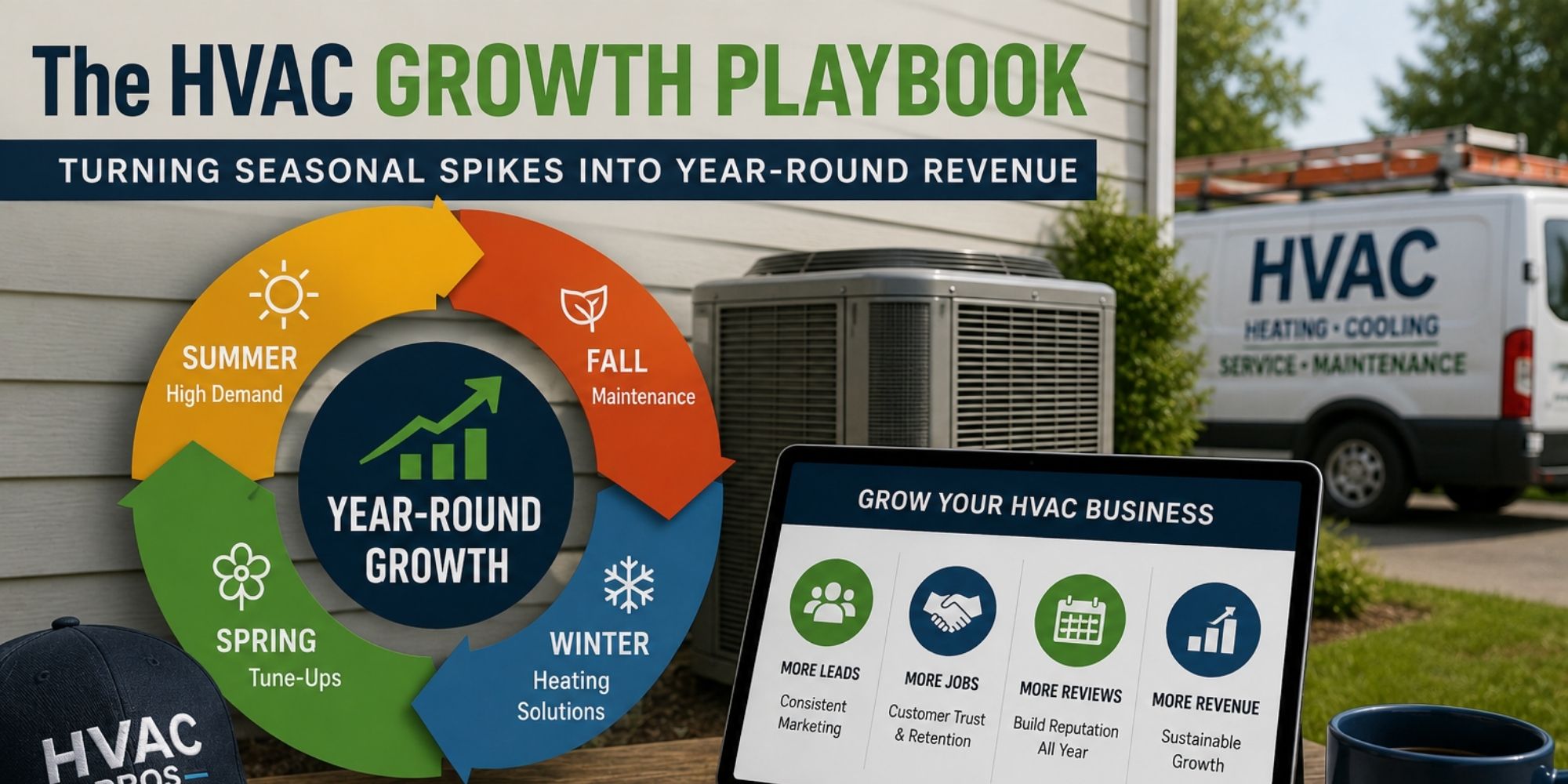
You’re booked solid in July and December, then staring at the phone in April wondering if it’s ever going to ring again. Your technicians are working 12-hour days during heat waves, then sitting idle when the weather’s perfect. You know you need consistent HVAC business growth, but every strategy you’ve tried still leaves you riding the seasonal roller coaster.
Here’s the uncomfortable truth: most HVAC companies are built like emergency rooms, not sustainable businesses. They make money when systems fail, not when customers thrive. That model caps your growth, burns out your team, and leaves you vulnerable every time the weather’s mild.
This playbook shows you how to break that cycle—how to build predictable revenue streams, stabilize cash flow year-round, and grow an HVAC business that doesn’t depend on weather emergencies to pay the bills.
What You’ll Learn
- Why the Traditional HVAC Revenue Model Fails
- Which Growth Stage Are You In?
- Building Your Recurring Revenue Foundation
- Off-Season Revenue Strategies That Actually Work
- How to Allocate Your HVAC Marketing Budget
- Digital Marketing Channels for Consistent Lead Flow
- Pricing for Profit, Not Just Volume
- Common HVAC Growth Mistakes (And How to Avoid Them)
- FAQ: Your HVAC Growth Questions Answered
Which Type of HVAC Business Owner Are You?
The One-Man-Band
You’re the technician, salesperson, and bookkeeper. Revenue is 100% tied to emergency calls. You want to hire help but can’t predict income month-to-month.
Your priority: Build predictable revenue so you can confidently hire your first tech.
The Growth-Stage Owner
You have 2-5 techs and decent peak-season revenue. But cash flow swings wildly, you’re constantly hiring and laying off, and marketing feels like throwing money at a wall.
Your priority: Stabilize revenue and build systems that don’t require you to touch every decision.
The Scaling Expert
You run a solid operation with multiple trucks and consistent volume. Now you want to double revenue without doubling your stress—and you need marketing that scales, not just more of what you’re doing.
Your priority: Optimize margins, increase customer lifetime value, and dominate your local market.
Why the Traditional HVAC Revenue Model Fails
Most HVAC businesses operate on what I call the “crisis dependency model.” When it’s 95 degrees or 15 degrees, the phone rings nonstop. When it’s 72 and sunny, crickets.
This creates three massive problems that cap your growth:
🚩 Problem #1: Unpredictable Cash Flow
You can’t plan for growth when you don’t know if next month will bring $40K or $140K. You can’t hire confidently. You can’t invest in marketing. You’re always in reaction mode, never in control.
🚩 Problem #2: Low Customer Lifetime Value
A customer calls for AC repair, you fix it, they disappear for three years. Your average customer is worth maybe $800-$1,200 over their lifetime. That’s barely enough to justify marketing costs, let alone build wealth.
🚩 Problem #3: Competing on Price Instead of Value
When your only offering is emergency repair, you’re competing with every other HVAC company on one thing: who shows up fastest and charges least. That’s a race to the bottom that burns out your team and your bank account.
The solution isn’t working harder during peak season. It’s fundamentally restructuring how your business generates revenue.
Building Your Recurring Revenue Foundation
The fastest way to stabilize HVAC business growth is converting one-time customers into recurring revenue members. This isn’t a nice-to-have. It’s the difference between a $500K business that feels chaotic and a $2M business that runs like a machine.
Maintenance Agreement Math That Makes Sense
Let’s say you charge $180/year for a basic maintenance agreement (two seasonal tune-ups). If you sign up 200 customers, that’s $36,000 in predictable annual revenue before you answer a single emergency call.
But the real value isn’t the $180. It’s what happens after:
- Agreement customers call you first when something breaks (you’re already “their” HVAC company)
- They’re 3-4x more likely to buy a system replacement from you when the time comes
- They refer neighbors because they’re engaged, not just transactional
- Average customer lifetime value jumps significantly — industry-wide HVAC CLV averages run well into five figures, and maintenance-plan members generate 2.4x-3.1x higher lifetime value than one-time service customers.
Basic Care
$15/month
- ✓ 2 seasonal tune-ups per year
- ✓ Priority scheduling
- ✓ 10% discount on repairs
- ✗ Filter delivery
- ✗ Extended warranty coverage
Premium Care
$29/month
- ✓ Everything in Basic
- ✓ Quarterly filter delivery
- ✓ 15% discount on repairs
- ✓ No trip charges
- ✓ 2-year parts/labor warranty
VIP Care
$49/month
- ✓ Everything in Premium
- ✓ Monthly filter delivery
- ✓ 20% discount on repairs
- ✓ Annual duct inspection
- ✓ Same-day emergency service
Pro Tip: Offer the membership immediately after every service call while you’re still on-site. Your close rate will be 35-50% when the system issue is fresh in their mind, versus 5-10% if you try to sell it cold later.
Script: “I can get you on our Premium Care plan right now for $29/month, which actually saves you money on today’s service and covers both your spring and fall tune-ups. Want me to add that on?”
What Percentage of Customers Should Be on Agreements?
Industry benchmarks for healthy HVAC businesses:
- Year 1-2 of offering agreements: Target 20-30% of your customer base
- Established program (3-5 years): 40-60% should be recurring members
- Best-in-class HVAC companies: 60-75% of customers on agreements, generating 30-40% of total revenue from recurring contracts alone
If you’re below 20%, your business is still too dependent on crisis calls. If you’re above 50%, you’ve built a real asset—a business that has value even when you’re not working.
Off-Season Revenue Strategies That Actually Work
Spring and fall aren’t “slow seasons”—they’re opportunity seasons if you know how to position your services. The problem isn’t lack of demand. It’s that most HVAC companies only market one thing: emergency repairs.
Services That Fill Your Calendar in Shoulder Months
Indoor Air Quality Upgrades
Position as health and allergy solutions, not HVAC add-ons. Average ticket: $800-$2,500.
- Whole-home air purifiers
- UV light installation
- Humidity control systems
- Advanced filtration upgrades
Duct Cleaning & Sealing
Market as energy savings and comfort improvements. Average ticket: $600-$1,800.
- Professional duct cleaning
- Aeroseal duct sealing
- Insulation improvements
- Duct repair and modifications
Preventive System Replacements
Target systems 12-15 years old before they fail. Offer financing and off-season discounts. Average ticket: $6,500-$12,000.
- Spring/fall installation discounts
- 0% financing for 12-24 months
- Trade-in credits for old equipment
- Energy rebate assistance
Smart Thermostat Installations
Low-friction upsell during tune-ups. Average ticket: $350-$650.
- Ecobee and Nest installations
- Multi-zone control systems
- Zoning upgrades
- Wireless sensor installations
Key Insight: Stop calling these “add-ons.” Position each as a standalone solution to a specific problem (allergies, high bills, uncomfortable rooms, aging equipment). Run dedicated marketing campaigns for each service during shoulder months, not just during tune-up season.
Off-Season Campaign Calendar
Here’s how successful HVAC companies structure their year to maintain consistent revenue:
January – February
Focus: Heating emergencies + indoor air quality (allergy/flu season positioning)
March – April
Focus: Spring tune-up campaigns + system replacement offers with financing
May – June
Focus: Pre-summer AC checks + duct sealing (energy savings before peak season)
July – August
Focus: Cooling emergencies + maintenance agreement sign-ups (easiest close during heat waves)
September – October
Focus: Fall tune-ups + smart thermostat upgrades + humidity control
November – December
Focus: Heating system checks + end-of-year replacement deals (tax write-offs for business customers)
How to Allocate Your HVAC Marketing Budget
Most HVAC owners either spend nothing on marketing (relying purely on word-of-mouth) or throw money randomly at Google Ads, Yelp, and Facebook hoping something sticks. Neither approach scales.
Here’s what actually works when you want predictable HVAC lead generation:
Marketing Budget by Revenue Stage
$0-$500K Revenue
Budget: 10-15% of revenue
($50K-$75K/year)
You need volume and visibility fast. Invest heavily in immediate lead sources and local presence.
$500K-$2M Revenue
Budget: 8-12% of revenue
($40K-$240K/year)
Balance paid lead generation with long-term SEO and reputation building.
$2M+ Revenue
Budget: 7-10% of revenue
($140K-$200K+/year)
Optimize existing channels, dominate local SEO, build brand equity that reduces acquisition costs.
Where to Invest Your Marketing Dollars
This isn’t theory—this is the allocation used by HVAC companies doing $1-5M/year consistently:
Google Local Service Ads
25-30%
Pay-per-lead model. Shows at the very top of Google. Average cost: $45-$85/lead in most markets (higher in competitive metros, up to $150+). Highest intent traffic available.
Google Ads (Search)
20-25%
Target emergency and service keywords. Cost per click: $8-$55 depending on keyword and market. Cost per lead runs $80-$150+ (branded search leads cost far less, around $34, than non-branded at $149+). Use geo-targeting and negative keywords aggressively.
SEO & Content Marketing
15-20%
Long-term investment. Local SEO, blog content, page optimization. Takes 6-12 months to show ROI but compounds over time.
Reputation Management & Reviews
10-15%
Review generation software, monitoring, response management. Powers everything else—bad reviews kill conversion.
Facebook/Instagram Ads
10-15%
Retargeting, maintenance agreement campaigns, brand awareness. Lower intent but great for shoulder-season services.
Email Marketing & CRM
5-10%
Seasonal campaigns to existing customers. Highest ROI channel but only works if you build your list.
Traditional (Direct Mail, Radio, etc.)
5-10%
Can work in specific markets, but much harder to track ROI. Test small before committing.
Non-Negotiable: Track every dollar. If you can’t measure cost-per-lead and customer acquisition cost by channel, you’re gambling, not marketing. Use call tracking, campaign URLs, and dedicated phone numbers for each source.
Digital Marketing Channels for Consistent Lead Flow
You want leads every week, not just during heat waves. That means building a diversified lead generation system where no single channel can kill your business if it changes.
Here’s what each channel does best and when to use it:
Google Local Service Ads (LSA): Your Top-of-Funnel Workhorse
What it is: The “Google Guaranteed” results that appear above everything else in search. You only pay when someone contacts you directly through the ad.
Why it works: Highest-intent traffic. Someone searching “AC repair near me” at 10pm on a Saturday wants help now, not information.
Cost: $30-$80 per lead depending on your market. Competitive in metro areas, much cheaper in suburbs.
Pro Tip: Respond to LSA leads within 2 minutes or you lose them. Set up auto-response texts and route leads to whoever’s available immediately. Speed-to-contact is the #1 factor in close rates from LSA.
Google Search Ads: Precision Targeting
What it is: The paid ads below LSA results. You bid on keywords like “furnace repair [city]” or “AC installation cost.”
Why it works: You control exactly which searches trigger your ads and can adjust bids by time of day, device, location, and more.
Cost: $15-$50+ per click. Replacement keywords cost more than repair keywords.
Common Mistake: Running Google Ads without negative keywords. You’ll waste thousands on searches like “DIY AC repair” or “HVAC jobs” or “cheap AC unit.”
Add these immediately: DIY, how to, jobs, careers, training, school, cheap, rent, used, manual, parts only.
SEO: The Compounding Asset
What it is: Ranking organically in Google for keywords like “best HVAC company [city]” or “AC repair near me.”
Why it matters: Once you rank, those clicks are free. A well-optimized site can generate 50-100 leads per month without ongoing ad spend.
Timeline: 6-12 months to see significant results. But once you’re there, you have a moat competitors can’t easily cross.
What makes HVAC SEO work:
- Google Business Profile optimization (complete, verified, active with photos and posts)
- City-specific service pages (“AC Repair in [City]” not just “AC Repair”)
- Blog content answering real questions (“How much does AC repair cost?” not “Our Services”)
- Consistent NAP (name, address, phone) across directories
- Reviews, reviews, reviews (Google weighs review velocity and recency heavily)
If you want a deep dive into HVAC-specific digital marketing strategies, check out our complete guide to digital marketing for HVAC companies.
Facebook/Instagram Ads: The Nurture Play
What it is: Targeted ads to homeowners in your service area, even when they’re not actively searching for HVAC help.
Why it works: Great for maintenance agreements, off-season promotions, and building brand awareness so you’re top-of-mind when their system fails.
Best use cases:
- Retargeting website visitors who didn’t call
- Promoting seasonal tune-up specials
- Financing offers on system replacements
- Educating homeowners about indoor air quality or energy savings
Pro Tip: Don’t sell emergencies on Facebook. Sell comfort, savings, and peace of mind. “Schedule your $89 spring tune-up before the heat arrives” converts better than “Need AC repair?”
Pricing for Profit, Not Just Volume
Here’s an uncomfortable truth: most HVAC businesses are too cheap. Not because they’re trying to be—they just don’t understand their real costs and they’re terrified of losing jobs to competitors.
The result? They book tons of calls, run themselves ragged, and wonder why they’re not making money.
What Your Pricing Actually Needs to Cover
A profitable HVAC service call isn’t just technician time + parts. Here’s the full picture:
↑ What Pushes Your Costs Up
- Technician wages + benefits + payroll taxes
- Truck payment, insurance, fuel, maintenance
- Licensing, insurance, bonding
- Tools, equipment, inventory
- Office rent/utilities
- Marketing and lead generation
- Software (dispatching, CRM, accounting)
- Warranty claims and callbacks
- Non-billable time (drive time, admin)
↓ What Improves Your Margins
- High first-time fix rates (fewer callbacks)
- Efficient routing and scheduling
- Higher average ticket through upsells
- Bulk purchasing and vendor relationships
- Service agreements (recurring revenue)
- Experienced techs who work faster
- Strong online reputation (less price shopping)
- Financing options (higher close rates)
Target Margins by Service Type
If you’re not hitting these margins, you’re either priced wrong or operationally inefficient:
Service/Repair Calls
40-55%
Gross margin after parts and labor. If you’re below 40%, your pricing is too low or you’re sending two techs when you need one.
Maintenance Agreements
50-65%
Higher margin because visits are planned, not emergency. Plus you control timing (batch visits by neighborhood).
System Replacements
35-45%
Lower percentage but higher dollars. A $10K replacement at 40% margin = $4K gross profit in one job.
Add-Ons (IAQ, Thermostats, etc.)
50-70%
Highest margin work. These are quick installs with low labor cost relative to price. Push these hard.
Reality Check: If your blended gross margin across all work is below 45%, you’re either underpricing or over-delivering on scope. Both kill growth. Track margin by service type monthly—it tells you exactly where to focus.
Common HVAC Growth Mistakes (And How to Avoid Them)
I’ve worked with dozens of HVAC companies trying to break through growth ceilings. These are the mistakes I see repeatedly—and they’re totally avoidable if you know what to watch for.
🚩 Chasing Volume Over Value
Saying yes to every job regardless of profitability. You stay busy but broke. Fix: Track margin by job type and stop doing low-margin work.
🚩 No Recurring Revenue Model
Every dollar depends on emergency calls. Cash flow is chaos. Fix: Launch maintenance agreements and get 30% of customers enrolled within 12 months.
🚩 Relying on One Lead Source
All leads from Google Ads or all from referrals. When that channel dips, your business tanks. Fix: Diversify across LSA, SEO, paid search, and social.
🚩 Ignoring Reviews and Reputation
Spending money on ads but losing 50% of leads because you have 3.2 stars on Google. Fix: Get systematic about asking for reviews after every positive job.
🚩 No Follow-Up System
A customer calls, you give a quote, they say “let me think about it,” and you never hear from them again. Fix: Build a CRM with automated follow-up sequences.
🚩 Hiring Too Late (Or Too Early)
Either burning out because you waited too long to hire, or hiring before revenue supports it. Fix: Hire when you’re turning away profitable work consistently for 90+ days.
The Growth Bottleneck Most HVAC Owners Miss:
It’s not marketing. It’s not pricing. It’s not having systems. Every decision runs through you. Every problem lands on your desk. You can’t scale because you’re the bottleneck. Fix this before spending another dollar on ads.
FAQ: Your HVAC Growth Questions Answered
How do successful HVAC companies maintain revenue during slow seasons?
+
Successful HVAC companies maintain year-round revenue through diversification strategies including maintenance agreements, off-season HVAC services like indoor air quality upgrades and duct cleaning, implementing financing options to make major system replacements attractive year-round, and using digital marketing to generate consistent lead flow even when weather doesn’t create urgency.
What’s the biggest mistake HVAC businesses make when trying to grow?
+
The biggest growth mistake is chasing volume without building customer lifetime value. Many HVAC companies focus exclusively on emergency calls and one-time replacements instead of building a recurring revenue base through maintenance agreements and service contracts. This creates a feast-or-famine cycle tied entirely to weather extremes rather than predictable monthly income.
How much should an HVAC company spend on marketing?
+
Most growing HVAC businesses allocate 7-12% of revenue to marketing, with newer companies often investing 10-15% during growth phases. The key is tracking cost per lead and customer acquisition cost by channel. A $500,000 HVAC business should budget $35,000-$60,000 annually for marketing, while a $2M company typically invests $140,000-$240,000 across digital advertising, SEO, local service ads, and reputation management.
What digital marketing strategies work best for HVAC lead generation?
+
The most effective HVAC lead generation strategies combine Google Local Service Ads for immediate visibility, SEO for long-term organic traffic, Google Ads targeting high-intent searches like “AC repair near me,” targeted Facebook ads for maintenance agreements during shoulder seasons, and email marketing to existing customers for tune-ups and upgrades. Successful HVAC companies use a multi-channel approach rather than relying on a single traffic source.
How do I build a customer base that generates recurring revenue?
+
Build recurring revenue by converting one-time service calls into maintenance agreement customers through immediate post-service offers, seasonal tune-up promotions with prepayment discounts, tiered service plans (basic, premium, VIP) that appeal to different customer segments, automated reminders before each season, and financing options that make system replacements more accessible. The goal is moving 40-60% of your customer base onto recurring agreements within 2-3 years.
Ready to Build Predictable HVAC Growth?
You know what needs to happen. The question is: can you execute it while running your business day-to-day?
BestLyfe Group helps HVAC companies build the marketing systems that support consistent growth. We handle strategy, execution, and optimization across multiple markets, so you can focus on delivering great service.
No pressure. No pitch. Just a conversation about where you are and where you want to be.
“`