

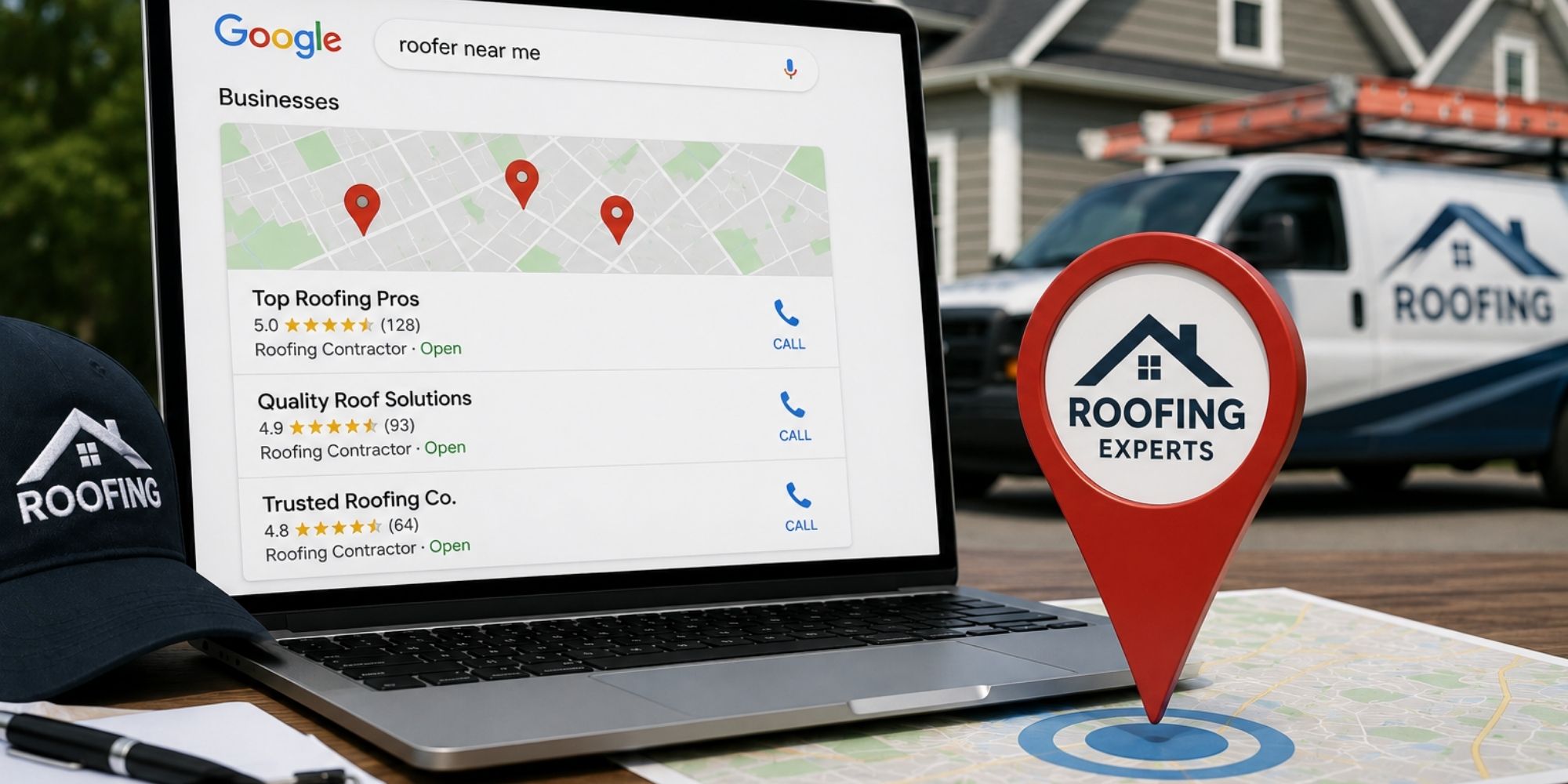
When someone’s roof is leaking at 2 AM, they’re not browsing page three of Google. They’re calling one of the three roofing companies that show up in the Google Map Pack at the top of their search results.
If you’re not in that top three, you’re invisible to the homeowners in your service area who are actively searching for a roofer right now.
Local SEO for roofing contractors isn’t optional anymore — it’s the difference between a full pipeline and wondering why your phone isn’t ringing.
This guide walks you through exactly how to optimize your roofing company for local search, rank in the Map Pack, and capture more qualified leads in the cities you actually serve.
📋 Table of Contents
- Who This Guide Is For
- Why the Map Pack Matters More Than Organic Rankings
- Optimize Your Google Business Profile Like a Pro
- Build a Consistent Review Generation System
- Create Service Area Pages That Actually Rank
- Get Your NAP Citations Right
- Use Local Content to Build Relevance
- Common Local SEO Mistakes Roofers Make
- Frequently Asked Questions
Which Type of Roofing Contractor Are You?
🚀 The Invisible Roofer
You do great work, but when people search for roofers in your area, you’re nowhere to be found. You’re buried on page two or three, and your phone only rings from referrals.
You need: A complete local SEO foundation — optimized Google Business Profile, consistent NAP citations, and service area pages.
📍 The Stuck-at-#4 Roofer
You show up in local search, but you’re always just outside the Map Pack. You’re close, but the top three spots go to your competitors every time.
You need: Review velocity, local content strategy, and advanced GBP optimization to push you into the top three.
🏆 The Multi-County Roofer
You serve multiple cities and counties, but you only rank well in the city where your office is located. You’re missing leads in the other areas you serve.
You need: A service area page strategy with unique, location-specific content for each market you want to dominate.
Why the Map Pack Matters More Than Organic Rankings
The Google Map Pack (also called the Local Pack or 3-Pack) is the box at the top of search results that shows three local businesses on a map. It appears for searches with local intent like “roofing company near me,” “roof repair [city name],” or “emergency roof leak.”
Here’s why it’s the most valuable digital real estate for roofers:
Map Pack stats that matter:
- The Map Pack appears above all organic search results
- 44% of Google searches have local intent
- Map Pack listings get 33% of all clicks on mobile
- Users are 2.7x more likely to call a business in the Map Pack than one in organic results
- 78% of local mobile searches result in an offline purchase within 24 hours
Translation: If you’re not in the Map Pack, you’re leaving qualified roofing leads on the table every single day.
Ranking #1 organically is great. But ranking in the top three of the Map Pack is better — especially for emergency services like roof leaks, storm damage, and urgent repairs.
Optimize Your Google Business Profile Like a Pro
Your Google Business Profile (formerly Google My Business) is the single most important factor for Map Pack rankings. It’s not enough to just claim your listing — you need to optimize every field and keep it active.
The Complete GBP Optimization Checklist for Roofers
✓ Business name: Use your legal name exactly. Don’t keyword-stuff (“ABC Roofing | Best Roofer in Dallas”).
✓ Primary category: “Roofing contractor” — this is critical for Map Pack eligibility.
✓ Secondary categories: Add relevant ones like “Roof repair service,” “Siding contractor,” “Gutter cleaning service.”
✓ Service areas: List every city, ZIP code, and county you serve. Be specific and complete.
✓ Phone number: Local number (not an 800 number). Must match website and citations exactly.
✓ Address: Use your real business address. If you work from home, get a proper business address or use a service area business profile.
✓ Website URL: Link to your homepage or a dedicated landing page for local traffic.
✓ Hours: Keep them accurate. Update for holidays. If you offer 24/7 emergency service, mark that clearly.
Write a Keyword-Rich Business Description
Your GBP description is 750 characters to tell Google and potential customers exactly what you do. Use this space strategically:
Example GBP description for a roofing company:
“[Company Name] is a licensed and insured roofing contractor serving [County] and surrounding areas since [year]. We specialize in residential and commercial roof replacement, roof repair, storm damage restoration, and emergency roof leak services. Our team handles all roofing materials including asphalt shingles, metal roofing, tile, and flat roofs. We offer free roof inspections, insurance claim assistance, and 24/7 emergency service. Family-owned, A+ BBB rated, and trusted by homeowners across [City 1], [City 2], and [City 3].”
Notice: service keywords, location keywords, trust signals, and real differentiators. No fluff.
Add Services with Keyword-Rich Descriptions
Google lets you add specific services to your GBP. Don’t skip this. Each service is another chance to rank for relevant keywords.
- Roof Replacement — Include materials (asphalt, metal, tile) and mention warranties
- Roof Repair — Emphasize fast response, leak detection, and storm damage
- Emergency Roof Leak Service — Highlight 24/7 availability and same-day service
- Storm Damage Inspection — Free inspections, insurance assistance
- Commercial Roofing — Flat roofs, TPO, EPDM, maintenance contracts
- Gutter Installation & Repair — If you offer it, add it
Each service should have a 300-character description. Use real, helpful language — not keyword spam.
Upload High-Quality Photos Every Month
Roofing companies with photos get 42% more direction requests and 35% more website clicks than those without. Google rewards active profiles.
Photo categories to include:
- Before/after project photos
- Your crew on job sites
- Different roofing materials you install
- Your trucks with your branding
- Team photos (builds trust)
- Close-ups of quality workmanship
Photo optimization tips:
- Name files with keywords (roof-replacement-dallas.jpg)
- Upload at least 3-5 new photos per month
- Use high-resolution images (min 720px wide)
- Geotagging helps (but don’t fake locations)
- Caption photos with location and service type
Use Google Posts Weekly
Google Posts are mini-updates that show on your GBP. They expire after 7 days, so you need to post consistently. Active profiles rank better.
What to post: Project updates, seasonal tips (“Is your roof ready for winter?”), service promotions, emergency availability reminders, customer testimonials, and community involvement.
Build a Consistent Review Generation System
Reviews are the second most important ranking factor for the Map Pack (after GBP optimization). But it’s not just about total review count — Google rewards review velocity and recency.
A roofing company with 80 reviews and 5 new reviews per month will outrank a competitor with 150 reviews but no new reviews in the past 6 months.
What Makes a Review Valuable for Local SEO
✓ What Helps Your Rankings
- Consistent flow of new reviews (3-5/month)
- Reviews that mention your city or service area
- Reviews that mention specific services (roof replacement, leak repair)
- Reviews with photos of completed projects
- Reviews with detailed descriptions
- High average rating (4.5+ stars ideal)
- Owner responses to every review
✗ What Hurts Your Rankings
- No new reviews for months
- Fake or incentivized reviews (Google detects this)
- Reviews from the same IP address
- Generic reviews with no detail (“Great company!”)
- Sudden spikes in reviews (looks unnatural)
- Unresponded-to negative reviews
- Filtered reviews (not visible on your profile)
The Simple Review Request System That Works
Most roofers rely on hoping customers will leave a review. That’s why most roofers don’t get enough reviews. You need a system:
Step 1: Get a short Google review link for your GBP (use a URL shortener like Bitly for easy sharing).
Step 2: Ask for the review in person at project completion. “If you’re happy with our work, we’d really appreciate a Google review — it helps other homeowners find us.”
Step 3: Send a follow-up text or email 2-3 days later with the direct review link. “Thanks again for trusting us with your roof! If you have a moment, we’d love a quick Google review: [link]”
Step 4: Follow up one more time 7 days later if no review has been left. “Just checking in — if you’re happy with your new roof, a Google review would mean a lot: [link]”
Step 5: Respond to every review (positive and negative) within 24-48 hours.
Pro tip: Ask satisfied customers to mention the city you served them in and the service you provided. “If you have a moment for a Google review, it’d be great if you could mention the roof replacement we did at your home in [City].” This creates keyword-rich reviews that boost your local relevance.
How to Handle Negative Reviews Without Tanking Your Rankings
Negative reviews happen. How you respond matters more than the review itself.
- Respond quickly (within 24 hours shows you care)
- Stay professional — never argue, defend, or get emotional
- Acknowledge their concern — “We’re sorry to hear about your experience”
- Offer to fix it — “Please call us at [number] so we can make this right”
- Take it offline — don’t negotiate in public review responses
A thoughtful response to a negative review actually increases consumer trust by 33% according to research. Future customers are watching how you handle problems.
Create Service Area Pages That Actually Rank
If you serve multiple cities or counties, you need dedicated service area pages for each location. These pages help you rank in the Map Pack and organic results for city-specific searches like “roofer in [city name].”
But here’s the catch: templated, thin location pages will hurt you more than help you.
What Makes a Service Area Page Rank vs. Get Penalized
↑ Strong Location Page
- Unique content written specifically for that city
- Local landmarks, neighborhoods, and specifics
- City-specific roofing concerns (climate, building codes, permit requirements)
- Real project examples from that area
- Testimonials from customers in that city
- Embedded Google Map showing your service area
- Local photos (job sites, neighborhoods)
- City-specific FAQ content
- Links to city resources (permit office, building department)
↓ Weak Location Page
- Same content with only the city name swapped
- Generic “We serve [City]” statements
- No local details or context
- Stock photos with no local relevance
- No real information about serving that area
- Thin content under 500 words
- No evidence you actually work in that city
- No unique value beyond keyword targeting
Google’s algorithm is sophisticated enough to detect templated location pages. If you can’t write genuinely unique, helpful content for a city, don’t create a page for it.
How to Structure a High-Performing Location Page
H1: Roofing Contractor in [City, State] | [Company Name]
Intro paragraph: Speak directly to residents of that city. “Homeowners in [City] face unique roofing challenges — from [local weather pattern] to [local building codes]. As a licensed roofing contractor serving [City] for [X years], we understand what it takes to protect homes in neighborhoods like [Neighborhood 1], [Neighborhood 2], and [Neighborhood 3].”
Services section: List your core roofing services with local context. “Roof Replacement in [City] — We’ve replaced hundreds of roofs in [City], working with homeowners to navigate [local permitting requirements] and choose materials that perform well in [local climate].”
Why Choose Us section: Include specific reasons relevant to that city. Proximity, local experience, projects you’ve completed there, community involvement.
Local roofing issues section: Talk about the roofing problems common in that area. Storm damage, hail, wind, snow load, heat, whatever is relevant.
Recent projects: Showcase 2-3 projects you completed in that city with before/after photos if possible.
Customer testimonials: Include reviews from customers in that city.
FAQ: Answer city-specific questions. “Do I need a permit for a roof replacement in [City]?” “What roofing materials work best in [City’s] climate?”
Reality check: If you serve 20 cities, creating 20 truly unique, high-quality location pages is a lot of work. Start with your top 3-5 most important cities and do them right. Then expand gradually. Quality beats quantity every time.
Get Your NAP Citations Right
NAP stands for Name, Address, Phone Number. Citations are online mentions of your business NAP on directories, websites, and platforms across the web.
Consistent NAP citations are a trust signal to Google. If your business info is consistent across 50+ directories, Google knows you’re a legitimate, stable business.
Inconsistent citations confuse Google and hurt your rankings.
The Core Citations Every Roofer Needs
🔍 Major Search & Map Platforms
- Google Business Profile
- Bing Places for Business
- Apple Maps
- Yelp
🏠 Home Services Directories
- Angi (Angie’s List)
- HomeAdvisor
- Houzz
- Thumbtack
- Porch
🔧 Industry & Trust Sites
- Better Business Bureau
- National Roofing Contractors Association
- Local chamber of commerce
- Local business directories
NAP Consistency Rules (Follow These Exactly)
Use EXACTLY the same format everywhere:
- If your GBP says “ABC Roofing LLC” — use LLC on every citation
- If your GBP says “123 Main Street” — don’t use “123 Main St.” on other sites
- If your GBP uses (555) 123-4567 — don’t use 555-123-4567 elsewhere
- Suite numbers, abbreviations, punctuation — all must match exactly
Even small variations confuse Google’s algorithm and dilute your local SEO power.
How to Find and Fix Inconsistent Citations
Search Google for: “[Your business name]” + “[Your city]”
Look through the results and check every directory listing. Note any inconsistencies. Log into each platform and correct them.
Use tools like Moz Local, BrightLocal, or Yext to scan for citation issues across hundreds of sites at once (these are paid tools but can save hours of manual work).
Use Local Content to Build Relevance
Beyond your service area pages, you need ongoing local content to signal to Google that you’re deeply connected to your service area. This is where blogging and resource pages come in.
Local Content Ideas That Build Topical Authority
- Storm damage guides by city — “How to File a Roof Insurance Claim in [City] After Storm Damage”
- Local permit and code guides — “Roof Replacement Permits in [County]: What You Need to Know”
- Neighborhood roofing cost breakdowns — “What Does a New Roof Cost in [Neighborhood]?”
- Climate-specific roofing advice — “Best Roofing Materials for [City’s] Climate”
- Local project showcases — “Recent Roof Replacement in [City] – Before and After”
- Seasonal maintenance guides — “Preparing Your [City] Roof for Hurricane Season”
Each piece of local content should naturally link to your relevant service pages and location pages. This internal linking structure passes SEO authority and helps all your pages rank better.
For more on building a complete digital marketing strategy for roofing companies, including content marketing, PPC, and lead generation, check out our full guide.
Get Local Backlinks to Boost Authority
Backlinks from local websites signal to Google that you’re a legitimate part of your community. They’re harder to get than general backlinks, but they’re more valuable for local rankings.
Easy Local Backlink Opportunities
- Local chamber of commerce membership
- Sponsor a local sports team or charity
- Get listed on your city’s business directory
- Partner with local realtors and home inspectors
- Write a guest post for a local news site or blog
- Offer to be a source for local journalists covering home improvement topics
Higher-Value Link Opportunities
- Local news coverage of a major project or community involvement
- Award or certification from local business organizations
- Partnership with local nonprofits (free roof repairs for low-income families)
- Educational content on your city or county’s website
- Case studies featured on suppliers’ or manufacturers’ sites
One link from your local newspaper or city government website is worth more than 20 links from random national directories.
Common Local SEO Mistakes Roofers Make
Here are the issues we see over and over when auditing roofing companies’ local SEO:
🚩 Incomplete or Abandoned GBP
You claimed your profile years ago and haven’t touched it since. No photos, no posts, no updates. Google rewards active profiles — yours is dead weight.
🚩 Inconsistent NAP Everywhere
Your website says “ABC Roofing LLC,” your GBP says “ABC Roofing,” and Yelp says “ABC Roofing Company.” Google can’t tell if these are all the same business.
🚩 No Review Strategy
You hope customers leave reviews. They don’t. Your competitors with 60+ reviews and a steady flow of new ones outrank you every time.
🚩 Keyword-Stuffed Business Name
Naming your GBP “Best Dallas Roofing Contractor – Roof Repair & Replacement” violates Google’s guidelines and can get you suspended.
🚩 Templated Location Pages
You created 30 location pages by copying and pasting the same content and swapping city names. Google sees this as spam and ignores them all.
🚩 Wrong or Missing Categories
Your primary GBP category is “General Contractor” instead of “Roofing Contractor.” You won’t show up in roofing-specific searches.
🚩 No Response to Reviews
You have 40 reviews and you’ve responded to zero of them. This signals to Google (and potential customers) that you don’t care about engagement.
🚩 Using a PO Box or Virtual Address
Google knows. If you don’t have a legitimate physical address in your service area, use a service area business profile and hide your address.
Frequently Asked Questions
How long does it take to rank in the Google Map Pack for roofing?
+
Most roofing companies see movement in the Map Pack within 60-90 days of implementing a solid local SEO strategy. Competitive markets may take 4-6 months. The timeline depends on your current Google Business Profile quality, review velocity, citation consistency, and how well you optimize for local signals like service area pages and location-specific content.
What’s the difference between Google Map Pack rankings and regular Google search rankings?
+
The Map Pack (also called Local Pack or 3-Pack) shows the top three local businesses on a map at the top of search results for location-based queries. These rankings are determined by Google Business Profile optimization, reviews, proximity, and local relevance signals. Regular organic rankings below the map are determined by traditional SEO factors like content, backlinks, and technical optimization. For roofers, Map Pack visibility drives significantly more qualified leads.
Do online reviews really affect my Map Pack rankings?
+
Yes, significantly. Review quantity, review velocity (how often you get new reviews), review recency, and review ratings are all direct ranking factors for the Google Map Pack. Roofing companies with 50+ reviews and a consistent flow of new reviews (3-5 per month) consistently outrank competitors with fewer or stagnant reviews, even if the competitor has better website SEO.
Should I create separate service area pages for every city I serve?
+
Yes, if you can create genuinely unique, helpful content for each location. Service area pages help you rank in the Map Pack and organic results for city-specific searches like “roof replacement in [city]”. Each page should include local landmarks, neighborhood-specific roofing concerns, local permitting info, and real project examples from that area. Thin, templated pages with only the city name swapped out can hurt more than help.
What are the most important NAP citations for roofing contractors?
+
The most important citations for roofers include Google Business Profile, Bing Places, Apple Maps, Yelp, Angi (formerly Angie’s List), HomeAdvisor, Houzz, BBB, your local chamber of commerce, and industry-specific directories like the National Roofing Contractors Association. Consistent Name, Address, and Phone Number (NAP) across all these platforms signals to Google that your business is legitimate and trustworthy.
Can I rank in the Map Pack if my office is outside my main service area?
+
Yes, but it’s harder. Google prioritizes proximity, so roofing companies with physical addresses inside a city generally have an advantage. However, you can compete by setting your service areas correctly in Google Business Profile, creating strong location-specific content, earning reviews that mention the cities you serve, and building local relevance signals through sponsorships, partnerships, and local backlinks.
Ready to Dominate Local Search in Your Market?
Local SEO for roofers isn’t set-it-and-forget-it. It requires consistent optimization, content creation, and reputation management. If you want expert help building a complete local SEO strategy that actually moves the needle, let’s talk.
No high-pressure sales pitch. Just a real conversation about what’s working in your market and how we can help you capture more roofing leads.
Related Resources
Want to go deeper into roofing marketing? Check out these resources:
- Our SEO Services — See how we help service businesses dominate local search
- Complete Digital Marketing Guide for Roofers — PPC, content, lead gen, and more
- Local Marketing Solutions — Market-specific strategies that work