

SEO for Electricians: How to Rank for High-Intent Repair Searches That Actually Convert
You’re booked three days out for service calls, but when business slows down, the phone goes quiet. Meanwhile, homeowners are searching “outlet not working” and “circuit breaker tripping” hundreds of times every month in your service area, and they’re hiring the electricians who show up first in Google.
The difference between a fully booked calendar and hoping the phone rings isn’t how good you are at electrical work. It’s whether your website ranks when someone in your city has an urgent electrical problem and pulls out their phone to find help.
This guide breaks down exactly how electrical contractors rank for repair searches that convert into service calls, not tire-kickers browsing for pricing. You’ll learn which keywords actually drive calls, how to structure your site so Google sends you the right traffic, and what to optimize first when you only have a few hours per week to invest in marketing.
Table of Contents
- Which Type of Electrical Contractor Are You?
- What High-Intent Repair Searches Actually Look Like
- The 5 Ranking Factors That Matter Most for Electricians
- Local SEO vs. Organic SEO: What Electricians Need to Know
- How to Structure Service Pages That Rank and Convert
- Google Business Profile: The Foundation of Local Visibility
- How to Track What’s Actually Working
- What to Expect: Realistic Timelines for Ranking
- The 6 Most Expensive SEO Mistakes Electricians Make
- Frequently Asked Questions
Which Type of Electrical Contractor Are You?
Your SEO strategy depends on which type of work you’re targeting. Pick the profile that best matches your business model:
Emergency-Focused Contractor
You offer 24/7 service and want calls from people with urgent problems — no power, sparking outlets, burning smells.
Priority: Local pack rankings + emergency service pages optimized for “electrician near me” and “emergency electrician” searches.
Most Common
Residential Service Contractor
You handle service calls, repairs, and small installations. You want steady inbound leads without relying on referrals or paid ads.
Priority: Service-specific pages (outlet repair, panel upgrades, troubleshooting) + local visibility across multiple cities.
Commercial/Industrial Contractor
You focus on larger projects, property managers, and facility maintenance. Your sales cycle is longer and more relationship-driven.
Priority: Authority content (guides, case studies) + LinkedIn visibility + organic rankings for commercial electrical terms.
What High-Intent Repair Searches Actually Look Like
Not all search traffic converts equally. A homeowner searching “how does electricity work” is browsing. A homeowner searching “half my outlets stopped working” is ready to hire someone today.
High-intent repair searches share three characteristics: they describe a specific problem, they imply urgency or frustration, and they’re typed by someone who needs help, not information.
Emergency Intent (Same-Day Need)
- emergency electrician near me
- electrician open now
- 24 hour electrician [city]
- sparking outlet emergency
- smell burning from outlet
- circuit breaker won’t reset
Problem-Specific Searches (This Week Need)
- outlets not working but breaker not tripped
- flickering lights in one room
- outlet stopped working suddenly
- electrical outlet not working in kitchen
- light switch not working properly
- dead outlet repair near me
Service-Driven Searches (Planning Mode)
- electrical panel upgrade cost
- electrician to install ceiling fan
- GFCI outlet installation near me
- add outlet to room cost
- whole house surge protector installation
- EV charger installation [city]
Key Insight: Emergency searches have the highest conversion rates (40-60%) but lower search volume. Problem-specific searches balance volume and intent. Service-driven searches have higher volume but longer consideration time. A smart SEO strategy targets all three layers.
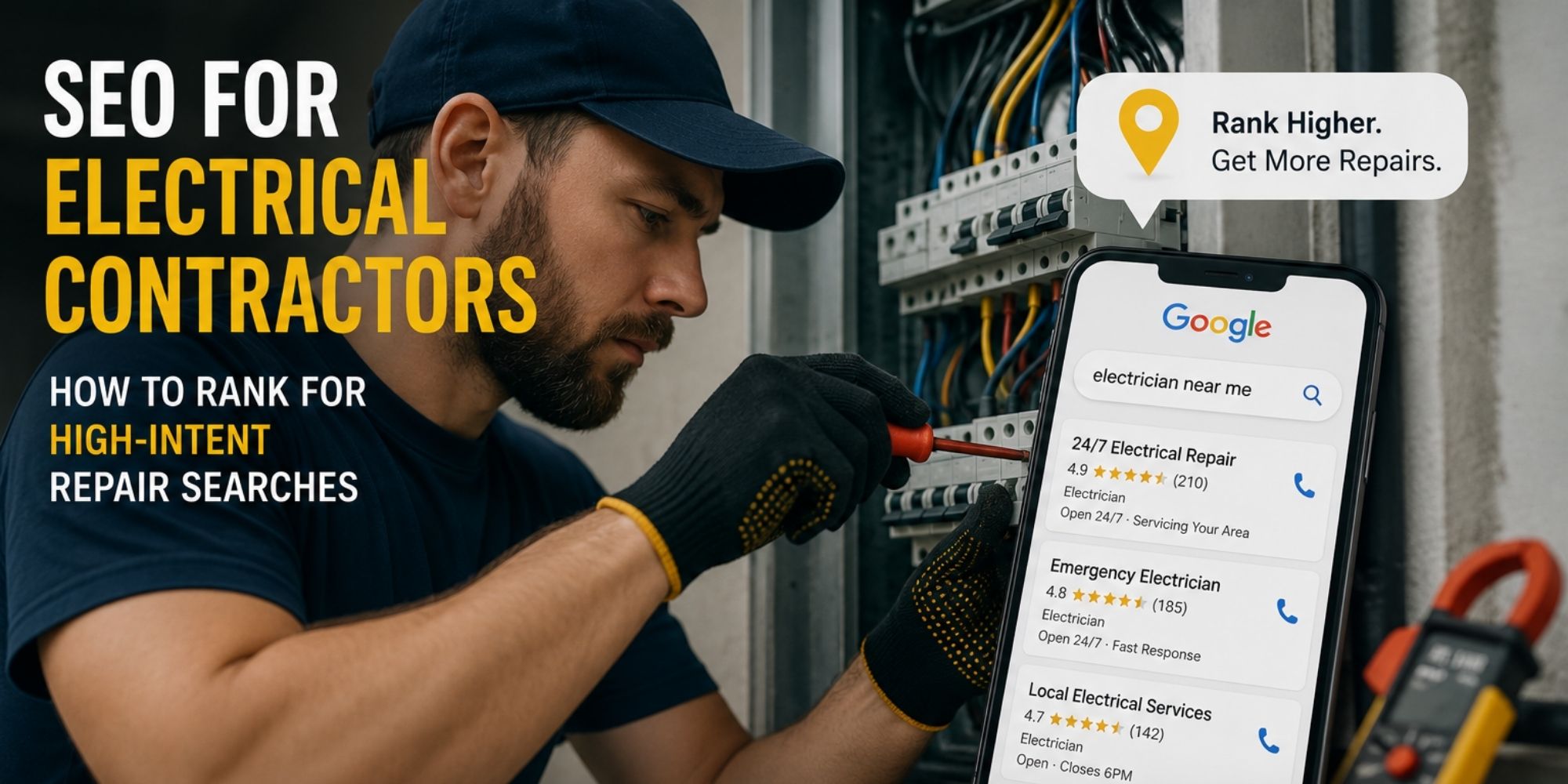
The 5 Ranking Factors That Matter Most for Electricians
Google uses over 200 ranking signals, but for local service businesses, five factors drive 80% of your visibility. Focus here first before worrying about technical details.
Google Business Profile Optimization
Your GBP is the single most important ranking factor for “near me” and local searches. A fully optimized profile with consistent NAP data, regular posts, and reviews beats a great website with a neglected profile.
Action: Complete every field, upload service photos weekly, respond to all reviews within 48 hours.
Service-Specific Page Content
Generic “residential electrical services” pages don’t rank. You need individual pages targeting specific problems: outlet repair, panel upgrades, GFCI installation, ceiling fan wiring. Each page should answer the exact question someone typed into Google.
Action: Build one detailed service page per primary keyword. Minimum 800 words with local context.
Reviews Volume and Recency
Google heavily weights review signals. An electrician with 50 reviews and a 4.8 star average will outrank a competitor with 200 reviews if those 50 are more recent and mention specific services in the review text.
Action: Get 2-4 new Google reviews every week. Ask customers to mention the specific service (panel upgrade, outlet repair).
Local Citations and NAP Consistency
Your business name, address, and phone number must be identical across every directory (Yelp, Angi, HomeAdvisor, Yellow Pages). Even small variations (Ave vs Avenue, Suite 100 vs #100) confuse Google and dilute your authority.
Action: Audit your top 20 citations. Standardize NAP format and fix mismatches within 30 days.
Mobile Site Speed and Usability
87% of electrical searches happen on mobile. If your site takes more than 3 seconds to load or requires pinch-zooming to read text, Google deprioritizes you. Click-to-call buttons and clear service descriptions matter more than flashy design.
Action: Test your site on a real phone. If the phone number isn’t clickable or service pages load slowly, fix it immediately.
Pro Tip: These five factors compound. A great GBP with bad website content won’t rank. Great content with no reviews won’t convert. Focus on improving all five in parallel, not perfecting one while ignoring others.
Local SEO vs. Organic SEO: What Electricians Need to Know
Most electricians confuse local SEO and organic SEO. They’re different strategies with different goals, and you need both to dominate your market.
Local SEO gets you into the map pack (the 3 businesses with pins that appear above organic results). Organic SEO gets you ranked in the blue links below the map. Both drive calls, but they require different tactics.
Local SEO (Map Pack Rankings)
Primary Goal: Show up in the map pack for “[service] near me” searches
Key Factors:
- Google Business Profile optimization
- Proximity to the searcher
- Review quantity and quality
- NAP consistency across directories
- Business category selection
Best For: Emergency calls, “near me” searches, mobile traffic
Organic SEO (Blue Link Rankings)
Primary Goal: Rank for problem-specific and service-driven searches
Key Factors:
- Service-specific page content
- Keyword targeting and relevance
- Backlinks from local sites
- Technical site health
- Content depth and authority
Best For: Service calls, project inquiries, capturing broader search volume
Here’s the key insight most electricians miss: the map pack captures 44% of all local search clicks, but the #1 organic result still gets 28%. If you only optimize for local SEO, you’re leaving half the available traffic on the table.
A mature SEO strategy targets both. Your Google Business Profile gets you emergency calls. Your service pages get you scheduled work. Your authority content supports both by building trust and topical depth.
How to Structure Service Pages That Rank and Convert
Most electrician websites have one generic “Services” page listing everything they do. This approach fails because Google doesn’t know what to rank you for, and visitors don’t get the specific answer they searched for.
The fix: build individual service pages that target one specific search query and answer every question a potential customer has about that service.
Service Page Content Structure
Every service page should follow this proven layout:
- H1 Header with Primary Keyword + Location
Example: “Electrical Outlet Repair in [City] — Fast Same-Day Service” - Opening Paragraph (Problem Recognition)
Start with the visitor’s situation: “When an outlet stops working, it’s more than an inconvenience — it’s a safety risk…” - Service Overview (What You Do)
2-3 sentences explaining the service in plain language - Common Problems This Service Solves
Bulleted list of specific issues (half my outlets don’t work, GFCI won’t reset, outlet sparking) - Process (What to Expect)
Step-by-step breakdown of what happens during the service call - Cost Context (Transparent Pricing)
Either specific pricing or honest ranges with explanations of what affects cost - Why This Matters (Consequences of Inaction)
What happens if they don’t fix this problem — safety risks, code violations, property damage - Location-Specific Context
How local factors affect this service (older homes, climate, local code requirements) - Clear Call to Action
Phone number, contact form, or scheduling link - FAQ Section
Answer 3-5 common questions about this specific service
Minimum word count: 800-1200 words. This isn’t arbitrary — Google needs enough content to understand what the page is about and confirm you’re authoritative on the topic.
Critical Mistake to Avoid: Don’t duplicate content across service pages. “Outlet repair” and “GFCI installation” need different content, not the same generic text with the service name swapped. Google penalizes duplicate content and it tanks your rankings.
Location Pages vs. Service Pages
If you serve multiple cities, you’ll also need location-specific pages. The structure differs from service pages:
Service Page
Focus: One specific service
URL: /outlet-repair/
H1: “Outlet Repair & Troubleshooting”
Content: Everything about that service — problems, process, cost, what to expect
Location Page
Focus: All services in one location
URL: /electrician-plano-tx/
H1: “Licensed Electrician in Plano, TX”
Content: Local context (neighborhoods served, typical projects, local code nuances), list of all services with links to service pages
Many electricians try to combine service + location into one page (like /outlet-repair-plano-tx/). This only works if you have enough unique local content to justify the page. Otherwise, stick with separate service and location pages and link between them strategically.
Learn more about structuring your entire website for maximum SEO impact in our SEO services guide, or explore how location targeting works across multiple service areas in our location optimization overview.
Google Business Profile: The Foundation of Local Visibility
Your Google Business Profile is the single highest-leverage ranking factor you control. A fully optimized GBP can outrank competitors with better websites, more backlinks, and bigger marketing budgets.
Yet most electricians treat it like a set-it-and-forget-it directory listing. They fill out the basics during setup and never touch it again. That approach guarantees mediocre results.
🚩 Red Flags Your GBP Is Hurting Your Rankings
🚩 Business description under 500 characters
🚩 No posts in the last 30 days
🚩 Service list is generic or incomplete
🚩 Fewer than 5 photos uploaded
🚩 Unanswered reviews (especially negative ones)
🚩 Service area not defined or overly broad
GBP Optimization Checklist
Business Name
Use your actual business name. Don’t keyword-stuff (e.g., “ABC Electric | 24hr Emergency Electrician Plano TX”). Google penalizes this and may suspend your profile.
Primary Category
Choose “Electrician” as primary. Add secondary categories only if genuinely relevant (Electrical Repair Service, Lighting Contractor). Don’t add categories you don’t actively perform.
Service Areas
Define specific cities and ZIP codes. Google prioritizes proximity, so if you claim the entire metro area, you dilute your authority. Better to dominate 5 cities than rank poorly across 25.
Business Description
Use all 750 characters. Lead with what you do and who you serve, then naturally work in keywords (emergency electrical repair, panel upgrades, licensed electrician). Write for humans, not keyword density.
Services List
Add every service you offer as a separate line item. Be specific: “GFCI Outlet Installation,” “Circuit Breaker Replacement,” “Whole House Rewiring.” These appear in search and help Google match you to queries.
Photos
Upload at least 20 photos: van with your logo, team members on job sites, completed work (before/after), electrical panels, and service area landmarks. Update monthly with fresh photos from recent jobs.
Posts
Publish 1-2 GBP posts per week. Short (150-300 words), include a photo, and target specific services or local events. Example: “Storm season is here — is your electrical panel ready? We’re inspecting panels in [City] this week. Call for a free safety check.”
Q&A Section
Seed your own Q&A with common questions. Don’t wait for customers to ask. Pre-populate with: “Do you offer same-day service?” “Are you licensed and insured?” “What areas do you serve?”
Pro Tip: The electricians who dominate local pack rankings treat their GBP like a living marketing asset, not a static listing. Set a weekly 30-minute calendar block: respond to reviews, upload photos, publish a post. This consistency signals to Google that you’re an active, engaged business.
How to Get More Google Reviews (Without Being Pushy)
Review velocity matters more than total count. Google prioritizes businesses with recent, consistent reviews over those with 200 old reviews and nothing new.
Target: 2-4 new reviews every week.
Simple system that works:
- Text the customer a thank-you message 2-3 hours after you finish the job
- Include a direct link to your Google review page (create a short branded link like yourcompany.com/review)
- Ask them to mention the specific service in their review (“If you’re happy with the outlet repair, we’d appreciate a quick review mentioning what we fixed”)
- Respond to every review within 48 hours — positive or negative
Don’t overthink this. Most customers are happy to leave a review if you make it easy and ask at the right moment — right after you solve their problem.
How to Track What’s Actually Working
SEO without tracking is guesswork. You need to know which keywords drive calls, which pages convert visitors, and which marketing efforts generate ROI.
Most electricians track nothing, then wonder why their marketing budget disappears with no clear results. The contractors who dominate their markets obsess over three metrics: where traffic comes from, which pages convert, and which leads turn into revenue.
Google Search Console
What it shows: Which search queries trigger your site in Google results, which pages rank, and your average position.
How to use it: Check weekly to see which keywords are moving up or down. Prioritize optimizing pages that rank #4-10 — these are closest to breaking into the top 3.
Setup: Free. Add your site at search.google.com/search-console
Google Analytics 4
What it shows: How visitors behave on your site, which pages they land on, and where they drop off.
How to use it: Track form submissions and button clicks as “conversion events.” Monitor your top landing pages — if a page gets traffic but no conversions, the content or CTA needs work.
Setup: Free. Connect to your site through Google Tag Manager.
Call Tracking
What it shows: Which marketing channels drive phone calls, which landing pages trigger calls, and what keywords preceded the call.
How to use it: Assign unique phone numbers to different traffic sources (website, GBP, paid ads). Track which numbers ring most and what the caller’s journey looked like.
Setup: Paid service. CallRail and CallTrackingMetrics are popular for electricians.
Reality Check: You don’t need expensive enterprise analytics. Start with the free tools (Search Console + Analytics) and basic call tracking. The goal isn’t perfect attribution — it’s knowing whether SEO is working and where to double down.
The Three Numbers That Matter Most
Track these metrics monthly. If these numbers trend up, your SEO is working:
- Organic traffic to service pages (not just homepage traffic — you want visitors landing on pages that convert)
- Conversion rate (calls + form fills divided by total visitors — aim for 3-8% for electricians)
- Cost per lead from organic (total monthly SEO investment divided by leads generated — should decrease over time as rankings improve)
Everything else is vanity metrics. Ranking #1 for “electrical services” means nothing if it doesn’t generate qualified calls from customers ready to hire.
What to Expect: Realistic Timelines for Ranking
SEO is not an overnight strategy. Anyone promising page-one rankings in 30 days is either lying or planning to use tactics that will get you penalized.
Here’s what actually happens when an electrical contractor commits to proper SEO:
Month 1: Foundation
Fix technical issues, optimize GBP, build core service pages, implement tracking. Minimal traffic changes — this is infrastructure work.
What you’ll see: GBP starts appearing more consistently. Search Console data begins populating.
Months 2-3: Early Movement
Google indexes new pages. Long-tail keywords (specific problem searches) start ranking. You’ll see the first organic leads trickle in.
What you’ll see: 10-20% increase in organic traffic. A few calls mentioning they found you on Google.
Months 4-6: Momentum Builds
Service pages break into top 10 for target keywords. Local pack rankings improve. Review velocity and consistent content updates compound. Organic leads become predictable.
What you’ll see: 30-50% increase in organic traffic. 5-10 organic leads per month. Some competitive keywords hitting page one.
Months 7-12: Competitive Rankings
Top 3 rankings for multiple high-value keywords. Local pack visibility in primary service areas. Backlinks from local sites and industry directories strengthen authority. SEO becomes a primary lead source.
What you’ll see: 100-200% increase in organic traffic year-over-year. 20-40 organic leads per month. Lower cost-per-lead than paid ads.
Important: These timelines assume consistent effort — ongoing content updates, review generation, and technical maintenance. If you optimize your site once and never touch it again, don’t expect sustained results. SEO is a momentum game, not a one-time project.
The 6 Most Expensive SEO Mistakes Electricians Make
These mistakes waste time, money, and opportunity. If you’re guilty of any of these, fix them before investing another dollar in SEO.
🚩 Mistake #1: Targeting Keywords That Don’t Convert
Ranking #1 for “types of electrical wiring” drives traffic from DIYers and students, not paying customers. Focus on problem-specific and service-driven keywords that indicate buying intent.
🚩 Mistake #2: Ignoring Mobile Experience
87% of electrical searches happen on mobile. If your phone number isn’t instantly clickable, your form doesn’t work on mobile, or your site takes 5+ seconds to load, you’re bleeding leads to competitors with better mobile experiences.
🚩 Mistake #3: Neglecting Google Business Profile
Your GBP is free, takes 30 minutes per week to maintain, and directly influences map pack rankings. Ignoring it while investing in paid ads is like buying a billboard but refusing to answer your phone.
🚩 Mistake #4: Building Zero Location-Specific Content
If you serve multiple cities but your website never mentions them, Google doesn’t know where to rank you. Create dedicated location pages or naturally reference cities in service pages and blog content.
🚩 Mistake #5: Hiring an SEO Agency That Doesn’t Understand Electrical Contractors
Generic SEO firms optimize for metrics that don’t matter (homepage traffic, keyword count) instead of outcomes that do (qualified service calls, cost per lead). Work with agencies that specialize in home service businesses and understand your business model.
🚩 Mistake #6: Expecting Instant Results
SEO takes 4-6 months to show meaningful results. Contractors who abandon their strategy after 8 weeks because they’re not #1 yet never reach the compounding growth phase. Commit to 12 months or don’t bother starting.
For a complete breakdown of how to build a digital marketing strategy that integrates SEO with paid ads, social media, and reputation management, read our Electrician Digital Marketing Blueprint.
Frequently Asked Questions
What are high-intent repair searches for electricians?
+
High-intent repair searches are queries that indicate immediate need and strong buying intent, such as “emergency electrician near me,” “electrical outlet not working,” or “circuit breaker keeps tripping.” These searchers are ready to hire, not just researching, making them the most valuable traffic for electrical contractors. They typically include problem descriptions, urgency signals, or location modifiers.
How long does it take to rank for electrician keywords?
+
With proper SEO implementation, most electrical contractors see initial movement within 4-8 weeks and competitive local rankings within 3-6 months. Emergency and repair keywords often rank faster than competitive installation terms because they’re more specific and have less competition. Sustained top-3 rankings typically require 9-12 months of consistent optimization, content creation, and review generation.
Should electricians focus on Google Ads or SEO?
+
The best approach is both. Google Ads deliver immediate emergency calls while SEO builds long-term visibility and lower cost-per-lead. Many successful electrical contractors run ads for emergency services while building organic rankings for repair and installation work, creating multiple lead channels. Once SEO matures (12+ months), you can reduce ad spend while maintaining lead volume through organic traffic.
What’s the ROI of SEO for electrical contractors?
+
Electrical contractors typically see 3-5x ROI from SEO within 12 months. A single residential service call from organic search can generate $200-800 in revenue, and commercial projects can exceed $10,000. Unlike paid ads, organic rankings continue generating leads without ongoing ad spend, making SEO one of the highest-ROI marketing investments for established electrical businesses.
How do I track which keywords are bringing in calls?
+
Use call tracking numbers on your website, Google Analytics to monitor landing pages, and Google Search Console to see which queries trigger your listings. Most electrical contractors also ask new callers how they found you during intake to validate which marketing channels are working. Call tracking software like CallRail or CallTrackingMetrics provides detailed attribution, showing the exact keyword and landing page that preceded each phone call.
Do I need separate pages for each service?
+
Yes. Generic “services” pages don’t rank well because Google can’t determine what specific problem you solve. Create individual pages for each major service (outlet repair, panel upgrades, ceiling fan installation, troubleshooting, etc.). Each page should target a specific keyword, answer related questions, and provide detailed information about that service. This approach improves both rankings and conversion rates.
How important are Google reviews for electrician SEO?
+
Extremely important. Google reviews influence both local pack rankings and consumer trust. Review recency matters more than total count — an electrician with 50 recent reviews will often outrank a competitor with 200 old reviews. Aim for 2-4 new reviews per week. Respond to all reviews within 48 hours, and encourage customers to mention the specific service in their review text to strengthen keyword relevance.
Ready to Dominate Local Search for Electrical Services?
Most electrical contractors treat SEO like a side project. The ones who dominate their markets treat it like the core business asset it is. If you’re ready to stop wondering where your next service call will come from and start building a predictable organic lead channel, let’s talk.
We work with electrical contractors who are done with expensive lead services and unreliable referrals. No pressure, no pitch — just a straightforward conversation about whether SEO makes sense for your business right now.