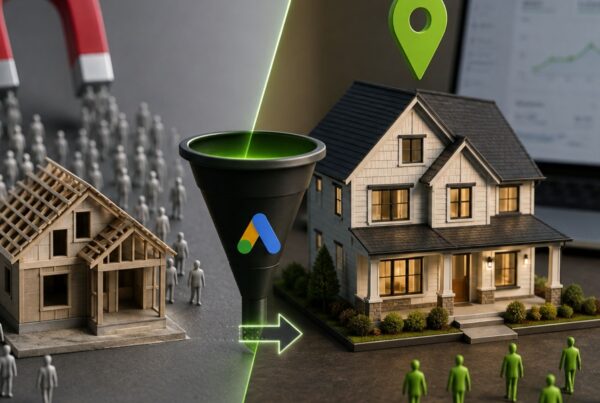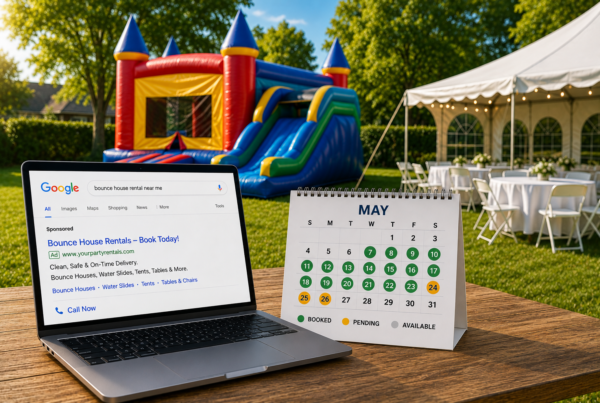

You’re spending $2,500 a month on Google Ads, getting plenty of clicks, but your phone isn’t ringing with quality leads. Or worse — it’s ringing with people 40 miles outside your service area asking if you mow lawns when you only install patios. Sound familiar?
Most landscaping companies bleed money on Google Ads because they treat it like a light switch — turn it on, hope for leads, wonder why the math doesn’t work. The difference between profitable ads and expensive disappointment comes down to how you structure campaigns, which searches you block, and whether your landing experience matches what the ad promised.
This guide shows you exactly how to run Google Ads that generate qualified landscaping leads without wasting budget on tire-kickers, DIY researchers, or people searching from three counties away.
Table of Contents
- Who This Guide Is For
- Why Landscapers Overpay for Clicks
- How to Structure Campaigns by Service Type
- How to Reduce Cost Per Click
- Why You’re Getting Clicks But Not Leads
- Landing Pages That Convert Clicks to Calls
- Tracking the Metrics That Actually Matter
- How Much to Spend (and When)
- Frequently Asked Questions
Who This Guide Is For
Before we dig into strategy, let’s make sure this is relevant to your situation.
You’re Running Ads Already
You have a Google Ads account, you’re spending money, but the leads aren’t matching the investment. Your cost per lead feels too high, or the quality is inconsistent.
You need: optimization tactics to reduce waste and improve targeting without starting from scratch.
You’re About to Start
You know Google Ads can work for landscaping companies, but you want to avoid the common mistakes that burn through budget in the first 60 days.
You need: a framework to launch campaigns correctly from day one so you’re testing strategy, not fixing foundational errors.
You Hired an Agency That Isn’t Delivering
Someone else is managing your account, but you don’t understand what they’re doing or why the results aren’t improving. You need to know what good performance looks like.
You need: enough knowledge to ask the right questions and hold your agency accountable to landscaping-specific best practices.
Why Landscapers Overpay for Clicks
Google Ads isn’t inherently expensive. It becomes expensive when you pay for the wrong clicks. Here’s where most landscaping companies leak money:
🚩 What Pushes Cost Up
- Broad match keywords with no negative list: You bid on “landscaping,” Google shows your ad for “landscaping jobs near me” and “landscaping design software.”
- No geographic restrictions: You serve a 20-mile radius but pay for clicks from people 50 miles away.
- Mixing service types in one campaign: Lawn care and hardscaping have different search intent, cost, and conversion rates — lumping them together kills performance.
- Sending clicks to your homepage: Someone searches “patio installation,” clicks your ad, lands on a homepage with 12 services and no clear next step.
- Running ads 24/7: You’re paying for clicks at 2 AM when no one answers the phone.
✓ What Keeps Cost Down
- Service-specific campaigns: Separate campaigns for lawn care, hardscaping, design, tree service — each with tailored keywords and landing pages.
- Tight geographic targeting: Radius targeting around your service area plus bid adjustments to prioritize close-in zip codes.
- Comprehensive negative keyword list: Block “jobs,” “salary,” “DIY,” “how to,” “free,” “cheap,” and any service you don’t offer.
- High-intent keywords: “Landscaper near me,” “patio installation cost,” “lawn care service” — phrases that signal readiness to hire.
- Ad scheduling during business hours: Run ads when you can answer the phone or respond to form fills within an hour.
- Landing pages that match the ad: If the ad promises patio installation pricing, the landing page delivers exactly that.
Pro Tip: Most landscapers see a 30-50% cost per click reduction within the first month just by adding negative keywords and tightening location targeting. It’s the fastest win in Google Ads optimization.
How to Structure Campaigns by Service Type
One campaign for “landscaping” doesn’t work. Someone searching for weekly lawn mowing has a completely different intent, urgency, and budget than someone researching a $15,000 backyard renovation.
Structure your account like this:
Lawn Care / Maintenance
Keywords: “lawn care service,” “lawn mowing near me,” “weekly lawn maintenance,” “grass cutting service”
Landing page: Lawn care services page with pricing tiers, service area map, call button
Typical CPC: $4-$12
Hardscaping / Patios
Keywords: “patio installation,” “hardscaping contractor,” “paver patio cost,” “retaining wall installer”
Landing page: Hardscaping portfolio with before/after photos, project cost ranges, consultation form
Typical CPC: $8-$25
Landscape Design / Installation
Keywords: “landscape designer,” “backyard landscaping ideas,” “landscape installation,” “outdoor living design”
Landing page: Design services page with process timeline, design examples, free consultation offer
Typical CPC: $6-$18
If you offer specialty services — irrigation, tree removal, snow removal, commercial property maintenance — give each one its own campaign. This lets you control budget by service line, write hyper-relevant ads, and send clicks to pages that actually convert.
Warning: Don’t split campaigns so narrowly that each one gets fewer than 10 clicks per week. You need volume to optimize. If a service is too niche, bundle it with a related campaign and use ad groups to separate keywords.
How to Reduce Cost Per Click Without Killing Volume
Lower cost per click doesn’t mean you win. A $5 click that converts at 15% is better than a $2 click that converts at 3%. But most landscapers can cut CPC by 20-40% without sacrificing lead quality by making these adjustments:
1. Use Location-Based Bid Adjustments
Go to your campaign settings → Locations → Edit → Bid adjustments. Increase bids by 20-30% for zip codes within 10 miles of your office. Decrease bids by 30-50% for the outer edges of your service area. This ensures you’re competitive where it matters and not overpaying for long-distance leads that rarely convert.
2. Add Negative Keywords Weekly
Check your search terms report every Monday. Look for any query that triggered your ad but isn’t relevant. Add it as a negative keyword. Common negatives for landscapers:
- jobs, salary, hiring, employment, career
- DIY, how to, tutorial, tips, ideas (unless you’re selling consultations)
- free, cheap, discount (these attract price shoppers who rarely hire)
- software, app, design tool, online, template
- Any service you don’t offer — if you don’t do irrigation, add “sprinkler,” “irrigation,” “watering system”
3. Improve Quality Score
Google rewards relevance with lower CPCs. Quality Score is based on three factors:
- Expected click-through rate: Write ads that include the keyword in the headline and promise a clear benefit.
- Ad relevance: Your ad should mirror the search query. If someone searches “patio installation,” your ad should say “Patio Installation Services” — not “Full-Service Landscaping.”
- Landing page experience: The page needs to load fast, be mobile-friendly, and deliver on the ad’s promise immediately.
A Quality Score improvement from 5 to 7 can cut your CPC by 20-30%. It’s free money just for being more relevant.
4. Use Long-Tail Keywords
“Landscaping” costs $15 per click and attracts everyone from homeowners to job seekers. “Patio pavers installation near me” costs $7 and reaches someone ready to get quotes. Long-tail keywords have lower competition, lower cost, and higher intent.
Use phrase match brackets: [patio installation], [lawn care service], [landscape design consultation]. This gives you some reach while filtering out irrelevant variations.
5. Schedule Ads Around Your Availability
If you don’t answer calls after 5 PM, don’t run ads after 5 PM. Set ad scheduling in your campaign settings to match your business hours. Leads that come in when you can’t respond have a 50% lower conversion rate — you’re paying for clicks that go cold before you ever make contact.

Why You’re Getting Clicks But Not Leads
This is the most frustrating problem in Google Ads: your budget is being spent, the clicks are happening, but your phone stays quiet. Here’s what’s actually going wrong:
🚩 The Six Reasons Clicks Don’t Convert
1. Search Intent Mismatch
Someone searching “backyard landscaping ideas” is researching, not hiring. They click, browse, leave. Use “near me,” “service,” “contractor,” “cost,” “hire” in your keywords to attract buyers, not browsers.
2. Landing Page Doesn’t Match the Ad
Your ad says “Get a Free Patio Design Consultation.” The landing page is your homepage with no mention of free consultations. The visitor feels tricked and bounces. Every ad needs its own service-specific landing page.
3. No Clear Call to Action
The page has beautiful photos but no obvious next step. Visitors don’t know if they should call, fill out a form, or request a quote. Make the CTA impossible to miss: bold button, contrasting color, above the fold.
4. You’re Not Tracking Phone Calls
Most landscaping leads happen over the phone, not through forms. If you’re only tracking form submissions, you think ads aren’t working when they actually are. Use call tracking numbers or Google’s call conversion tracking.
5. Slow Page Load Speed
Your landing page takes 6 seconds to load on mobile. Half your clicks bounce before they even see your content. Use Google PageSpeed Insights — if you score below 50 on mobile, fix it before spending another dollar on ads.
6. Geographic Leakage
You serve a 20-mile radius but target a 40-mile radius “just in case.” People outside your service area click, realize you don’t serve them, and leave. Tighten your targeting to actual service zones.
Pro Tip: Run a simple test — search for your own ad, click it, and complete the conversion process on your phone. Is the phone number clickable? Does the form work? Can you complete it in under 30 seconds? If you struggle, your customers are struggling worse.
Landing Pages That Convert Clicks to Calls
Your ad gets someone to click. Your landing page gets them to call. This is where most landscaping Google Ads campaigns fail.
A high-converting landing page for landscapers includes:
Above the Fold
- Headline that matches the ad: If the ad promised “Patio Installation,” the headline says “Professional Patio Installation in [City]”
- Clickable phone number: Big, bold, impossible to miss — especially on mobile
- One clear value proposition: “Licensed, Insured, 12-Year Warranty” or “Free Design Consultation with Every Estimate”
- Hero image or video: Before/after of a completed project, not a stock photo of grass
Mid-Page
- Service details: What’s included, how long it takes, what makes you different
- Portfolio/gallery: 6-10 high-quality photos of your actual work
- Trust signals: Reviews, certifications, years in business, warranty information
- Service area map: Shows you serve their neighborhood
Bottom
- Second CTA: Repeat the phone number and add a simple form (name, email, phone, brief project description)
- FAQ section: Answer the three questions every prospect has (pricing, timeline, warranty)
- Urgency element: “Schedule your free consultation this week” or “Limited spring installation slots available”
Critical mistake to avoid: Don’t send Google Ads traffic to your homepage. Ever. A homepage tries to serve everyone and converts no one. Service-specific landing pages convert 3-5x better because they speak directly to the visitor’s search intent.
Tracking the Metrics That Actually Matter
Most landscapers look at the wrong numbers. Impressions don’t matter. Click-through rate is vanity. Here’s what you actually need to track:
Cost Per Lead
Total ad spend ÷ total leads (calls + forms). This is your primary health metric.
Good range: $30-$80 for lawn care, $60-$150 for design/installation, $100-$250 for commercial.
Conversion Rate
Leads ÷ clicks. Shows how well your landing page performs.
Good range: 8-15% for service-specific landing pages. Below 5% means your page or targeting needs work.
Cost Per Customer
Total ad spend ÷ actual customers who paid you. Requires tracking leads through your sales process.
The ultimate number: If your average project is $3,000 and cost per customer is $500, you’re printing money. If it’s $2,500, you’re losing.
Search Term Report
The exact phrases people typed before clicking your ad. Review weekly to find negative keywords and discover new keyword opportunities.
How to use it: Any query that spent money but got zero conversions → add as negative.
Set up call tracking. Use a service like CallRail or Google’s built-in call conversion tracking. Without it, you’re flying blind — you see clicks but have no idea if they’re turning into phone calls.
How Much to Spend (and When to Spend It)
There’s no magic budget number, but there is a minimum threshold to get meaningful results. Below $1,500/month, you don’t have enough data to optimize effectively. You’re testing blind.
Starter Budget
$1,500-$2,500/month
Focus on one or two core services. Run ads during business hours only. Expect 20-50 leads per month depending on service type and competition.
Growth Budget
$3,000-$6,000/month
Cover multiple service types with separate campaigns. Expand to weekend hours. Test different ad copy and landing pages. Expect 50-120 leads per month.
Scale Budget
$6,000+/month
Dominate your market across all services. Run display remarketing. Expand geographic reach. Test Performance Max campaigns. At this level, Google Ads should be a reliable customer acquisition channel, not an experiment.
Seasonal Budget Allocation
Landscaping is seasonal. Don’t spread your budget evenly across 12 months. Concentrate spending when demand is highest:
- March-May (spring): 35% of annual budget — everyone wants lawn care and new landscaping before summer
- June-August (summer): 30% of annual budget — maintenance and hardscaping projects
- September-October (fall): 20% of annual budget — cleanup and last-minute projects
- November-February (winter): 15% of annual budget — pause or reduce to brand awareness unless you offer snow removal
If you run a $3,000/month average budget, that might look like $5,000 in April, $4,500 in May, $3,500 in June-August, $2,500 in September-October, and $1,000 in winter months.
Frequently Asked Questions
How can landscapers reduce their cost per click in Google Ads?
+
Start with location-based bid adjustments — increase bids for close-in zip codes, decrease for outer areas. Add negative keywords weekly from your search terms report to block irrelevant traffic. Improve Quality Score by matching ad copy to landing pages and using service-specific keywords. Switch from broad match to phrase match for better control. Schedule ads only during business hours when you can respond to leads immediately.
What are the best Google Ads strategies for landscaping companies?
+
Separate campaigns by service type (lawn care, hardscaping, design) so you can control budget and messaging for each. Use radius targeting around your service area with bid adjustments favoring nearby locations. Create dedicated landing pages that match each ad’s promise. Track phone calls as conversions since most landscaping leads call rather than fill out forms. Use long-tail keywords like “patio installation near me” instead of generic terms like “landscaping.” Add negative keywords to filter out job seekers and DIY researchers.
Why are my Google Ads getting clicks but not landscaping leads?
+
You’re likely attracting the wrong search intent (researchers instead of buyers), sending clicks to your homepage instead of service-specific landing pages, not tracking phone calls so you miss most conversions, targeting too wide a geographic area and paying for clicks from people outside your service zone, or your landing page doesn’t deliver what the ad promised. Fix this by using buyer-intent keywords, creating dedicated landing pages, setting up call tracking, tightening location targeting, and making your call-to-action impossible to miss.
What is a good cost per lead for landscaping Google Ads?
+
For residential lawn care, $30-$80 per lead is typical. Landscape design or installation runs $60-$150 per lead. Commercial landscaping often costs $100-$250 per lead due to higher project values and longer sales cycles. What matters more than raw cost is your close rate and average project value. A $100 cost per lead is profitable if you close 20% at $3,000+ average jobs. Track cost per customer, not just cost per lead, to understand true profitability.
Should landscaping companies use broad match keywords in Google Ads?
+
Use broad match carefully and only with a comprehensive negative keyword list. Phrase match and exact match give you much better control over who sees your ads. If you do use broad match, pair it with Smart Bidding and review search term reports weekly to identify and exclude irrelevant queries. Most small landscaping companies get better results starting with phrase match on service-specific keywords, then expanding once they have conversion data to guide optimization.
How much should a landscaping company spend on Google Ads?
+
Start with a minimum of $1,500-$3,000 per month to gather enough data for meaningful optimization. This typically generates 30-60 clicks per week, which is enough to test and refine your approach. Seasonal businesses should increase budget 2-3x during peak months (spring/summer) and reduce during winter unless offering snow removal. Scale based on lead quality and your crew’s capacity to handle volume, not arbitrary percentage rules. If you’re getting profitable leads at $2,000/month, test $3,000 and measure the incremental return.
Ready to Stop Wasting Money on Google Ads?
You don’t need a bigger budget. You need a smarter strategy — one built specifically for how landscaping customers actually search, evaluate, and hire.
Whether you’re running ads that aren’t converting or you’re about to launch your first campaign, we can help you structure Google Ads that generate qualified leads without the waste. No pressure, no pitch — just a straight conversation about what’s working in your market right now.
Related resources: