
Are Your Roofing Google Ads Costing More Than They Should?
You’re paying $40 per click and half of them are tire-kickers, DIY YouTubers, or people three states away. Your Google Ads budget disappears before you even get a phone call, and you’re wondering if this whole thing is a scam designed to drain roofing companies dry.
It’s not a scam, but roofing Google Ads cost more than almost any other trade—and most campaigns are structured to waste money. The average cost per click for roofing keywords runs between $15 and $90+ depending on your market, and without the right setup, you’ll pay premium prices for junk traffic.
This guide shows you exactly why roofing clicks are so expensive, where the budget leaks happen, and how to build campaigns that convert searchers into actual roofing jobs instead of burning through your marketing dollars on people who will never hire you.
Table of Contents
- Why Google Ads Are So Expensive for Roofing Companies
- Which Type of Roofing Company Are You?
- What Pushes Roofing Google Ads Costs Up (and Down)
- How to Lower Your Cost Per Click Without Killing Volume
- How to Stop Paying for Clicks That Don’t Become Leads
- Campaign Structure That Actually Works for Roofers
- Red Flags That Your Campaign Is Bleeding Money
- FAQ: Google Ads for Roofing Companies
Which Type of Roofing Company Are You?
Just Starting Google Ads
You’ve heard Google Ads can bring roofing leads but you’re not sure where to start or how much to spend.
Focus on: Cost drivers, campaign structure basics, and avoiding the most expensive beginner mistakes that drain budgets fast.
Already Running Ads (But Struggling)
You’re spending money every month but the cost per lead feels too high and half the calls aren’t even qualified.
Focus on: How to stop wasting budget on bad clicks, negative keyword strategies, and landing page fixes that lower cost per lead.
Working with an Agency (or Considering It)
You want to understand what good Google Ads management actually looks like so you know if you’re getting your money’s worth.
Focus on: Red flags that signal poor campaign management and what a properly structured roofing campaign should include.
Why Google Ads Are So Expensive for Roofing Companies
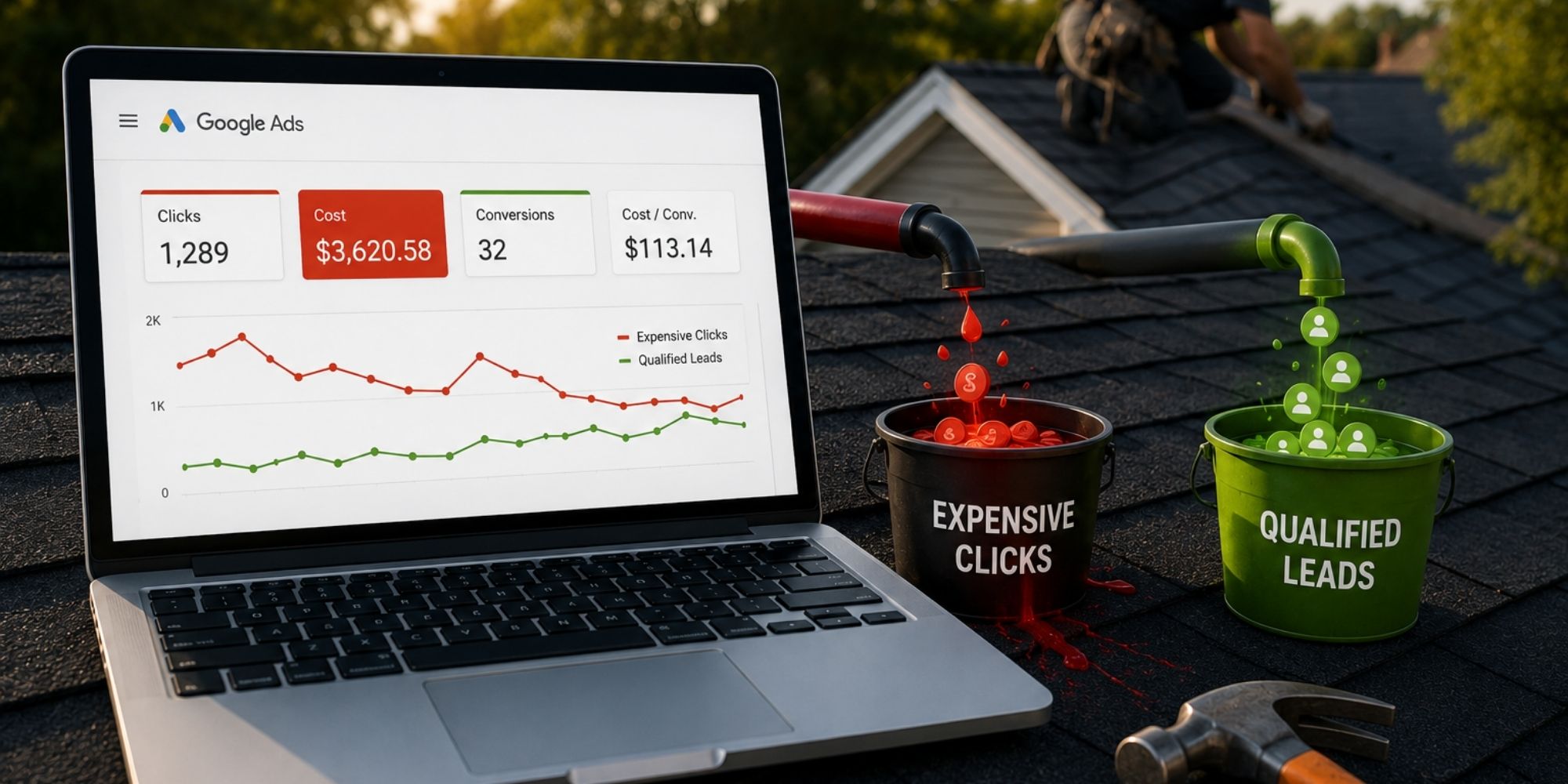
Roofing is one of the most expensive industries in Google Ads, and it’s not because Google hates roofers. It’s because the competition is brutal and the stakes are high.
When someone searches “roof repair near me,” they’re not browsing—they need help now. That high intent means every roofing company in your area is bidding on the same clicks, driving prices up through pure competition.
Here’s what makes roofing Google Ads cost so much:
- High average job value: A roof replacement can run $8,000 to $30,000+. Google knows this, your competitors know this, and everyone’s willing to pay more per click when the potential return is that high.
- Emergency search intent: Storm damage, leaks, and structural issues create urgent demand. People searching aren’t price shopping—they need a roofer today, which increases bidding aggression.
- Local market saturation: In competitive markets, you’re not just bidding against other local roofers. You’re competing with national lead-gen companies, platforms like HomeAdvisor, and aggressive regional franchises.
- Seasonal spikes: Spring storm season and fall prep periods drive search volume (and CPC) even higher as demand surges and every roofer floods the auction.
In smaller markets, you might see average CPCs around $15-$25. In competitive metro areas, clicks for high-intent keywords regularly hit $50-$90 or more. If your campaign isn’t tightly controlled, you can burn through $1,000+ in a week with very little to show for it.
Reality check: You can’t make roofing clicks cheap. But you can make them worth it by improving targeting, relevance, and conversion rates so every expensive click has a better chance of becoming a paying customer.
What Pushes Roofing Google Ads Costs Up (and Down)
Understanding what drives your costs helps you control them. Here’s what actually moves the needle on roofing Google Ads cost.
↑ What Pushes Cost Up
- Broad match keywords that trigger on irrelevant searches
- Generic landing pages that don’t match ad intent
- Poor mobile experience causing high bounce rates
- No negative keywords filtering out junk traffic
- Bidding on competitor names (expensive, low conversion)
- Running ads 24/7 instead of during peak hours
- Targeting outside your service area
↓ What Keeps Cost Down
- Phrase and exact match keywords for tighter control
- Service-specific landing pages (roof repair, replacement, inspection)
- Fast-loading mobile pages with clear calls to action
- Aggressive negative keyword list (DIY, jobs, materials, etc.)
- Location-based keywords (“roofer in [city]”)
- Ad scheduling during business hours and high-conversion times
- Tight geographic targeting to areas you actually serve
Quality Score is the hidden cost multiplier. Google rewards campaigns that deliver relevant, fast, user-friendly experiences by lowering your CPC. If your ad, keyword, and landing page don’t align tightly, you’ll pay more per click than competitors with better-optimized campaigns—even if you’re bidding the same amount.
How to Lower Your Cost Per Click Without Killing Volume
You can’t make roofing clicks cost $2. But you can bring a $60 click down to $35-$45 through better campaign hygiene and smarter targeting. Here’s how.
1. Use Location-Based Keywords Instead of Broad Terms
“Roof repair” is expensive and generic. “Roof repair in Fort Worth” is cheaper, more targeted, and converts better because the searcher is looking in your area.
Build keyword lists around your service cities and neighborhoods. You’ll pay less per click and get better-qualified traffic from people who can actually hire you. Learn more about location-based targeting strategies.
2. Tighten Your Match Types
Broad match keywords trigger on anything remotely related—including searches that have nothing to do with hiring a roofer. Start with phrase match and exact match keywords to control what you’re paying for.
You can add broad match later once you have conversion data and a solid negative keyword list. But if you’re bleeding budget, tighter match types stop the hemorrhaging immediately.
3. Build Service-Specific Landing Pages
Sending every click to your homepage kills Quality Score and conversion rate. If someone searches “roof leak repair,” they should land on a page about roof leak repair—not a generic “we do everything” homepage.
Create dedicated landing pages for each major service: repairs, replacements, inspections, storm damage. Match the ad copy to the page headline. Google rewards this alignment with lower CPCs and better ad positions.
4. Optimize for Mobile Speed and Usability
Most roofing searches happen on mobile, often in urgent situations. If your landing page takes 6 seconds to load or the phone number isn’t tap-to-call, you’re paying for clicks that bounce before they even see your offer.
Test your pages on mobile. Fast load times, clear headlines, and easy contact options improve Quality Score and conversion rates—which lowers what you pay per click over time.
Pro tip: Google’s algorithm adjusts your CPC based on expected conversion rate. Improve your landing page experience and you’ll pay less per click—even if your bid stays the same. It’s the most underrated cost-reduction lever in Google Ads campaigns.
How to Stop Paying for Clicks That Don’t Become Leads
Lowering CPC is one thing. Stopping waste is where the real savings happen. Most roofing campaigns bleed money on clicks from people who will never hire you.
Build a Negative Keyword List (And Keep Building It)
Negative keywords prevent your ads from showing on irrelevant searches. Without them, you’ll pay for clicks from job seekers, DIYers, people looking for materials, and searchers outside your service area.
Start with these roofing-specific negatives:
- jobs, careers, hiring, employment
- DIY, do it yourself, how to, tutorial
- materials, supplies, shingles, nails
- free, cheap, discount (unless you specifically run promotions)
- contractor license, training, course
- Cities and zip codes outside your service area
Check your search terms report weekly. You’ll find bizarre queries triggering your ads—add them as negatives immediately to stop the bleeding.
Exclude Geographic Areas You Don’t Serve
If you only work in a 30-mile radius, don’t pay for clicks from people 50 miles away. Use location targeting and location exclusions to keep your ads focused on the areas where you can actually take jobs.
This is especially critical for roofing—people often search generically but expect local service. Wasting budget on out-of-area clicks is one of the most common and preventable leaks.
Use Ad Scheduling to Avoid Midnight Clicks
Emergency roof repairs happen at all hours, but most qualified leads come during business hours when people can actually call and talk to someone. Running ads 24/7 wastes money on clicks that go to voicemail or get ignored.
Schedule your ads to run when your phones are staffed or when conversion rates are highest. You can still capture after-hours traffic through organic rankings and SEO—but don’t pay premium CPCs for clicks when you can’t convert them.
Track Conversions, Not Just Clicks
You don’t make money from clicks. You make money from phone calls and form submissions that turn into roofing jobs. Set up conversion tracking for calls and forms so you can see which keywords, ads, and campaigns actually produce leads.
Without conversion tracking, you’re flying blind. You might be paying $50/click for keywords that never convert while ignoring cheaper keywords that bring in qualified jobs. Check out our Google Ads resources for tracking setup guides.
Warning: If you’re not tracking which clicks become customers, you can’t optimize anything. You’re just guessing and hoping—while your competitors use actual data to outbid you more efficiently.
Campaign Structure That Actually Works for Roofers
A single campaign with 50 random keywords dumped into one ad group is a budget death sentence. Proper structure gives you control, better Quality Scores, and clearer data.
Here’s a basic roofing campaign structure that works:
Roof Repair
Ad groups:
- Leak repair
- Storm damage repair
- Emergency roof repair
Each ad group has tightly themed keywords and a dedicated landing page.
Roof Replacement
Ad groups:
- Full roof replacement
- Residential reroofing
- Shingle replacement
Higher-value jobs with different intent than repairs—separate campaign.
Roof Inspection
Ad groups:
- Free roof inspection
- Storm damage assessment
- Pre-sale inspection
Lower immediate intent but high long-term value—track to sale.
Why this structure works: Each campaign targets a specific service with relevant ad copy and landing pages. You can control budgets independently, adjust bids based on profitability, and get clean performance data for each service line.
Lumping everything together makes optimization impossible. Separating by service type gives you the control you need to stop wasting money and scale what works. For more on digital marketing strategy for roofing companies, see our guide on digital marketing for roofers.
Red Flags That Your Campaign Is Bleeding Money
If you’re running Google Ads yourself or working with an agency, watch for these warning signs that you’re paying for traffic that will never convert.
🚩 High click volume, almost no calls or forms
You’re attracting the wrong traffic or your landing page isn’t converting. Check search terms and page experience immediately.
🚩 Average CPC above $60 with no geographic targeting
You’re bidding on national-level keywords or letting your ads show everywhere. Tighten your location targeting now.
🚩 Search terms report full of “how to” and “DIY” queries
You’re paying for people who want to do it themselves, not hire you. Add negative keywords immediately.
🚩 Every keyword uses broad match
You have zero control over what triggers your ads. Switch to phrase and exact match to stop the waste.
🚩 All traffic goes to your homepage
Quality Score is suffering and visitors bounce because they can’t find what they searched for. Build service-specific landing pages.
🚩 No conversion tracking set up
You’re spending money blind. You can’t optimize what you don’t measure. Set up call and form tracking today.
If more than two of these apply to your campaign, you’re likely wasting 30-50% of your ad spend on clicks that will never become roofing jobs. Fixing these issues can cut your cost per lead in half without reducing traffic volume.
FAQ: Google Ads for Roofing Companies
Why are Google Ads so expensive for roofing companies?
Roofing Google Ads are expensive because you’re competing with every roofer in your market for the same high-intent keywords. Average cost per click ranges from $15 to $90+ depending on your market, with competitive cities pushing even higher. The combination of high competition, emergency search intent, and substantial job values creates an expensive bidding environment where every click matters.
How can roofers lower their cost per click in Google Ads?
Lower your CPC by improving Quality Score through tightly matched ad groups, specific landing pages, and mobile-optimized experiences. Use location-based keywords instead of broad terms, exclude irrelevant search queries with negative keywords, and schedule ads during your highest-converting hours. Better targeting and relevance reduce what Google charges per click while improving lead quality.
How can roofing companies stop wasting Google Ads budget on clicks that don’t become leads?
Stop wasting budget by excluding DIY searches, job seekers, and out-of-area queries through negative keywords. Build service-specific campaigns with dedicated landing pages that match search intent exactly. Track calls and forms to conversion, not just clicks. Most waste comes from broad targeting, poor ad-to-page alignment, and paying for clicks from people who aren’t ready to hire a roofer.
What’s a realistic Google Ads budget for a roofing company?
In competitive markets, expect to spend $2,000-$5,000/month minimum to get meaningful volume and test what works. Smaller markets might see results with $1,500-$2,500/month. With average CPCs between $30-$60, a $1,000 monthly budget only gets you 15-30 clicks—not enough data to optimize effectively. Budget should align with your lead volume goals and market competitiveness.
Should roofing companies use broad match keywords?
Start with phrase and exact match keywords for tighter control and less waste. Broad match can work once you have strong conversion data and an aggressive negative keyword list—but in the beginning, broad match burns budget on irrelevant traffic. Most roofing companies get better ROI using phrase and exact match with location modifiers rather than letting Google’s algorithm decide what’s relevant.
How important is Quality Score for roofing Google Ads?
Quality Score directly impacts what you pay per click. A campaign with Quality Score 7+ will pay significantly less than one with Quality Score 3—even with identical bids. Improve Quality Score by aligning keywords, ad copy, and landing pages tightly, ensuring fast mobile load times, and maintaining high click-through rates. In expensive industries like roofing, Quality Score improvements can save thousands per month.
What metrics should roofing companies track in Google Ads?
Track cost per lead (not cost per click), conversion rate, phone call volume, form submissions, and ultimately cost per acquired customer. Click-through rate and Quality Score indicate campaign health, but the real metric is how much you’re paying for qualified roofing leads that turn into jobs. Set up conversion tracking for calls and forms from day one—without it, you’re optimizing blind.
Ready to Stop Wasting Money on Google Ads?
Let’s build a roofing Google Ads campaign that actually brings qualified leads instead of burning through your budget on junk traffic. No pressure, no pitch—just a real conversation about what’s working in your market and how to make your ads profitable.