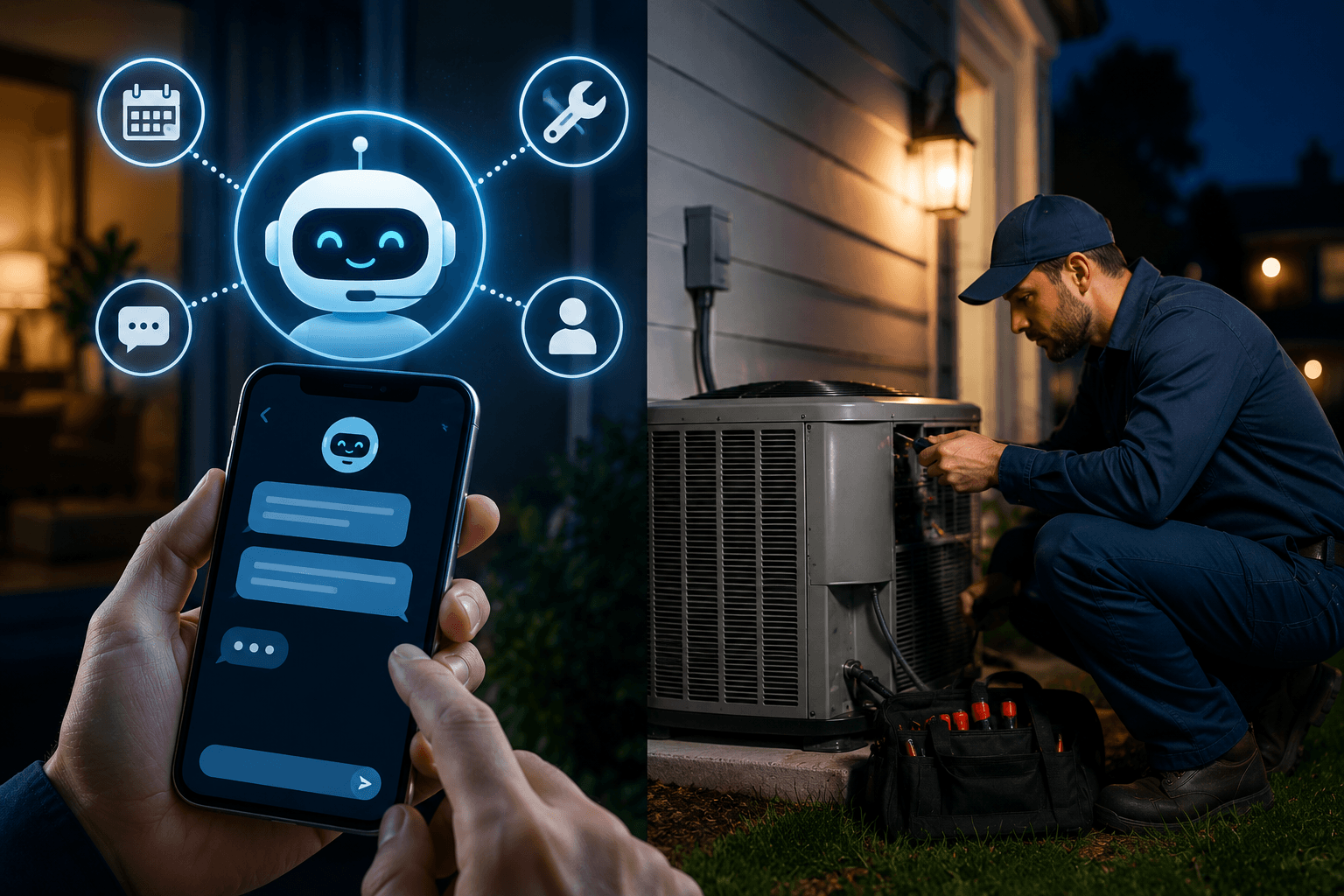

Imagine this scenario:
A homeowner wakes up at 2:13 AM because their air conditioner has stopped working during a heat wave. They grab their phone, search for an HVAC company, and land on a website.
They have questions.
Can someone come out tomorrow?
Do you service their area?
How much does an emergency visit typically cost?
But nobody is available to answer.
In the past, that interaction often ended with the visitor leaving the website and continuing their search elsewhere.
Today, many HVAC companies are exploring AI-powered chatbots as a way to engage visitors, answer common questions, and capture lead information around the clock.
This article explains how an AI chatbot HVAC solution works, what it can realistically do, where it fits into a customer experience strategy, and what business owners should understand before implementing one.
What Is an AI Chatbot for HVAC Companies?
An AI chatbot is a software tool that uses artificial intelligence and natural language processing to communicate with website visitors through conversational messages.
Unlike traditional chat widgets that rely on pre-programmed responses, modern AI chatbots can understand context, answer questions, and guide users through conversations that feel more natural.
For HVAC businesses, chatbots are often used to:
- Answer common service questions
- Collect lead information
- Schedule appointments
- Route inquiries to the correct department
- Provide service area information
- Assist visitors outside business hours
The goal is not necessarily replacing human interaction but improving responsiveness when staff members are unavailable.
Can an AI Chatbot Really Answer HVAC Leads at 2AM?
The short answer is yes.
AI chatbots operate continuously and can engage visitors regardless of business hours.
When someone visits a website late at night, a chatbot can:
- Respond instantly
- Ask qualifying questions
- Gather contact information
- Identify service needs
- Create appointment requests
- Answer frequently asked questions
While a chatbot cannot physically dispatch a technician, it can help ensure the visitor receives immediate engagement rather than encountering silence.
For many businesses, that responsiveness helps maintain momentum during the decision-making process.
What Questions Can an HVAC AI Chatbot Answer?
How Much Can an HVAC Chatbot Handle?
Modern AI systems are capable of addressing a wide range of customer inquiries.
Common examples include:
- Do you offer emergency HVAC service?
- What brands do you service?
- How often should HVAC systems be maintained?
- Do you install new air conditioners?
- What are your service hours?
- How can I schedule an appointment?
The chatbot can also collect details that help prepare staff for future conversations.
Examples include:
- Customer name
- Phone number
- Address
- Equipment type
- Service concern
The more information gathered upfront, the smoother the handoff can be when a human team member follows up.
What Are the Benefits of AI Chatbots for HVAC Companies?
Faster Response Times
One of the primary advantages is speed.
Visitors receive answers immediately rather than waiting until the next business day.
Consistent Customer Experience
AI chatbots deliver consistent responses regardless of time, staffing levels, or call volume.
Improved Lead Capture
Some visitors leave websites simply because they cannot find information quickly.
A chatbot creates an interactive path that may encourage more engagement.
Better Website Utilization
Many websites receive traffic outside normal business hours.
Chatbots help businesses interact with visitors who might otherwise leave without taking action.
Are AI Chatbots Better Than Live Chat?
AI Chatbot vs Live Chat: What’s the Difference?
This is a common question.
Live chat connects visitors directly to a human representative.
AI chatbots use artificial intelligence to automate conversations.
Both approaches have strengths.
AI chatbots excel at:
- Availability
- Speed
- Handling repetitive questions
- Gathering information
Human representatives excel at:
- Complex conversations
- Unique situations
- Relationship building
- Negotiation and sales discussions
Many businesses use a combination of both rather than viewing them as competing solutions.
How Do HVAC Chatbots Fit Into a Larger Marketing System?
Chatbots are often most effective when integrated into a broader customer acquisition strategy.
For example:
- Search engine optimization drives visitors to the website.
- Paid advertising generates traffic.
- Website content answers customer questions.
- Chatbots engage visitors and capture information.
- Follow-up systems continue the conversation.
Businesses researching automation often benefit from understanding how AI tools fit into broader marketing ecosystems.
For additional context, this guide to AI-driven marketing and automation strategies explores how these technologies work together as part of a larger growth framework.
What Should HVAC Companies Look for in an AI Chatbot?
How to Choose an AI Chatbot for an HVAC Business
Not all chatbot platforms are designed equally.
Business owners often evaluate factors such as:
- Natural language capabilities
- Appointment scheduling integration
- CRM compatibility
- Mobile responsiveness
- Lead capture features
- Reporting and analytics
The best solution depends on operational needs, existing systems, and customer expectations.
Businesses exploring conversational AI may also find it useful to learn about related technologies such as AI voice agents and intelligent customer interaction systems.
Understanding the broader category helps provide context for how chatbots fit into evolving customer communication strategies.
How Professionals Evaluate AI Chatbot Performance
When professionals assess chatbot effectiveness, they usually focus on outcomes rather than novelty.
Common evaluation criteria include:
- Conversation completion rates
- Lead capture rates
- Visitor engagement
- Response accuracy
- Appointment requests generated
- Customer satisfaction feedback
The objective is not simply implementing AI but determining whether the technology improves the overall customer experience.
Successful implementations typically prioritize usefulness over complexity.
Explore Related Digital Marketing Topics
AI chatbots represent one piece of a larger digital marketing landscape.
Businesses interested in learning more about automation, lead generation, customer experience, and online growth strategies can explore additional resources within the Digital Marketing knowledge hub.
Studying related topics often helps business owners better understand how different marketing systems interact.
Frequently Asked Questions About AI Chatbots for HVAC Companies
Can an AI chatbot book HVAC appointments?
Many modern chatbots can collect appointment information and integrate with scheduling systems, although functionality varies by platform.
Do HVAC customers actually use chatbots?
Many customers are comfortable using chatbots for basic questions, scheduling requests, and information gathering, particularly outside business hours.
Are AI chatbots available 24/7?
Yes. One of their primary benefits is continuous availability regardless of business hours.
Can an AI chatbot replace office staff?
Generally, chatbots are used to assist staff rather than replace them. They handle repetitive inquiries while humans focus on more complex interactions.
How accurate are HVAC AI chatbots?
Accuracy depends on the platform, training data, and implementation. Well-configured systems can answer many common questions effectively.
Is an AI chatbot worth it for a small HVAC company?
The answer depends on lead volume, customer behavior, and business goals. Many smaller companies evaluate chatbots as a way to improve responsiveness without increasing staffing requirements.
Conclusion
AI chatbots are changing how HVAC companies interact with potential customers, particularly outside traditional business hours.
By answering questions, collecting information, and providing immediate engagement, chatbots help bridge the gap between visitor interest and human follow-up.
While they are not a replacement for experienced team members, they can play a valuable role within a broader customer communication strategy.
As AI technology continues to evolve, understanding how chatbots fit into the customer journey can help businesses make more informed decisions about automation, engagement, and lead management.
If you’d like to explore this topic further, our related guides go deeper into AI, digital marketing systems, and customer communication strategies.