
You’re running a successful home service business. Your work is solid, customers are happy, but growth feels harder than it should. You’ve tried a few marketing tactics—maybe some Google Ads, a Facebook campaign, or SEO work—but results have been inconsistent, and you’re not sure what’s actually worth the investment.
The truth is, most home service businesses waste money on marketing that looks good but doesn’t generate qualified leads. This guide breaks down what actually works, how to prioritize your efforts, and how to build a marketing system that consistently fills your calendar with the right kind of work.
No hype. No agency pitch. Just practical guidance based on what produces measurable results for plumbers, electricians, HVAC companies, remodelers, and other service businesses.
Table of Contents
- Where You Are Right Now
- What Makes Home Service Marketing Different
- The Three-Pillar Marketing Foundation
- How to Actually Budget Marketing Spend
- Marketing Channels That Generate Real Leads
- The Expensive Mistakes Most Businesses Make
- Realistic Timeline: When You’ll See Results
- How to Measure What’s Actually Working
- Frequently Asked Questions
Where You Are Right Now
Before diving into tactics, it helps to recognize where your business actually stands. Marketing priorities shift dramatically based on stage.
🚀 Early Stage
Your situation: Business is less than three years old or under $300K in annual revenue. Most leads come from referrals and word of mouth. You’re not sure where to invest first.
Priority focus: Google Business Profile optimization, basic website with clear service pages, reputation system to capture reviews, and exploring paid search to control lead flow during slow periods.
📈 Growth Stage
Your situation: Doing $500K–$2M annually. You have some marketing in place but results are inconsistent. You’ve tried a few things, unsure what’s worth doubling down on.
Priority focus: Systematic SEO strategy, refined paid search campaigns with conversion tracking, automated email sequences for past customers, and expansion into adjacent service areas or offerings.
🏆 Established Business
Your situation: Multi-million dollar operation with crews and infrastructure. Marketing exists but may have grown chaotic. You want predictable lead flow and better efficiency.
Priority focus: Advanced local SEO with content depth, sophisticated paid campaigns segmented by service type, multi-location optimization, conversion rate improvements, and customer lifetime value maximization.
What Makes Home Service Marketing Different
Marketing a plumbing company isn’t the same as marketing a software product or retail store. The buying cycle, customer intent, and conversion patterns are fundamentally different.
High-intent, immediate-need buyers dominate your lead pool. Someone searching “emergency furnace repair” at 11 PM isn’t browsing casually—they need help now. Most of your revenue comes from people who were strangers 48 hours ago and became customers because you showed up when they searched.
Local service areas define everything. A customer 30 miles away is worthless if you don’t serve their area. Every dollar you spend reaching people outside your coverage zone is waste. Effective marketing hyper-focuses on the specific ZIP codes, cities, and neighborhoods you actually operate in.
Reputation is your real competitive advantage. When someone needs a contractor, they’re comparing you against three other businesses in about 12 minutes. Whoever has the most convincing proof—reviews, photos, clear explanations—usually wins. Marketing amplifies reputation; it doesn’t replace it.
Key insight: Home service marketing isn’t about building brand awareness over months. It’s about being visible and credible at the exact moment someone decides they need your service. That changes everything about where and how you invest.

The Three-Pillar Marketing Foundation
Before you spend a dollar on advertising or campaigns, three foundational elements must be solid. Without these, you’re pouring money into a leaky bucket.
Pillar 1: Google Business Profile Optimization
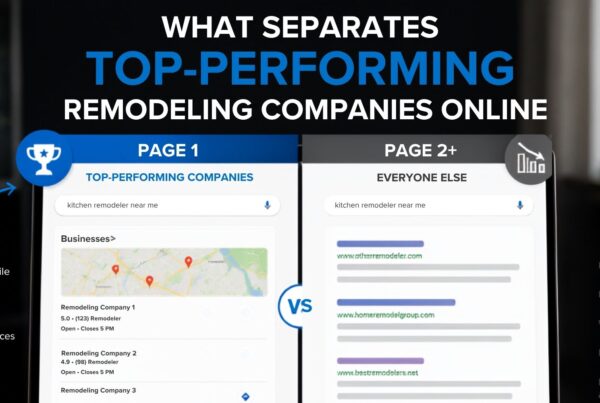
Your Google Business Profile (formerly Google My Business) controls whether you appear in the map pack when someone searches for your service. For most home service businesses, 30–50% of qualified leads come from local search results, and the map pack dominates mobile screens.
A fully optimized profile includes accurate service area boundaries, primary and secondary categories that match what customers actually search, weekly photo uploads showing real work, and responses to every review within 24 hours. Most businesses set this up once and forget it—big mistake. Google rewards profiles that stay active and engaged.
Pillar 2: A Website Built for Conversion, Not Just Looks
Pretty websites don’t generate leads. Websites that clearly explain what you do, where you do it, and how to contact you—while loading fast on mobile—do. The vast majority of your traffic arrives on mobile devices, often while standing in a flooded basement or staring at a broken AC unit.
Your site needs dedicated service pages for each major offering (not one generic “services” page), location-specific pages for each city you cover, visible phone numbers in the header, and a contact form that works without forcing users through unnecessary steps. If someone can’t figure out whether you serve their area and offer their needed service within 10 seconds, they’re gone.
Non-negotiable: Mobile load speed under three seconds. Google heavily penalizes slow sites in search rankings, and real users abandon sites that don’t load immediately. Run a speed test and fix what’s broken before investing in any traffic-generation tactics.
Pillar 3: A System for Capturing and Showcasing Reviews
Reviews aren’t just social proof—they directly influence local search rankings and conversion rates. A business with 100+ Google reviews and a 4.7+ star average will outperform a competitor with better SEO but only 12 reviews.
The businesses winning on reputation have a systematic process: after every completed job, the customer receives a text or email with a direct link to leave a review. No manual reminders. No hoping they remember. Automated follow-up within 24 hours of project completion. Capture reviews while the positive experience is fresh.

How to Actually Budget Marketing Spend
Most business owners either wildly overspend on the wrong things or underfund marketing entirely, then wonder why growth stalls. The right approach ties spending directly to revenue and customer acquisition goals.
Standard industry benchmark: allocate 7–12% of gross revenue to marketing if you’re established and maintaining growth. Newer businesses or those in aggressive expansion mode may push 15–20% temporarily. Below 5% usually means you’re coasting on referrals and vulnerable to market shifts.
↑ What Pushes Marketing Costs Up
- Highly competitive local markets (major metro areas)
- High average job value (remodeling, HVAC replacement)
- Multiple service lines requiring separate campaigns
- Aggressive growth targets in new service areas
- Heavy reliance on paid advertising over organic channels
↓ What Keeps Marketing Costs Down
- Strong organic search rankings reducing paid ad dependency
- Established reputation with 100+ reviews
- Focused service area (not spread too thin geographically)
- High repeat and referral customer rate
- Optimized conversion rates reducing cost per acquisition
The mistake isn’t spending too much or too little—it’s misallocating the budget. A business spending $4,000/month split across Facebook ads, Yelp, Angi, and billboards will usually underperform a competitor spending the same amount concentrated on Google Ads and SEO.
How to Distribute Your Marketing Budget
Here’s a realistic allocation for a $1M/year home service business investing 10% ($100K annually, roughly $8,300/month):
- 45% to Google Ads ($3,750/month) — Immediate lead generation during peak seasons and service-specific campaigns
- 30% to SEO ($2,500/month) — Long-term organic visibility through content, technical optimization, and link building
- 15% to Reputation Management ($1,250/month) — Review generation tools, monitoring, and response management
- 10% to Email/Retention Marketing ($800/month) — Automated sequences for past customers, seasonal maintenance reminders, special offers
This isn’t a universal formula, but it reflects where most established businesses see the highest return. Adjust based on your market, competition, and specific growth goals.

Marketing Channels That Generate Real Leads
Not all marketing channels produce equal results. Some deliver qualified leads consistently. Others burn budget with little to show. Here’s what actually works for home service businesses.
Local SEO: The Highest ROI Long-Term Investment
When someone searches “water heater replacement near me” or “emergency electrician [your city],” you want to be one of the three businesses in the map pack or top five organic results. That’s local SEO—optimizing so Google shows your business when high-intent local searches happen.
Effective local SEO involves optimizing your Google Business Profile, building location-specific pages on your site, earning backlinks from local organizations and directories, creating service-specific content that answers real questions, and maintaining consistent NAP (name, address, phone) across all online listings.
Timeline: Results take 3–6 months to show momentum, but compound over time. A business ranking #1 for “HVAC repair [city]” generates leads 24/7 without ongoing ad spend.
Google Ads (Local Services Ads + Search Ads)
Google Ads lets you buy immediate visibility for high-intent searches. When organic rankings take time to build, paid ads fill the gap and generate leads from day one.
Local Services Ads (LSAs) appear at the very top of search results with a green “Google Guaranteed” badge. You pay per lead (phone call or message), not per click. For many home service businesses, LSAs deliver the most cost-effective leads because Google pre-qualifies them.
Search Ads appear below LSAs and give you more control over targeting, ad copy, and landing pages. They work best for competitive keywords, specialty services, or when you need volume beyond what LSAs provide alone.
The mistake most businesses make: running ads without conversion tracking. If you don’t know which keywords generate profitable jobs versus tire-kickers, you’re flying blind.
Pro tip: Pause broad match keywords and focus on exact and phrase match for service-specific terms. “Plumber” attracts people looking for jobs or DIY advice. “Emergency plumber [city]” attracts people with burst pipes who need help now.
Reputation Marketing and Review Generation
This isn’t technically a lead generation channel, but it’s a multiplier on everything else. A business with 200 five-star reviews converts at 2–3x the rate of a competitor with 30 reviews—even if the competitor ranks higher or has better ads.
Build a system where every completed job triggers an automated review request. Use a tool that sends a text with a direct Google review link. Make leaving a review frictionless, and you’ll capture 30–40% of customers versus the 5–10% who remember to do it on their own.
Email Marketing for Past Customers
Acquiring a new customer costs 5–7x more than selling to an existing one. Email marketing keeps your business top of mind when past customers need work again or know someone who does.
Seasonal reminders work especially well: HVAC tune-ups before summer, gutter cleaning before fall, water heater inspections after five years. Automate sequences based on job completion dates and service type. A past customer who had a furnace installed three years ago is a prime candidate for a maintenance checkup email.

What About Social Media, Direct Mail, and Other Channels?
Social media (Facebook, Instagram) works better for brand awareness than lead generation. Some businesses see results from Facebook ads targeting specific demographics or retargeting website visitors, but for most home service companies, social delivers lower ROI than search-based channels. Keep a basic presence for credibility, but don’t expect it to fill your calendar.
Direct mail still works in affluent neighborhoods for high-ticket services like remodeling or luxury HVAC systems. Most businesses will see better returns from digital, but direct mail can supplement if you have budget to test it systematically.
Lead generation services (Angi, HomeAdvisor, Thumbtack) provide volume but quality varies wildly. You’re competing against three other contractors for the same lead, and pricing is often race-to-the-bottom. Use these tactically during slow periods, not as a primary growth strategy.
The Expensive Mistakes Most Businesses Make
These patterns cost businesses tens of thousands in wasted spend every year. Recognize them early and course-correct.
🚩 Chasing Every Channel
Spreading budget across Google, Facebook, Yelp, Angi, direct mail, and billboards means doing everything poorly. Focus wins. Pick 2–3 high-ROI channels and dominate them before expanding.
🚩 No Conversion Tracking
Running campaigns without knowing which keywords or ads generate actual jobs is marketing malpractice. Implement call tracking and form tracking on day one, or you’re guessing with your budget.
🚩 Ignoring Mobile Experience
75% of local searches happen on mobile. If your site doesn’t load fast and display correctly on phones, you’re losing half your potential leads before they even see your offer.
🚩 Set It and Forget It
Marketing isn’t a “launch and ignore” function. Google algorithm updates, seasonal demand shifts, and competitive changes require ongoing optimization. Monthly reviews and adjustments are non-negotiable.
🚩 Terrible Landing Pages
Sending paid traffic to your homepage instead of dedicated service pages kills conversion rates. Every ad should point to a page specifically about that service, in that location, with a clear call to action.
🚩 Neglecting Reviews
A business with 20 reviews from three years ago looks abandoned. Reviews need continuous generation—not a one-time push. Build it into your operational workflow, not a marketing afterthought.
Realistic Timeline: When You’ll See Results
Different channels produce results on different timelines. Understanding this prevents premature panic or false confidence.
Foundation Setup
Google Business Profile optimization, review system implementation, conversion tracking setup, initial campaign builds
Paid Ads Momentum
Google Ads and LSAs start generating consistent leads. Data accumulates for optimization. Early SEO work begins but no organic ranking movement yet
SEO Takes Hold
Organic rankings begin improving for less competitive terms. Map pack visibility increases. Review count grows. Paid campaigns become more efficient with optimization
Compounding Returns
Strong organic presence reduces paid ad dependency. Reputation compounds. Email sequences drive repeat business. Marketing ROI significantly improves as organic leads increase
Businesses that commit to a 12-month strategy consistently outperform those chasing quick wins. Month three looks discouraging for SEO. Month nine looks transformative. The key is not quitting during the lag period.

How to Measure What’s Actually Working
You can’t improve what you don’t measure. Most businesses track vanity metrics (website traffic, impressions) while ignoring what actually matters: qualified leads and customer acquisition cost.
The Metrics That Actually Matter
Cost per lead (CPL) tells you how much you’re paying to generate one inquiry. Track this by channel. If Google Ads produces leads at $80 each and Facebook at $180, you know where to allocate more budget.
Lead-to-customer conversion rate reveals whether you’re getting quality leads or tire-kickers. A 30% close rate on leads means your marketing is attracting the right people. A 5% close rate means something’s broken—either targeting or sales process.
Customer acquisition cost (CAC) is the total marketing spend divided by new customers acquired. If you spent $10,000 and landed 25 customers, your CAC is $400. Compare that to average job value to determine profitability.
Return on ad spend (ROAS) measures revenue generated per dollar spent. A 5:1 ROAS means every $1 invested returns $5 in revenue. Most home service businesses target 4:1 to 7:1 depending on margins.
Pro tip: Use call tracking numbers for each marketing channel. When someone calls from a Google Ad versus your website versus a direct mail piece, you know exactly which channel drove that lead. Dynamic number insertion takes this further by showing unique numbers based on traffic source.
What to Review Monthly
Set a recurring monthly meeting (even if just with yourself) to review:
- Total leads by channel — which sources produced the most inquiries
- Cost per lead by channel — efficiency of each marketing dollar
- Conversion rates — what percentage of leads became paying customers
- Search ranking changes — movement in local pack and organic results for key terms
- Review growth — new reviews added and overall rating
- Website performance — traffic, bounce rate, mobile experience
This review reveals patterns. Maybe paid ads perform exceptionally in June but waste money in November. Maybe one service generates leads at half the cost of another. You can’t optimize without this visibility.
Frequently Asked Questions
What type of marketing actually works for home service businesses?
+
The most effective marketing for home service businesses combines a strong local SEO foundation with consistent reputation management, strategic paid advertising during peak seasons, and email nurturing for past customers. Success comes from focusing on high-intent channels where customers actively search for services rather than interruption-based advertising.
How much should a home service business spend on marketing?
+
Most established home service businesses should allocate 7-12% of gross revenue to marketing. New businesses or those in growth mode may invest 15-20%. The key is distributing that budget strategically across channels that generate qualified leads rather than spreading too thin across every platform.
How long does it take to see results from home service marketing?
+
Timeline varies by channel. Paid advertising can generate leads within days. Local SEO typically shows momentum in 3-6 months. Reputation building is ongoing but shows compounding returns after 6-12 months. The businesses that succeed commit to a 12-month strategy rather than expecting overnight results.
Do I need to be on social media if I run a home service business?
+
Social media is not essential for most home service businesses. Your customers are searching Google when they need help, not scrolling Instagram looking for a plumber. A basic presence helps with brand credibility, but most businesses see better ROI investing in SEO, Google Ads, and reputation management before building extensive social media campaigns.
What’s the difference between leads and qualified leads in home services?
+
A lead is anyone who contacts you. A qualified lead is someone in your service area, with a legitimate need, reasonable budget, and timeline that matches your availability. Marketing that generates 20 qualified leads is far more valuable than campaigns producing 100 unqualified tire-kickers.
Should I hire a marketing agency or do it myself?
+
If you’re skilled at technical execution and have 10+ hours per week to dedicate to marketing, DIY is viable for basic tactics. Most business owners generate better returns by focusing on operations and hiring specialists for SEO, paid ads, and website optimization. The break-even point is typically when you’re doing $500K+ in annual revenue.
Ready to Build a Marketing System That Actually Works?
We help home service businesses cut through the noise and invest in marketing that generates qualified leads and measurable growth. No pressure, no pitch—just a conversation about where you are and where you want to go.