

You’re doing great work in your service area, but when someone searches “landscaper near me,” your competitors show up instead. That’s not a quality problem — it’s a visibility problem. Local SEO determines whether your business appears in Google Maps results, the local pack, and location-based searches that drive the majority of landscaping leads.
This guide explains how local SEO works for landscaping companies, what signals Google uses to rank businesses locally, and which actions actually move the needle. By the end, you’ll understand how to improve your local search presence without wasting time on outdated tactics or things that don’t matter.
Table of Contents
- → Which Type of Landscaper Are You?
- → What Local SEO Actually Means for Landscapers
- → What Google Uses to Rank Local Landscaping Businesses
- → Your Google Business Profile Is the Foundation
- → Citations and NAP Consistency Across the Web
- → How Reviews Impact Your Local Rankings
- → Creating Location-Specific Content That Actually Ranks
- → Common Local SEO Mistakes Landscapers Make
- → How to Track Your Local SEO Progress
- → Frequently Asked Questions
Which Type of Landscaper Are You?
📍 Single-Location, Small Service Area
You serve one city or a tight 15-mile radius. Your customers are mostly residential. Referrals and Google Maps results drive most of your leads.
Your priority: Dominate your Google Business Profile and collect consistent reviews.
🗺️ Multi-City Service Provider
You cover 3 to 5 cities or a region spanning 30+ miles. You need visibility in multiple locations but lack physical storefronts in each.
Your priority: Build location-specific content and earn reviews from each service area.
🏢 Commercial-Focused Landscaper
Your clients are property managers, HOAs, and commercial accounts. Lead sources are more referral-based, but you still need online visibility for credibility.
Your priority: Build authority content and ensure your profile reflects commercial expertise.
What Local SEO Actually Means for Landscapers

Local SEO is the practice of optimizing your online presence so you appear when potential customers search for landscaping services in your geographic area. Unlike traditional SEO, which focuses on ranking for broad national keywords, local SEO prioritizes proximity and relevance to the searcher’s location.
When someone searches “landscaper near me” or “landscaping company in [city name],” Google uses location signals to determine which businesses to show. This includes your Google Business Profile, your website’s location signals, citations on other websites, and reviews from customers in that area.
Most landscaping leads come from local searches. 46% of all Google searches have local intent, and “near me” searches have grown over 500% in recent years. If you’re not optimized for local search, you’re invisible to the majority of people actively looking for your services right now.
💡 Quick Tip: Local SEO isn’t about tricking Google. It’s about clearly communicating where you operate, what you do, and why you’re trustworthy. The better you answer those questions, the more likely you are to rank.
What Google Uses to Rank Local Landscaping Businesses
Google evaluates local businesses using three primary factors: relevance, distance, and prominence. Understanding how these work helps you focus on what actually matters rather than guessing or wasting effort on tactics that don’t influence rankings.
Relevance: Does Your Business Match the Search?
Relevance measures how well your Google Business Profile and website content match the searcher’s query. If someone searches “lawn maintenance,” Google checks whether your profile lists lawn maintenance as a service. If your profile says “landscape design” but not “lawn care,” you’re less likely to appear for maintenance-related searches.
This is why your business category selection and service descriptions matter. A complete, specific Google Business Profile performs better than a vague or incomplete one.
Distance: How Close Are You to the Searcher?
Distance is straightforward: Google prioritizes businesses closer to the person searching. If someone in the north part of town searches “landscaper near me,” businesses in that area get preference over those across town, even if the farther business has better reviews.
You can’t change your physical location, but you can optimize for your actual service area by creating content that mentions the neighborhoods, zip codes, and cities you serve. This signals geographic relevance even if your office is elsewhere.
Prominence: How Well-Known and Trusted Is Your Business?
Prominence measures your business’s authority and reputation online. Google considers:
- Review quantity and quality — more reviews with higher ratings signal trust
- Citations — mentions of your business name, address, and phone number on other websites
- Backlinks — links from other reputable sites to your website
- Website authority — how established and trustworthy your site appears
- Engagement signals — clicks, calls, direction requests, and profile interactions
Prominence is built over time through consistent effort. It’s why a newer landscaping company might struggle to outrank an established competitor even with a better website — the competitor has years of accumulated trust signals.

Your Google Business Profile Is the Foundation
Your Google Business Profile (formerly Google My Business) is the single most important local SEO asset for a landscaping company. It controls your visibility in Google Maps, the local pack, and Knowledge Panel results — the three placements that generate the majority of local search clicks.
A complete, optimized profile significantly outperforms an incomplete one. Here’s what actually matters:
Essential Profile Elements
- Primary category: Choose “Landscaper” or “Landscape Designer” — this is the strongest relevance signal
- Additional categories: Add specific services like “Lawn Care Service” or “Landscape Lighting Designer”
- Service area: Define the cities and zip codes you serve
- Business description: 750-character summary mentioning services, service area, and what makes you different
- Attributes: Select relevant tags like “Family-owned” or “Free estimates”
- Hours: Keep these accurate and updated for holidays
- Services menu: List each service you offer with brief descriptions
Photos and Visual Content
Businesses with photos receive 42% more requests for directions and 35% more clicks to their websites. Upload:
- Before/after project photos
- Team photos showing professionalism
- Equipment and work-in-progress shots
- Logo and cover photo
- At least one new photo every 2 weeks
⚠️ Common Mistake: Many landscapers set up their profile once and never touch it again. Google rewards active profiles with fresh content. Post updates, respond to reviews, and add new photos regularly to signal that you’re an engaged, active business.
Google Posts: Free Visibility Boosts
Google Posts appear directly in your Business Profile and give you a way to share updates, promotions, or seasonal content. They expire after 7 days, so posting weekly keeps your profile active. Use them for:
- Seasonal service reminders (“Spring cleanup season is here”)
- Project showcases with before/after photos
- Limited-time offers or availability windows
- Answering common customer questions
For more depth on using digital channels effectively, see our guide on digital marketing for landscaping companies.
Citations and NAP Consistency Across the Web
A citation is any online mention of your business name, address, and phone number (NAP). Citations help Google verify your business information and build confidence that your business is legitimate and accurately represented across the web.
Consistency is more important than quantity. If your address is listed as “123 Main St” on your website but “123 Main Street” on directory sites, Google sees conflicting information. This confusion can suppress your rankings.
Where to Build Citations
Start with high-authority directories and industry-specific platforms:
Core Directories
- Yelp
- Facebook Business
- Better Business Bureau
- Yellow Pages
- Bing Places
- Apple Maps
Industry-Specific Sites
- Houzz
- Angi (formerly Angie’s List)
- HomeAdvisor
- Thumbtack
- Porch
- Lawn Love
Local Directories
- Chamber of Commerce
- Local business associations
- City/county directories
- Local news sites
- Community calendars
💡 Pro Tip: Before building new citations, audit your existing ones. Use a tool like Moz Local or BrightLocal to find inconsistencies, then fix them. Cleaning up bad data is more valuable than adding new listings on top of errors.
How to Format Your NAP Consistently
Pick one format and use it everywhere:
- Street vs St: Choose one abbreviation style
- Suite numbers: “Suite 100” or “#100” — stick with one
- Phone format: (555) 555-5555 or 555-555-5555
- Business name: Use your legal name exactly as registered
Small formatting differences might seem trivial, but search engines parse this data programmatically. Consistency removes ambiguity.
How Reviews Impact Your Local Rankings
Online reviews are both a ranking factor and a conversion factor. Google considers review quantity, recency, rating, and diversity when determining local pack rankings. At the same time, reviews influence whether someone clicks your listing or chooses a competitor.
Research shows that businesses with 40+ Google reviews see significantly higher click-through rates than those with fewer than 10. Reviews above 4.0 stars perform best, but authenticity matters more than perfection — a few 4-star reviews mixed in actually increase trust.

How to Generate More Reviews Without Being Pushy
Most satisfied customers don’t leave reviews unless asked. The key is making the ask at the right moment and making the process effortless:
✅ Right After Project Completion
Ask when the customer expresses satisfaction. “We’re glad you’re happy with the results! If you have a minute, a Google review would mean a lot.” Send a follow-up text or email with a direct review link.
✅ Make It Easy with Direct Links
Use your Google review shortlink (find it in your Business Profile dashboard). Put it in email signatures, text messages, and invoices. The fewer steps between the ask and the review, the higher your conversion rate.
✅ Train Your Crew to Ask
Your field team interacts with customers daily. Give them a simple script: “If you’re happy with how everything turned out, we’d appreciate a quick review on Google.” Empower them to ask naturally.
Responding to Reviews Signals Active Engagement
Google rewards businesses that respond to reviews. Response rates correlate with higher rankings because it signals you’re an active, engaged business. Respond to both positive and negative reviews:
- Positive reviews: Thank the customer by name and mention something specific they mentioned
- Negative reviews: Respond calmly, acknowledge the issue, offer to discuss offline, and show you care about resolution
- Timing: Aim to respond within 24–48 hours while the conversation is fresh
For tactical advice on turning reviews into consistent lead flow, read our post on generating landscaping company leads online.
🚨 Never Incentivize Reviews: Offering discounts or gifts in exchange for reviews violates Google’s policies and can result in penalties or profile suspension. Always ask organically and never compensate for positive feedback.
Creating Location-Specific Content That Actually Ranks

If you serve multiple cities or a broad region, location-specific content helps you rank in areas where you don’t have a physical office. The challenge is creating pages that are genuinely useful rather than thin, templated content that Google ignores.
What Makes a Strong Location Page
A location page should answer the question: “Why is this page relevant to someone in this specific city?” Generic pages with only the city name swapped don’t add value. Strong location pages include:
- Unique opening paragraph referencing the specific city, its neighborhoods, or local characteristics
- Service details specific to that area — local climate considerations, common landscaping needs, popular styles
- Past project examples or case studies from that city
- Service area map showing neighborhoods you cover
- Local testimonials or reviews from customers in that city
- City-specific FAQs addressing common local questions
How to Scale Location Content Without Templating
If you serve 10+ cities, creating fully unique content for each becomes time-intensive. Here’s how to scale while maintaining quality:
Tier Your Locations
Prioritize your top 3–5 cities with full, detailed pages. For secondary cities, create shorter but still unique content. Focus depth where revenue opportunity is highest.
Use Local Data Points
Reference local landmarks, climate conditions, soil types, HOA regulations, or common landscaping styles. This demonstrates genuine local knowledge and can’t be faked by a template.
Show Real Work from That Area
Embed photos of projects you’ve completed in that city. Real proof of service delivery is the strongest signal you can send to both Google and potential customers.
For strategic approaches to attracting qualified local leads, explore our guide on landscaping lead generation.
Common Local SEO Mistakes Landscapers Make
Even well-intentioned landscapers make avoidable errors that suppress their local search performance. Recognizing these patterns helps you avoid wasting time on tactics that don’t work or accidentally hurting your rankings.
🚩Keyword Stuffing the Business Name
Adding keywords to your Google Business Profile name (“Joe’s Landscaping | Best Lawn Care in Denver”) violates Google’s guidelines and can result in suspension. Use your actual business name only.
🚩Ignoring Negative Reviews
Not responding to negative reviews signals you don’t care about customer experience. Even if you can’t resolve the issue, a professional response shows future customers you take feedback seriously.
🚩Setting Service Area Too Broadly
Claiming you serve a 100-mile radius dilutes your local relevance. Google prioritizes businesses with focused service areas. Set a realistic radius where you actually want to work and can deliver quality service.
🚩Inconsistent NAP Information
Your address listed differently across your website, Google, and directory sites confuses Google. Audit your citations and fix discrepancies before building new ones.
🚩Neglecting Mobile Optimization
Over 60% of local searches happen on mobile. If your website is slow, hard to navigate on mobile, or requires zooming to read, you’re losing leads before they even contact you.
🚩Creating Duplicate Location Pages
Thin, templated pages that only swap city names provide no value and can be filtered out by Google. If you can’t create unique content for a location, don’t create a page for it.
Emerging tools like AI can help streamline some local SEO tasks without sacrificing quality. Learn more in our post on AI automations for landscaping businesses.
How to Track Your Local SEO Progress
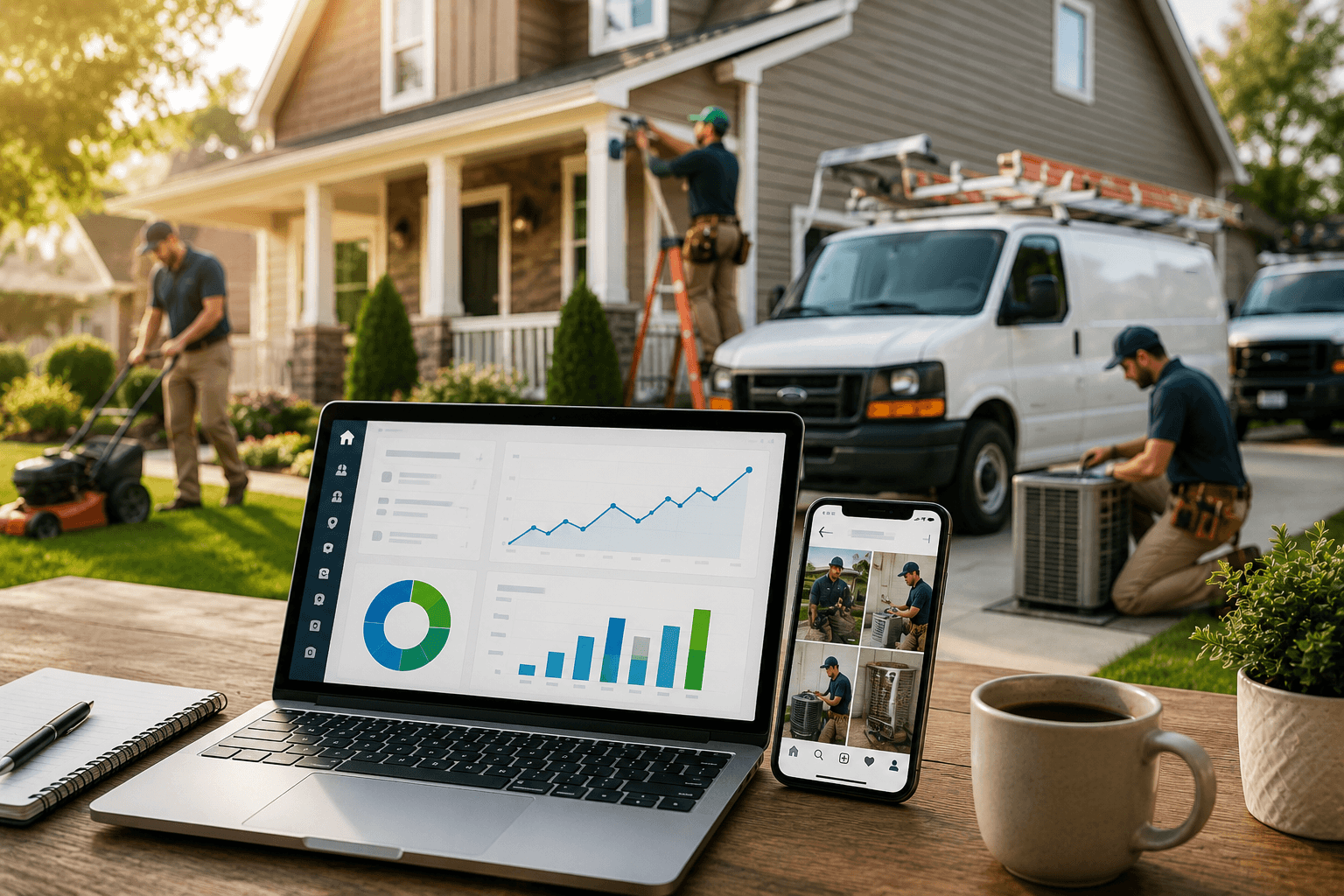
Tracking local SEO requires monitoring several data points over time. Rankings fluctuate daily, so focus on trends rather than day-to-day changes. Measure what matters: visibility, engagement, and lead volume.
Key Metrics to Monitor Monthly
Google Business Profile Insights
- Search impressions (direct vs discovery)
- Profile views
- Actions taken (calls, direction requests, website clicks)
- Photo views
Ranking Position Tracking
- Local pack rankings for key searches
- Organic rankings for location + service keywords
- Grid position in Google Maps results
- Competitor position changes
Review Growth & Ratings
- Total review count
- Average star rating
- Review velocity (new reviews per month)
- Response rate
Tools for Tracking Local SEO Performance
- Google Business Profile Insights — free, built-in analytics for your profile performance
- Google Search Console — shows which search queries drive traffic and how you rank
- BrightLocal or Whitespark — paid tools for tracking local rankings and citation health
- Google Analytics — track website traffic sources, conversions, and user behavior
- Call tracking software — attribute phone calls back to specific marketing channels
Set a monthly review cadence. Pull your metrics on the same day each month and compare trends over 90-day periods. Short-term fluctuations are normal; sustained directional movement is what matters.
Frequently Asked Questions
What is local SEO for landscapers?+
Local SEO for landscapers is the practice of optimizing your online presence to appear in search results when potential customers search for landscaping services in your specific geographic area. This includes Google Maps results, local pack rankings, and organic search results that prioritize nearby businesses. It focuses on location-based signals like your Google Business Profile, local citations, reviews, and location-specific content to help you show up when someone searches “landscaper near me” or “landscaping company in [city name].”
How long does it take for local SEO to work for a landscaping company?+
Most landscaping companies start seeing local SEO results within 3 to 6 months, though initial improvements in Google Business Profile visibility can appear within weeks. Timeline depends on your starting point, competition level in your market, and consistency of optimization efforts. Companies in smaller markets or with less competition may see traction faster, while competitive metro areas typically require 4 to 8 months of sustained work before significant ranking improvements appear.
Why isn’t my landscaping business showing up on Google Maps?+
If your landscaping business isn’t showing up on Google Maps, the most common causes are: incomplete or unverified Google Business Profile, incorrect business category selection, inconsistent NAP (name, address, phone) information across directories, lack of recent reviews, or being outside the searcher’s location radius. Google prioritizes businesses that are close to the searcher, have complete profiles, actively collect reviews, and maintain consistent information across the web.
Do online reviews actually help my landscaping company rank higher locally?+
Yes, online reviews directly impact local search rankings. Google considers review quantity, recency, rating, and diversity when determining local pack rankings. Reviews also influence click-through rates and trust signals. Landscaping companies with consistent, recent reviews and ratings above 4.0 stars typically outrank competitors with fewer or older reviews, even if other SEO factors are similar. Reviews on Google Business Profile carry the most weight for local rankings.
How much does local SEO cost for a landscaping business?+
Local SEO for landscaping companies typically ranges from $500 to $2,500 per month depending on market competitiveness, service area size, and scope of work. DIY efforts cost time but minimal money. Smaller markets with less competition can maintain rankings with lower monthly investment, while competitive metro areas require more sustained content, citation management, and optimization work. Initial setup and optimization often require higher upfront investment in months one through three.
Should I target multiple cities in my landscaping SEO strategy?+
Yes, if you actually serve those areas. Target cities where you have a physical presence, service history, or can realistically deliver quality work. Create separate location pages for each city only if you can provide unique, valuable content for that area. Avoid thin, templated pages that only swap city names. Google rewards businesses that demonstrate genuine connection to the areas they claim to serve through local content, reviews from those areas, and consistent service delivery.
Ready to Improve Your Local Search Visibility?
Local SEO isn’t a one-time setup — it’s an ongoing process of optimization, engagement, and consistency. If you’re ready to show up where your customers are searching, we can help you build a strategy that fits your market and goals.