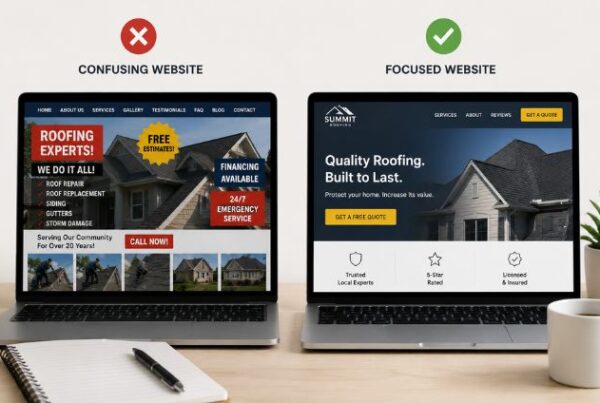

Your website can look polished, load quickly, and still quietly lose customers every day. A homeowner lands on your site, glances around for ten seconds, feels slightly unsure, and disappears before ever calling, booking, or filling out a form. No warning. Just another lead gone.
That’s why home service website conversion matters so much. Your website isn’t a digital brochure—it should turn visitors into calls, quote requests, and paying customers. When it doesn’t, the problem is usually not one giant mistake. It’s friction.
What’s Inside This Guide
- Your Homepage Makes Visitors Work Too Hard
- Your Website Talks About You First
- Your Calls to Action Are Weak or Hidden
- Your Navigation Has Too Many Choices
- Your Service Pages Are Too Generic
- Your Site Doesn’t Build Trust Fast Enough
- Your Photos Look Generic
- Your Website Is Slow on Mobile
- Your Forms Ask for Too Much
- Your Site Is Missing Local Context
- Traffic Doesn’t Match Landing Pages
- Built for Design Awards, Not Customers
- Your Copy Is Too Vague
- No Clear Reason to Choose You
- You’re Not Tracking Visitor Behavior
- SEO Can’t Save Poor Usability
- How to Improve Conversion
- Frequently Asked Questions
🏠 Homeowner Looking for Help
You need a plumber, electrician, roofer, or HVAC tech. You’re comparing local companies and trying to figure out who’s legit, available, and worth calling.
🔧 Home Service Business Owner
Your website gets traffic but not enough leads. You’ve spent money on SEO, ads, or a redesign—and you’re wondering why conversion still feels stuck.
📊 Marketer or Agency Partner
You manage campaigns for home service clients. Traffic numbers look solid, but something between clicks and conversions isn’t working—and you need to fix it.
1. Your Homepage Makes Visitors Work Too Hard
A homeowner with a leaking pipe, broken AC, or damaged roof is not browsing your website for fun. They want answers—fast. Yet many home service websites open with vague copy like “Quality Service You Can Trust.”
That sounds fine. It also tells the customer almost nothing.
💡 Pro Tip: Your homepage should quickly explain what you do, who you help, where you work, why someone should trust you, and what action they should take. The customer should not need to scroll halfway down to understand whether they’re in the right place.
A plumber might lead with something clear like: “Plumbing Repair and Installation for Homeowners Across North Atlanta” followed by a direct action: “Call Now or Request Service.”
Your first screen has one job: make the next step obvious.
2. Your Website Talks About You Before It Talks About the Customer
Home service websites often lead with statements like “We have been in business since…” or “We are family owned…” Those points can help build trust—but they usually shouldn’t be the first thing a stressed homeowner has to process.
Your visitor is thinking: “Can you fix my problem?”
❌ Instead of:
“We have 25 years of experience in HVAC.”
✅ Try:
“If your AC is blowing warm air, short-cycling, or refusing to turn on, our team can diagnose the problem and help you understand the next step.”
Strong website copy frames your business through the customer’s needs, not the other way around.
3. Your Calls to Action Are Weak, Hidden, or Confusing
A surprising number of home service websites make visitors hunt for the next step. You might have buttons labeled “Learn More,” “Discover,” or “Explore.”
Those aren’t automatically wrong. But if someone wants an electrician at their house, “Explore” probably isn’t what they came to do.
⚠️ Warning: Your calls to action should match what customers actually want. Examples: Call for Service • Request an Estimate • Schedule an Appointment • Get a Quote • Check Availability • Book Service
Clarity wins. And your primary action should appear in more than one place—visitors shouldn’t have to scroll back to the top because they finally decided to call you.
4. Your Navigation Has Too Many Choices
More options do not always create a better experience. Sometimes they create decision fatigue. Imagine a homeowner opening your menu and seeing 14 different choices, several dropdowns, vague labels, and five pages they don’t understand.
They aren’t thinking “Wow, what a robust information architecture.” They’re thinking “Where do I click?”
A Cleaner Navigation Might Include:
- Services
- Service Areas
- About
- Reviews
- Financing
- Contact
Then organize individual services underneath logical categories. The point is not to make your website tiny—it’s to make movement intuitive.
5. Your Service Pages Are Too Generic
If every page on your site says roughly the same thing, you have a conversion problem and possibly a search visibility problem. A roofing page should feel like a roofing page. A water heater page should feel like a water heater page.
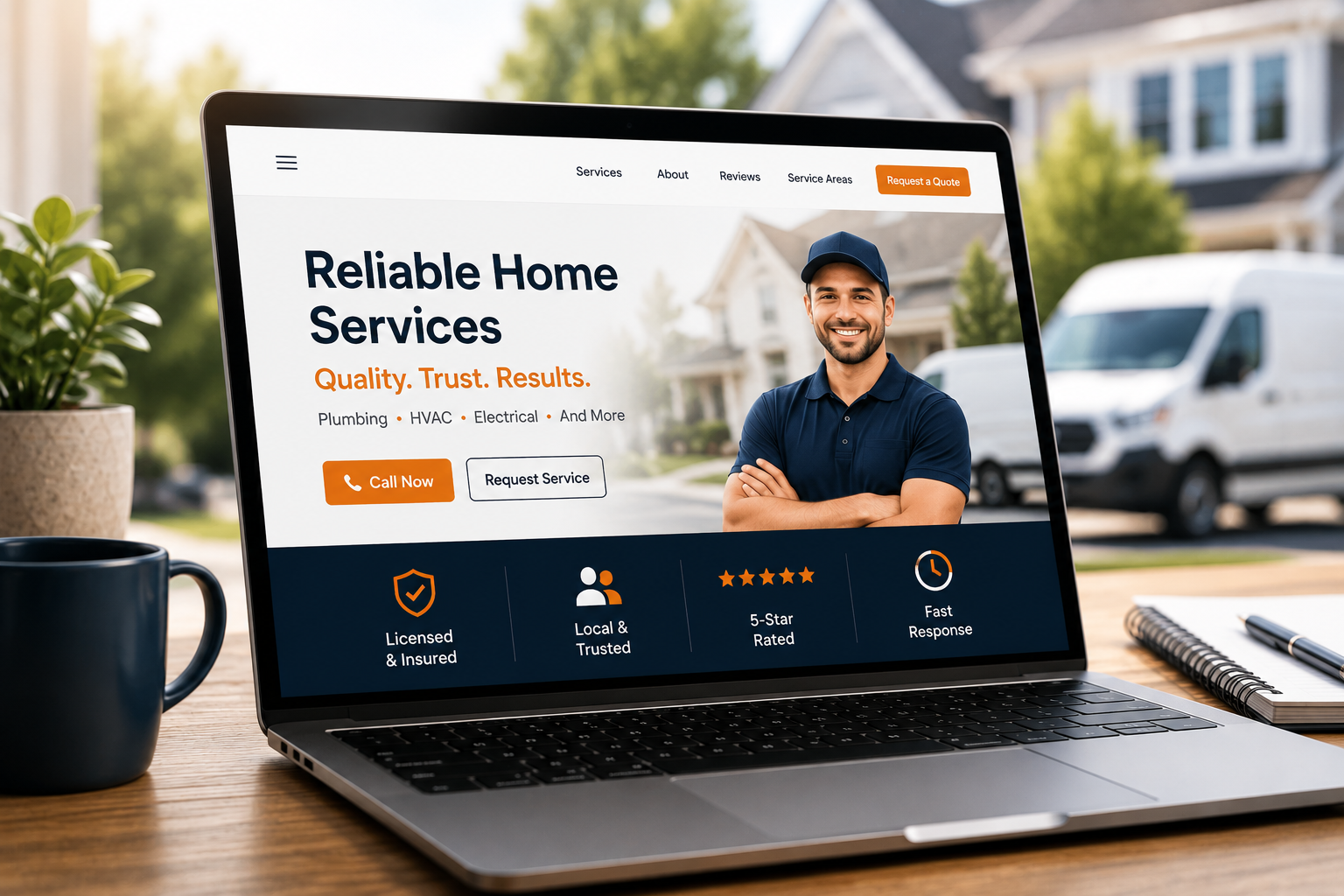
Strong service pages should explain:
- What the service includes
- Common problems customers experience
- Signs the service may be needed
- What customers can expect
- Why your company is qualified
- What areas you serve
- How to take the next step
Visitors often arrive directly on service pages from search engines, ads, map listings, or referrals. They may never see your homepage. Every important page should be able to build confidence on its own.
6. Your Site Doesn’t Build Trust Fast Enough
Home service customers are inviting someone into their property. Trust matters—a lot. Your website should reduce uncertainty by showing real evidence that your company is legitimate and experienced.
Social Proof
- Customer reviews
- Google ratings
- Real project photos
- Team photos
Credentials
- Certifications
- Licenses
- Insurance info
- Professional affiliations
Guarantees
- Service guarantees
- Financing options
- Years in business
- Clear contact info
The stronger the decision, the more reassurance people may need. A homeowner spending $200 on a minor repair may make a faster decision than someone considering a $25,000 roof replacement.
7. Your Photos Look Like They Could Belong to Anyone
Stock photography has its place. But if every image on your website looks like a smiling model holding a wrench in a suspiciously spotless kitchen, customers may start wondering whether they’re looking at your business or a template.
🚨 Non-Negotiable: Real images build credibility. Show your crew, trucks, completed projects, before-and-after photos, your office, equipment, and actual jobs being completed. Authenticity creates distinction—especially when customers are comparing several local businesses that make very similar claims.
8. Your Website Is Slow on Mobile
A beautiful desktop site does not help much if the mobile version is clunky. Home service customers often search from their phones—standing next to a broken appliance, sitting in a hot house, looking at storm damage, or trying to schedule service between meetings.
Mobile Users Need:
- Fast load times
- Large tap targets
- Readable text
- Simple navigation
- Click-to-call buttons
- Short forms
- Clear pricing information
Test this now: Pull out your phone. Call yourself from your website. Fill out your own form. Try to schedule service. See how annoying it is. That exercise can be surprisingly educational.
Responsive design is not just a technical checkbox—it directly affects how easy it is to become a customer.
9. Your Forms Ask for Too Much
Every extra form field creates another small piece of friction. Do you really need someone’s full address, secondary phone number, referral source, detailed project description, budget, preferred contact method, and best time to call before you can even start the conversation?
❌ Friction-Heavy Form
- Full name
- Email address
- Phone number
- Secondary phone
- Full street address
- Service needed
- Detailed description
- Budget range
- How did you hear about us?
- Preferred contact method
- Best time to call
✅ Simple Lead Form
- Name
- Phone
- Service needed
You can gather additional information after the lead raises their hand.
Forms should be designed intentionally—not built like an interrogation.
10. Your Site Is Missing Local Context
Home services are local. Your website should make that obvious. If you serve Lawrenceville, Duluth, Suwanee, or surrounding communities, customers should not have to wonder whether you actually work there.
Local Context Can Include:
- Service area pages
- City mentions in content
- Local project examples
- Regional service considerations
- Customer testimonials from nearby areas
- Neighborhood or community references
This also creates stronger alignment between your website, local search visibility, and the customer’s intent. Someone searching for a plumber in their city wants reassurance that the company actually serves their city. Give it to them.
11. Your Website Gets Traffic but Doesn’t Match the Traffic Source
This is a big one. Suppose you run an ad for “Emergency AC Repair.” The visitor clicks. Then they land on a homepage promoting maintenance plans, new installations, indoor air quality, commercial services, financing, and the company history. Somewhere down the page is a small link to emergency repair.
That is unnecessary friction.
⚠️ Warning: Your website experience should match where the visitor came from. A visitor searching for “roof replacement near me” should land somewhere that quickly addresses roof replacement. A visitor clicking an AC-repair ad should not have to decode your entire service menu. The tighter the match between intent and landing page, the easier the decision becomes.
12. Your Website Is Built for Design Awards Instead of Customers
Here is where website projects sometimes go sideways. The design starts becoming the star of the show. Huge animations. Unusual menus. Text flying across the screen. Videos loading everywhere. Buttons hidden behind creative interactions.
It looks impressive. And the customer just wants to schedule a plumber.
🚩 Red Flags of Over-Design
🚩 Animations delay critical information
🚩 Navigation requires experimentation
🚩 Contact info is hard to find
🚩 Page load times exceed 3 seconds
🚩 Mobile version is an afterthought
🚩 CTAs are visually buried
Good design should support usability. It should help visitors understand where they are, what you do, and what comes next. A website should look professional—but its real job is to make buying easier.
13. Your Copy Is Too Vague
Some home service websites say a lot without really saying anything. Phrases like “Superior solutions,” “Unmatched quality,” or “Industry-leading excellence” sound polished—but they don’t help a homeowner make a decision.
❌ Vague Copy:
“We deliver superior HVAC solutions.”
✅ Specific Copy:
“We repair, replace, and maintain residential heating and cooling systems, with clear recommendations before work begins.”
Specificity reduces uncertainty. And uncertainty kills conversions.
14. There Is No Clear Reason to Choose You
A homeowner may have five tabs open. Why should they choose your company? Your website needs a clear answer. Not “We care about our customers”—everyone says that.
Better Differentiators May Include:
- Same-day availability
- Flexible financing options
- Upfront, clear estimates
- Licensed and insured technicians
- Workmanship guarantees
- Specialized expertise in specific systems
- Family-owned, local business
- 24/7 emergency service
- Transparent pricing practices
- Unique installation or service process
Your differentiator does not need to be revolutionary. It needs to be believable and relevant.
15. You’re Not Tracking What Visitors Actually Do
You cannot improve website conversion intelligently if you do not know what visitors are doing. Traffic alone does not tell the whole story. A page with 1,000 visits and three leads may be less valuable than a page with 300 visits and 25 leads.
Conversion Actions
- Phone calls
- Form submissions
- Appointment bookings
- Quote requests
Behavior Signals
- Click-to-call activity
- Page engagement
- Drop-off points
- Traffic source
Performance Data
- Landing page performance
- Device breakdown
- Time on page
- Scroll depth
Measure behavior that connects to business outcomes.
16. SEO Cannot Save a Website That Nobody Wants to Use
Getting found matters. But visibility is only one half of the equation. If SEO sends 5,000 visitors to a confusing website, you have mostly created a bigger leak.
The same applies to paid ads, social media, email, and referrals. Every marketing channel eventually sends customers somewhere—usually, that somewhere is your website.
💡 Key Insight: Website experience influences the performance of nearly every other marketing investment you make. Traffic without conversion is just expensive attention that leads nowhere.
How to Improve Home Service Website Conversion
You do not necessarily need to rebuild everything tomorrow. Start by fixing the biggest points of friction.
Clarify the First Screen
Make sure your homepage immediately communicates: main service, service area, primary benefit, and primary call to action.
Simplify Navigation
Remove unnecessary menu choices and make services easy to locate.
Strengthen Service Pages
Give each important service a useful, specific page built around the customer’s questions and decision process.
Add Trust Signals
Bring reviews, credentials, guarantees, photos, and proof closer to the decision points.
Improve Mobile Usability
Test your website on an actual phone. Call yourself. Fill out your own form. Try to schedule service. See how annoying it is.
Reduce Form Friction
Only ask for information you genuinely need at that stage.
Match Landing Pages to Intent
Search traffic, PPC traffic, and local visitors should land on pages relevant to why they clicked.
Track Real Conversions
Measure calls, leads, quotes, and booked appointments rather than assuming traffic equals success.
Keep Improving
Conversion optimization is rarely a one-time project. Customer behavior changes. Services change. Markets change. Your website should evolve with them.
Frequently Asked Questions About Home Service Website Conversion
What is a good home service website conversion rate?
+
There is no single conversion rate that applies to every home service business. Performance can vary based on service type, traffic source, location, urgency, pricing, device, and what counts as a conversion. The better question is whether your site is consistently turning qualified visitors into profitable leads and whether that performance is improving.
Why does my home service website get traffic but no leads?
+
Common causes include weak calls to action, poor mobile usability, vague messaging, lack of trust signals, slow pages, irrelevant landing pages, confusing navigation, or traffic that does not match your services. Conversion problems usually require looking at both traffic quality and website experience.
Should every home service have its own page?
+
Important services generally benefit from dedicated pages because customers often search for specific solutions. A dedicated service page can explain the problem, service, process, trust signals, service area, and next step more clearly than a broad general-services page.
How important are reviews for home service websites?
+
Reviews can play an important role because homeowners often compare several providers before reaching out. Featuring credible reviews near important conversion points can help reduce uncertainty and support trust.
Should pricing be listed on a home service website?
+
It depends on the service. Some businesses can publish fixed prices or starting prices, while others require an inspection before quoting accurately. When exact pricing is not practical, explain how estimates work so visitors know what to expect.
How can I tell where my website is losing customers?
+
Start with analytics and conversion tracking. Look at high-traffic pages with weak lead activity, mobile performance, form abandonment, landing-page behavior, and where visitors exit. Then test changes based on the evidence rather than redesigning pages at random.
Your Website Should Be Working as Hard as You Are
Home service owners spend plenty of time getting customers to the website—SEO, Google Ads, social media, referrals, truck wraps, reviews, networking. All of that effort gets a lot less valuable when the website makes the next step harder than it needs to be.
A strong home service website should feel simple. The visitor knows what you do, they know you serve their area, they trust what they see, and they know exactly how to contact you. That is the goal behind the Seamless Navigation Blueprint: remove friction, create clarity, and build the journey around the action the customer actually came to take.
No pressure, no pitch. Just a conversation about what’s working, what’s not, and what comes next.