

Peak season has a funny way of sneaking up on party rental companies. One week, you have plenty of bounce houses, tents, tables, chairs, water slides, and inflatables sitting available. A few weeks later, everyone suddenly wants the same Saturday.
The instinct is usually to crank up advertising once demand starts climbing. That’s often too late. A stronger Google Ads party rental company strategy starts before your busiest weeks arrive—when customers are actively planning birthdays, school events, church festivals, corporate gatherings, graduations, and backyard parties.
Table of Contents
- Why Party Rental Companies Should Advertise Before Peak Season
- Target Booking Intent, Not Just Traffic
- Build Campaigns Around What You Actually Want to Rent
- Use Your Calendar as a Marketing Tool
- Your Landing Page Can Make or Break the Campaign
- Use Negative Keywords to Stop Paying for the Wrong Searches
- Geography Matters More Than Most Realize
- Track Reservations, Not Vanity Metrics
- Know Which Rentals Produce the Best Customers
- What a Pre-Season Google Ads Plan Might Look Like
- Frequently Asked Questions
📅 You’re Planning Early
You know your busy season is coming and want to fill the calendar with profitable bookings before competitors grab all the good dates. You need a smarter approach than waiting until demand peaks.
💰 You’re Wasting Ad Budget
You’re getting clicks but not enough reservations. Your ads might be targeting the wrong searches, sending people to the wrong pages, or competing for traffic you can’t profitably convert.
🎯 You Want Better Results
You’re already advertising but want campaigns that fill specific inventory gaps, reduce last-minute price discounting, and connect marketing dollars directly to booked dates.
Why Party Rental Companies Should Advertise Before Peak Season
Your customers don’t all book the week of their event. Some parents reserve a bounce house weeks ahead. Schools and churches may start planning even earlier. Weddings, company picnics, festivals, and larger events can have significantly longer planning windows.
That creates an important distinction: The beginning of your busy season and the beginning of your customers’ search season are not necessarily the same thing.
💡 Pro Tip: If your calendar normally gets packed in May, waiting until May to aggressively market summer rentals means you’re competing for customers who may already have chosen another company.
Pre-season campaigns allow you to appear while people are still comparing bounce house rentals, water slide rentals, tent rentals, table and chair rentals, obstacle courses, interactive games, event packages, and party rentals near their city. You’re reaching customers while decisions are still being made instead of chasing whatever demand is left over.
Google Ads Works Best When You Target Booking Intent, Not Just Traffic
There’s a big difference between someone searching “bounce house ideas for birthday” and “bounce house rental near me.” The first person might be researching. The second person is waving their wallet at Google.
Google Ads is particularly useful for party rental companies because Search campaigns can put your business in front of customers expressing direct commercial intent. But not every keyword deserves the same budget.
✓ High-Intent Searches
These are usually closest to a transaction:
- bounce house rental
- water slide rental
- party rentals near me
- inflatable rental
- tent rental
- obstacle course rental
- table and chair rental
- bounce house rental in [city]
- water slide rentals in [city]
↓ Lower-Intent Searches
These may still have value, but they’re usually farther from booking:
- birthday party ideas
- things to do for kids
- backyard party inspiration
- how much does a bounce house cost
- graduation party themes
Paying for both groups without distinguishing between their intent can drain a budget surprisingly fast. Clicks don’t rent inflatables. Customers do.
Build Campaigns Around What You Actually Want to Rent
One of the easiest ways for a party rental company’s Google Ads account to become messy is putting every rental category into one campaign and hoping Google’s algorithm sorts everything out. Your campaign structure should reflect the business.
Campaign: Water Slides
- water slide rentals
- inflatable water slides
- giant water slide rentals
- water slide rental near me
Campaign: Bounce Houses
- bounce house rental
- moonwalk rental
- inflatable bounce house
- bounce house rental near me
Campaign: Tents
- party tent rental
- event tent rentals
- wedding tent rental
- tent rental near me
That separation makes it easier to understand what customers want and how efficiently each category generates bookings. It also gives you more control when availability changes.
Use Your Calendar as a Marketing Tool
Party rental companies have something many service businesses don’t: a finite inventory tied to specific dates. That means your advertising decisions should account for both products and calendar capacity.
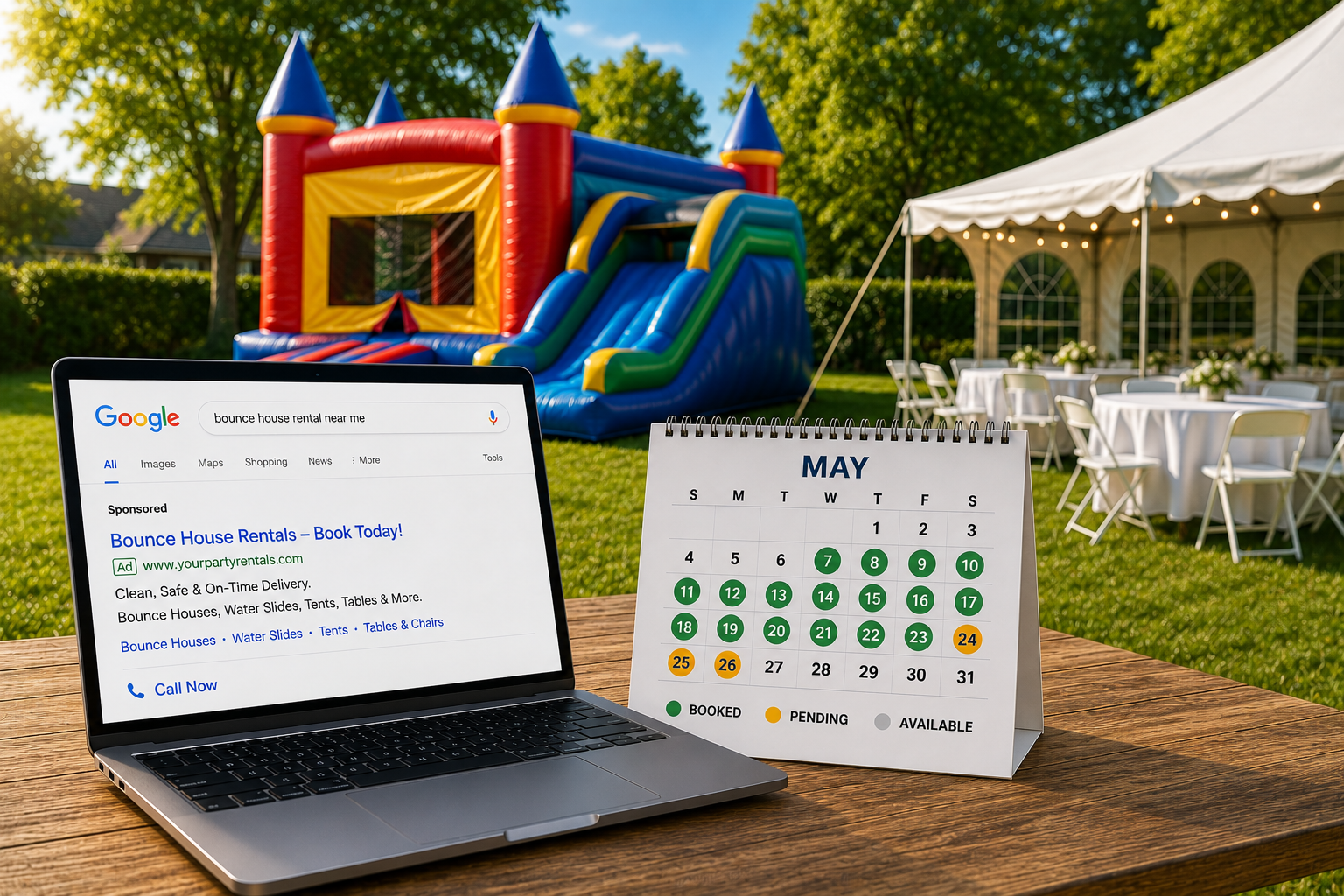
Imagine you’re approaching a major holiday weekend. You have 90% of water slides reserved, 70% of bounce houses reserved, 35% of obstacle courses reserved, and plenty of tables and chairs available.
Continuing to push water slides aggressively may generate leads you can’t fulfill. A smarter move could be shifting more budget toward obstacle courses, packages, dry inflatables, or other inventory with open capacity.
⚠️ Important: This is where advertising stops being a traffic strategy and becomes a revenue-management strategy. The question isn’t “How many clicks did we get?” It’s “What inventory do we still need to sell for the dates that matter?”
Match Ads to the Rental the Customer Searched For
Suppose someone searches for “water slide rental.” Then your ad says “Party Rentals for Every Occasion.” They click and land on your homepage. Now they have to find the rentals menu, select inflatables, find water slides, filter through products, and figure out whether you deliver to their area.
Every unnecessary step creates another opportunity for someone to leave.
Instead, the journey should look more like:
Search: Water slide rental near me
Ad: Water Slide Rentals for Backyard Parties
Landing page: Water slide inventory
Next action: Check availability or reserve
Simple. A good ad earns the click. A good website finishes the job.
Your Landing Page Can Make or Break the Campaign
You can have excellent keywords and compelling ads and still burn through money if the page after the click creates friction. A party rental landing page should quickly answer questions like:
- Do you have what I’m looking for?
- Do you deliver to my area?
- What does it cost?
- Is the equipment clean and safe?
- Is my date available?
- What’s included?
- How do I reserve it?
- Can I trust this company?
The visitor shouldn’t have to hunt for basic information. Useful conversion elements can include:
- Clear rental categories
- Real equipment photos
- Pricing or starting prices
- Service-area information
- Delivery details
- Reviews
- Safety information
- Availability or booking buttons
- Click-to-call options
- FAQs
Your Google Ads budget shouldn’t be paying to send people into a digital scavenger hunt.
Don’t Send Every Search to the Homepage
Your homepage has a job. Being the perfect landing page for every Google search probably isn’t it.
- Someone searching for “tent rentals” should ideally land on a relevant tent rental page
- Someone searching for “water slide rentals” should see water slides
- Someone searching specifically in a city you serve should quickly understand that you deliver there
The closer the landing-page experience matches the searcher’s intent, the fewer questions the visitor has to answer before taking the next step. That’s especially important on mobile, where many customers are researching while juggling kids, work, venue details, guest lists, and fifteen other things.
Use Negative Keywords to Stop Paying for the Wrong Searches
A good Google Ads campaign isn’t just about deciding what you want to appear for. You also need to decide what you don’t want.
🚩 Common Negative Keywords for Party Rentals
The exact negative keyword list will vary by company. The important part is regularly reviewing actual search terms and removing traffic that doesn’t match your business model. Every irrelevant click is money that could have gone toward someone actively trying to reserve equipment.
Geography Matters More Than Most Party Rental Companies Realize
There’s little value in generating a fantastic lead 75 miles beyond your profitable delivery area. Party rental campaigns should account for where you realistically want to deliver.
✓ Prioritize These Areas
- Core cities
- High-value neighborhoods
- Areas with strong historical booking volume
- Cities close to your warehouse
- Locations with manageable delivery costs
- Markets where competition is weaker
Not every city deserves equal treatment.
A city 10 minutes away with healthy order values and frequent bookings may deserve a larger share of your budget than a distant market where every delivery eats into your margins.
Track Reservations, Not Vanity Metrics
Impressions can look impressive. Clicks feel productive. Neither necessarily means you’ve made money.
For a party rental company, useful conversion tracking may include:
- Completed online reservations
- Quote requests
- Phone calls
- Contact forms
- Availability checks
- Deposits
- Checkout completions
And if you know the revenue associated with a reservation, feeding meaningful conversion values back into your advertising data can make the picture even clearer. Google’s automated bidding systems optimize around the conversion actions and values advertisers provide.
🚨 Critical: If your campaign counts every button click as a “lead,” the dashboard may look fantastic while the calendar remains suspiciously empty. Measure what matters.
Know Which Rentals Produce the Best Customers
Not every conversion has equal value. A $175 basic bounce house reservation is different from a $2,500 school event involving tents, tables, chairs, inflatables, concessions, and interactive games.
That doesn’t mean the smaller booking is bad. It means your campaign should understand the difference. Look beyond cost per lead and ask:
- Which categories generate the highest average orders?
- Which keywords generate multi-item bookings?
- Which cities produce profitable deliveries?
- Which customers tend to become repeat customers?
- Which event types create bigger transactions?
- Which rentals frequently lead to add-ons?
Sometimes the keyword with the higher cost per click produces the better customer. Cheap traffic isn’t automatically profitable traffic.
Don’t Panic and Rewrite Everything After Three Days
One of the fastest ways to sabotage a campaign is constantly changing it before enough information exists to evaluate it. Campaigns need useful conversion data. Automated bidding systems also adapt to changes in conversion behavior and account history.
💡 Pro Tip: Patience isn’t the same as passivity. It means making decisions from evidence instead of nerves. Give changes enough time to be evaluated properly rather than judged from a tiny sample.
Increase Budget Before Demand Peaks—Not After Everything Is Booked
If historical booking patterns tell you customers start searching heavily six weeks before a key period, that’s when your marketing should prepare to capture demand. Not six weeks later.
Party rental companies can build their planning around events such as:
- Spring break
- Easter
- Graduation season
- Memorial Day
- Summer parties
- Fourth of July
- Back-to-school events
- Fall festivals
- Halloween
- Holiday parties
The exact calendar depends on your market, climate, inventory, and customer base. The bigger strategic lesson is simpler: Know when your customers begin shopping, and make sure your campaign is ready before they arrive.
Retarget People Who Almost Booked
Party rental customers often comparison shop. They may visit three companies, check availability, show their spouse, text the PTA committee, get distracted by dinner, and disappear. That’s normal. It doesn’t necessarily mean the first visit was wasted.
Retargeting gives you another opportunity to stay visible to people who already showed interest. This becomes especially useful for customers who:
- Viewed multiple rental products
- Started checkout
- Checked availability
- Visited pricing pages
- Added products to a cart
- Returned several times without reserving
The customer who disappears today may still be planning the same event tomorrow.
Google Ads Should Work With SEO, Not Replace It
Google Ads and SEO solve different parts of the visibility problem. Ads can help you appear quickly for valuable searches. SEO can build organic visibility over time. Strong party rental companies often benefit from both.
You might use Google Ads to aggressively target high-value searches during important booking windows while building organic visibility around rental categories, service areas, questions, and local searches. The goal isn’t choosing whichever channel has the coolest dashboard. It’s building a system that consistently helps customers find you.
What a Pre-Season Google Ads Plan Might Look Like
A practical approach could look something like this:
8–12 Weeks Before Peak Demand
Review phase
- Previous booking data
- Top-selling rentals
- Profitable locations
- Average order values
- Search terms
- Conversion tracking
- Landing pages
- Inventory capacity
6–8 Weeks Before Peak Demand
Campaign launch
Begin or strengthen campaigns around priority inventory. Build dedicated ad groups and landing-page paths around categories such as water slides, bounce houses, tents, obstacle courses, and event packages.
4–6 Weeks Before Peak Demand
Optimization phase
Identify:
- Which searches are generating reservations
- Which cities perform best
- Which rentals have remaining availability
- Which products are nearing capacity
- Which negative keywords should be added
Shift budget accordingly.
2–4 Weeks Before Peak Demand
Final push
Push inventory you still need to book. Reduce unnecessary spending on products or dates already approaching capacity. Retarget qualified visitors who haven’t completed their reservations.
During Peak Season
Active management
Keep watching the calendar. Your ads should reflect what you can still fulfill profitably. Selling something you’ve already sold out isn’t marketing. It’s just expensive disappointment.
Frequently Asked Questions About Google Ads for Party Rental Companies
Are Google Ads worth it for a party rental company?
+
Google Ads can be useful for party rental companies because customers frequently search online when they are actively looking for specific rentals in a specific area. The campaign still needs the right targeting, conversion tracking, landing pages, and booking economics to determine whether the advertising is profitable.
When should a party rental company start running Google Ads?
+
Start before your busiest dates if customers typically reserve rentals ahead of time. Review historical booking data to identify when searches and reservations begin increasing, then build your campaign around that buying window instead of waiting until peak season arrives.
What keywords should a party rental company target?
+
Prioritize commercially focused searches connected to your inventory and service area, such as “bounce house rental,” “water slide rental,” “tent rental,” and city-specific variations. The exact keyword mix should reflect what you actually rent and where you profitably deliver.
Should party rental Google Ads go to the homepage?
+
Not always. Searches for specific rental categories generally benefit from landing pages that immediately show relevant inventory, pricing or quote information, service areas, trust signals, and a clear booking action.
How much should a party rental company spend on Google Ads?
+
There isn’t one correct budget for every company. Budget decisions should account for local search demand, competition, average order value, gross margin, delivery costs, booking capacity, conversion rate, and how many profitable reservations the business can realistically fulfill.
What should party rental companies track in Google Ads?
+
Track meaningful business actions such as completed reservations, deposits, calls, quote requests, contact forms, and qualified availability checks. Whenever possible, connect advertising performance to actual booking revenue rather than relying only on clicks or form submissions.
Fill the Calendar Before Everyone Else Starts Fighting for It
Peak season isn’t the time to discover whether your marketing works. It’s the time the work you’ve already done should start paying off.
A smart Google Ads strategy for a party rental company begins with knowing what you want to rent, where you want to deliver it, when customers start searching, and what a profitable booking actually looks like. Then the ads, keywords, landing pages, tracking, budget, and booking experience all support the same goal: turning high-intent searches into reserved dates.
Because a full dashboard is nice. A full calendar is better.
Ready to Build a Paid-Search Strategy Around Profitable Bookings?
If you’re ready to build a paid-search strategy around profitable bookings instead of vanity metrics, talk with BestLyfe Group about your growth goals.
No pressure, no pitch — just a conversation about what’s working and what could work better.
“`